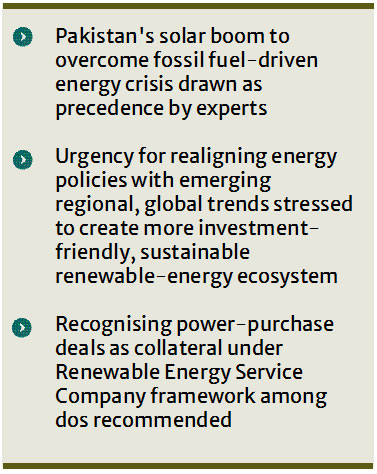
A clarion call comes from experts for urgent policy reforms to harness solar fortune to overcome fossil fuel-driven energy crisis and they underpin their suggestion with Pakistan's solar-power boon as precedence.
The urgency comes from an expert-level meet arranged Tuesday by the Centre for Policy Dialogue (CPD) that has suggested far-reaching policy, fiscal and financial reforms to accelerate rooftop solar adoption in Bangladesh.
 The call is latched with warnings that the country risks repeating the failures of its once-celebrated Solar Home System (SHS) programme unless structural barriers are removed and long-term system retention is prioritised.
At the dialogue, titled 'Solar Revolution in Pakistan in the Eyes of Country's Leading CSO: Lessons for Bangladesh from National Budget Perspective', energy experts, policymakers and industry representatives examined Bangladesh's renewable energy transition and drew lessons from Pakistan's rapid solar expansion.
Speaking as chief guest, Chief Whip of Parliament Md Nurul Islam Moni said the government remained committed to expanding renewable energy to strengthen energy security, reduce dependence on imported fuels and support sustainable economic growth.
He reveals that Bangladesh is pursuing a major solar-energy agreement with China, which could be signed during Prime Minister Tarique Rahman's ongoing visit to Beijing.
"The government is seriously pursuing a solar-related deal with China and there is a strong possibility it will be concluded during the Prime Minister's current visit," he told the audience.
Moni says the government is working to expand solar-energy use from urban rooftops to rural irrigation systems, noting that solar-powered irrigation could significantly reduce fuel subsidies currently provided to farmers.
He also highlights the tax incentives included in the proposed budget for renewable-energy industries and urges banks, financial institutions and businesses to invest in the free-available energy sector.
Moderating the session, CPD Research Director Dr Khondaker Golam Moazzem said Bangladesh must urgently realign its energy policies with emerging regional and global trends to create a more investment-friendly and sustainable renewable-energy ecosystem.
Presenting CPD's keynote paper, Research Associate Atikuzzaman Shazeed traces Bangladesh's solar journey from the off-grid SHS programme launched in 2003 to the current push for rooftop solar and net-metering systems.
He notes that the SHS programme, once regarded as one of world's largest off-grid electrification initiatives, brought electricity access to more than 20 million people through approximately six million systems installed across rural Bangladesh.
Annual installations rose from just 1,087 units in 2003 to a peak of 853,000 in 2013 before collapsing to only 3,455 units in 2018 as rapid national grid expansion rendered the off-grid model increasingly irrelevant.
According to CPD's SHS Survey 2025, nearly 47 per cent of installed solar-home systems are now non-functional, largely because of battery failures and the absence of any structured mechanism to retrofit, upgrade or integrate the systems with the expanding grid.
The keynote sounds a warning that Bangladesh must avoid creating a similar "retention crisis" in the emerging rooftop-solar sector.
The CPD has identified a series of barriers constraining growth. For residential consumers, cumulative import duties of between 27.5 and 33.6 per cent on solar panels and inverters significantly raise installation costs.
Also, banks remain reluctant to provide small, long-term solar loans, while Bangladesh Bank's green refinancing facilities are hampered by lengthy documentation requirements and delayed disbursement.
Regulatory hurdles, including system-size restrictions and inconsistent net-metering approvals, further discourage adoption.
The think-tank recommends simplifying net-metering rules, introducing a unified digital approval platform, rationalising duties on photovoltaic equipment, creating dedicated green-financing facilities and recognising power-purchase agreements as collateral under a Renewable Energy Service Company framework.
It also proposes expanding net metering to solar irrigation pumps and establishing a national distributed renewable energy-coordination body under the Sustainable and Renewable Energy Development Authority (SREDA) to monitor system performance and retention rather than focusing solely on installation targets.
The dialogue also examined Pakistan's recent solar boom through a presentation by Muhammad Basit Ghauri, Manager of Special Initiatives and China Programme at Renewables First.
Ghauri says Pakistan had experienced one of the world's fastest-distributed solar expansions, with solar panel imports reaching 17.9 gigawatts in fiscal year 2025, up sharply from previous years. An estimated 28 to 38 gigawatts of solar capacity has already been deployed, nearly all of it through distributed and behind-the-meter systems. Distributed solar generation now accounts for around 46 per cent of Pakistan's net grid electricity sales.
He says approximately 7.3 million Pakistani households had adopted solar power by 2025, with 73 per cent of installations located in rural areas. The expansion was driven by rising electricity tariffs, declining confidence in grid reliability, simplified net-metering regulations and a dramatic fall in solar-panel prices resulting from Chinese manufacturing overcapacity.
Comparing the two countries, Ghauri argues that Bangladesh shares many of the structural conditions that preceded Pakistan's solar surge, including power-sector overcapacity and heavy dependence on imported fuels. However, import duties of between 11 and 58 per cent on solar equipment have kept installation costs substantially higher than in Pakistan, creating what he describes as a largely self-imposed barrier to rapid adoption.
Representatives from the Infrastructure Development Company Limited (IDCOL), Bangladesh Independent Power Producers Association (BIPPA), Bangladesh Sustainable and Renewable Energy Association (BSREA) and Coastal Livelihood and Environmental Action Network (CLEAN) also participated in discussion.
bdsmile@gmail.com
© 2026 - All Rights with The Financial Express

