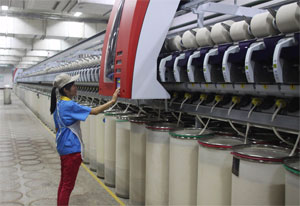
 ZOUPING: A worker checks a control panel in a texile factory in Zouping, east China\'s Shandong province on Tuesday.China\'s outbound investment more than doubled in August to 12.62 billion USD, data showed, far outstripping foreign direct investment (FDI
 BEIJING, Sept 16 (AFP): China's outbound investment more than doubled in August to $12.62 billion, data showed Tuesday, far outstripping foreign direct investment (FDI) into the country, which fell to a four-year low.
China has been actively acquiring foreign assets, particularly energy and resources, to power its economy, with firms encouraged to "go out" and make overseas acquisitions to gain market access and international experience. Officials have said overseas direct investment (ODI) could exceed FDI this year.
The 112.1 per cent year-on-year increase in ODI announced by the commerce ministry was a dramatic contrast to the 14.0 per cent fall in FDI, which sank to $7.20 billion. Both sets of figures exclude investment in financial sectors.
FDI was also less than July's $7.81 billion and was the lowest since July 2010, when it stood at $6.92 billion.
Commerce ministry spokesman Shen Danyang denied any link to Beijing's multiple probes into foreign companies.
Chinese authorities have in recent months launched anti-monopoly, pricing and other inquiries into scores of foreign firms in sectors ranging from auto manufacturing and pharmaceuticals to baby milk.
The investigations have raised concerns among investors that Beijing is targeting overseas companies.
But Shen denied any connection between the investigations and the fall in FDI. "They are not related," he said, declining to comment further.
But he added that China plans to revise three laws governing overseas companies and Sino-foreign joint ventures.
"By revising the laws, we hope to... create a more stable, transparent and predictable legal environment for foreign investment in China," he told reporters.
Hans Dietmar Schweisgut, the new European Ambassador to China, said that he doubted whether it made sense to "judge this on the basis of one or two cases".
But he added that it is not in China's interests to "single out foreign companies and scare them away".
"Quite honestly, I think when you look at the policy objectives and the need to bring about ... a more balanced economy, it will not really make much sense to scare away foreign investors and foreign economic actors, which I think can make important contribution to achieving this change," he said.
For the first eight months of the year, China's ODI was up 15.3 per cent at $65.17 billion.
In that period, investment into the EU soared 257.1 per cent, leaped 116.7 per cent into Japan, and increased 73.3 per cent into Russia, the ministry said without giving totals.
It climbed 16.0 per cent into the US, reaching $3.26 billion.
Ministry officials were unable to explain immediately the huge monthly increase.
Also in the first eight months, FDI was down 1.8 per cent year-on-year at $78.34 billion.
It slumped 43.3 per cent from Japan-which is embroiled in territorial and historic rows with Beijing-to $3.16 billion, fell 17.9 per cent from the EU to $4.20 billion, and dropped 16.9 per cent from the US to $2.08 billion.
But from South Korea-which has been enjoying closer diplomatic ties with China-it climbed 31.3 per cent to $3.02 billion, and from Britain it rose 18.9 per cent to $850 million.
China's economy expanded 7.7 per cent in 2013, the same as 2012 -- the worst pace since 7.6 per cent in 1999.
Beijing's official growth target for this year is 7.5 per cent, also the same as in 2013, while gross domestic product grew 7.4 per cent in the first half of this year.
© 2026 - All Rights with The Financial Express

