Lingering political unrest has slowed down growth in wages, exports and imports, thereby resulting in consumption fall in the country, economists warn.
They say the total consumption has dropped as the growth in remittances, wages, imports and exports has decreased in the last couple of months, which can dampen growth prospects.
The consumption is a major component for stimulating the gross domestic product (GDP) growth of a country. When a country's consumption increases, its economy gets a boost as well.
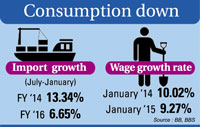
The import growth rate came down to 6.65 per cent during the July-January period of the current financial year (FY) 2014-15 from 13.34 per cent compared with the corresponding period of the previous fiscal year, central bank data shows.
The Bangladesh Bureau of Statistics has no updated data on current consumption expenditure and one has to understand trend of current consumption from proxy indicators like import payments.
The statistics agency data shows that the wage growth rate in January decreased to 9.27 per cent from 10.02 per cent comparing to the same month in last FY 2014.
According to the Export Promotion Bureau (EPB), although earnings from shipment of goods in February grew by 5.15 per cent compared to the same period in 2014, it has fallen short of target set for the July-February period in the current fiscal year.
The flow of inward remittances fell by 5.20 per cent in February mainly due to ongoing political unrest, according to Bangladesh Bank data.
Bangladesh's export earnings increased by 2.43 per cent to US$ 20.31 billion in the first eight months of the current FY 2015 from US$ 19.83 billion during the same period in the last FY 2014.
Bangladeshi migrant workers sent remittances worth US$ 1.18 billion in February 2015, which is $ 64.62 million lower than the level of remittance receipts in the previous month. In January, remittances stood at $ 1.24 billion.
Lead Economist at the World Bank Dr Zahid Hussain said political deadlock has put serious impact on Bangladesh's overall consumption.
"When an economy faces troubles like political unrest, different income groups from poor to middle class start saving their earnings. In such case, they start decreasing the consumption for boosting their savings. Bangladesh, at this moment, is facing such kind of problem," he told the FE.
Dr Hussain said: "The private consumption in Bangladesh is nearly 77 per cent of the total gross domestic expenditure. So, if the private expenditure falls even by 2-3 percentage points, the growth will come down," he said, adding that if the consumption growth drops by 2.0 percentage points, the GDP growth will fall by 1.4 percentage points.
The Boston-trained economist believes that political unrest prevailing in the country for more than two months has pushed down the overall consumption which is likely to dampen the Bangladesh's growth prospect in the current fiscal year.
Director general of the Bangladesh Institute of Development Studies (BIDS) Mustafa K Mujeri said the Bangladesh's overall consumption has fallen due to the prevailing political impasse.
"Since political deadlock has affected incomes of some particular groups, especially lower groups, their consumption has decreased," he told the FE.
Informal and daily wage earners are being hit hard by political unrest, Dr Mujeri added.
Dr MA Taslim, an economics professor at Dhaka University, said the consumption might fall due to political unrest in the country as different income groups especially daily wage earners have been affected severely.
The economists have suggested that all political parties should resolve the political crisis for the sake of the country's economic growth, which has stayed at around 6.0 per cent trajectory over the last one decade.
kabirhumayan10@gmail.com
© 2026 - All Rights with The Financial Express

