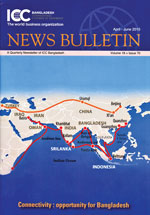
Bangladesh needs to develop a deep-sea port to emerge as the transportation hub in the South Asian Region, the International Chamber of Commerce-Bangladesh said.
In the editorial of the ICCB News Bulletin released on Tuesday, the chamber also identified energy cooperation with Bhutan, Nepal, India and Myanmar and establishment of more economic or industrial zones to transform its geographical advantage to become the regional economic hub.
"The implementation of the new initiatives will help Bangladesh transform its geographical advantage and create opportunities for accelerating the pace of business cooperation among the countries," the editorial said.
"One of the easiest ways to boost sustainable growth is promoting regional economic integration that facilitates freer movement of goods, services and investment, helping to achieve regional developmental objectives by creating jobs," it said.
The chamber said the geographical location between three major regions of Asia -South Asia, South East Asia and East Asia-provides a "unique opportunity" for Bangladesh to take advantage from cross-border movement of goods and services and investment flows.
Since 2013, the initiative of Bangladesh-China-India-Myanmar Economic Corridor (BCIM-EC) has maintained good momentum of development with collaboration of the BCIM countries, but a lot is yet to be done, the editorial said.
According to experts, the BCIM Corridor is a win-win arrangement. The linkages of transport, energy, and telecommunications networks will enable the region to emerge as a thriving economic belt that will promote social development of communities along the Corridor.
Against the backdrop of the present global economic scenario, BCIM Economic Corridor is on the top agenda of Chinese "One Belt and One Road" initiative. The corridor is a modern version of the Silk Road and a revision of the 1999 Track II Kunming initiative between BCIM countries.
Under the "One Belt and One Road," Kunming Province will be connected to Kolkata in India, Mandalay in Myanmar and Dhaka and Chittagong in Bangladesh. The economic corridor is expected to benefit the four neighbouring countries as it will facilitate trade by providing greater market access due to improved connectivity.
Bangladesh and China have also signed six deals to further boost bilateral ties between the two countries at public and private sectors.
China, being the largest trading partner of Bangladesh, is already involved in development of mega infrastructure projects of Bangladesh.
It is estimated that in the next five years, China will invest an additional $500 billion in other countries, import over $10 trillion worth of products and send 400 million tourists abroad. Bangladesh, as China's close neighbour and trusted friend, can take an even more favorable posture to make good use of "Chinese opportunities."
China and India are the two largest emerging economies while Bangladesh and Myanmar boast rich natural and human resources.
Indian Prime Minister's recent visit to China as a follow-up of Chinese President Xi Jinping's visit to India, the two countries have signed agreements wherein China will invest in India some $22 billion to strengthen economic collaboration.
This will definitely be beneficial for the economic corridor and enable the four countries to work for each other's advantages, accelerate economic growth and open wider opportunities for them.
According to the ADB, Bangladesh's real income gains will be 6.9 per cent of GDP and export will grow by 86 per cent by 2030 if connectivity between South Asia and Southeast Asia improves.
However, Bangladesh will have to spend $14.268 billion to prepare its road, rail, ports and energy infrastructures to contribute to the integration, said the ADB in a recent study.
In the recent developments, the Asian Development Bank has agreed to invest US$505 million in railway link and the World Bank has expressed its interest to provide US$1.0 billion for infrastructure development in Bangladesh for connectivity between Bangladesh, Bhutan, India and Nepal.
Bangladesh is also likely to receive $5.9 billion between 2016 and 2018 from the ADB for its infrastructure projects.
© 2026 - All Rights with The Financial Express

