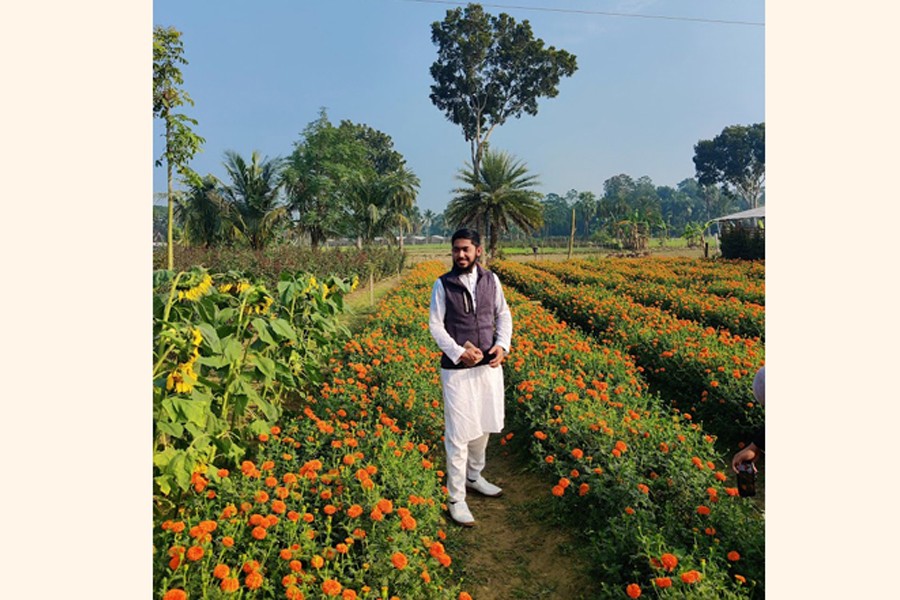
JASHORE, Dec 20 (UNB): As winter settles in Jashore, Gadkhali, Bangladesh's flower capital, bursts into vibrant blooms, drawing visitors and boosting both the local economy and tourism.
With the festive season approaching, including the New Year, flower growers and traders here are brimming with optimism for a flourishing season of sales.
Nestled in Jhikargachha upazila, Gadkhali and its surrounding villages-Panisara, Navaran and nearby areas-are now carpeted with blossoms, heralding the start of a vibrant flower season.
Farmers have already begun harvesting a rainbow of blooms, while traders rush to dispatch them across the country.
According to Agriculture Department officials, the region boasts around 7,000 flower growers cultivating approximately 1,200 hectares, of which nearly 650 hectares are dedicated to flowers.
Eleven varieties thrive here, from the elegant gladiolus and fragrant tuberose to roses, gerbera, marigold, gypsy, rodstick, calendula and chrysanthemums.
Abdur Rahim, president of the Gadkhali Flower Producers and Marketing Cooperative Society, shared the economic heartbeat of the region, saying, "The flower market here crosses Tk 4.0 billion annually. Daily trading at the wholesale market ranges between Tk 1.5 million and Tk 2.0 million. On Victory Day alone, we sell worth around Tk 50 million."
The wholesale flower market along the Jashore-Benapole highway buzzes with life from early morning. Farmers bring freshly cut blooms from their fields, while retailers and wholesalers from across the country bargain for the best prices before distributing them nationwide and abroad.
Winter, they say, is the season of roses-and of optimism. Grower Nimon noted, "Rose prices are now between Tk 5 and Tk 6 per piece. The prices of rose and marigold are relatively low due to high supply, but we anticipate a rise ahead of Victory Day. Political stability will also play a crucial role in market performance."
Sadiq Hossain, another grower, expressed cautious optimism, saying, "Market conditions are better than last year. If prices remain stable, farmers will recover their costs."
Flower sales typically peak between November and April, with surges around major days such as Victory Day, International Mother Language Day, Independence Day, Pahela Baishakh, Valentine's Day, the Spring Festival, and the English New Year.
This season, however, tuberose production has declined due to monsoon crop losses, pushing prices up to Tk 15-18 per piece. Current market rates for other flowers include marigold at Tk 400-500 per 100 flowers, gladiolus at Tk 8-10 per piece, gerbera at Tk 10-15, and chrysanthemum at Tk 5-8 per piece.
Md Abu Zafar, general secretary of the Gadkhali Flower Growers and Traders Welfare Association, reflected the growers' sentiment, stating, "If the situation remains normal, we anticipate three to four hundred crores in sales during the five key festive days of the season."
This year, flowers are cultivated on roughly 800 hectares across Jashore district, with around 650 hectares in Gadkhali and nearby areas dedicated to commercial production.
Jhikargachha Upazila Agriculture Officer Md Nurul Islam said farmers are fully prepared for the season and receive technical support to prevent diseases, adding, "The market situation is good, and growers are expected to benefit."
Deputy Director of the Department of Agricultural Extension Mosharraf Hossain highlighted the ongoing incentives and technological support aimed at keeping the flower economy vibrant.
Gadkhali alone meets nearly 70 per cent of the nation's flower demand, with annual production worth around Tk 400 crore reaching consumers through farmers and traders.
Beyond economics, flower farming has added a new dimension to local tourism, attracting visitors eager to witness fields awash with colours.
The story of commercial flower cultivation in Gadkhali began in 1982, when Sher Ali Sardar of Panisara village first grew tuberose on a single bigha of land. Inspired by his success, many local farmers gradually shifted from traditional crops to the cultivation of blossoms, transforming the region into Bangladesh's floral heartland.
As the festive season unfolds, Gadkhali continues to bloom-not just with flowers, but with hope, colour, and the promise of prosperity, locals said.
© 2026 - All Rights with The Financial Express

