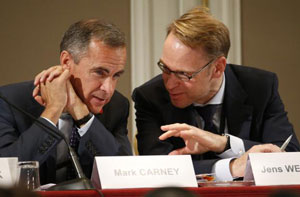
 Bank of England Governor Mark Carney (left) and Germany\'s Bundesbank President Jens Weidmann attended a conference of central bankers hosted by the Bank of France in Paris on November 7. — Reuters
 LONDON, Nov 10 (Reuters): The world's biggest banks should hold a buffer of bonds in case of a collapse so that government bailouts are avoided, a global regulatory body proposed on Monday.
The draft rule is the last major piece of banking reform put forward by world leaders since the 2007-09 financial crisis forced taxpayers to shore up undercapitalized lenders.
The Financial Stability Board (FSB), made up of regulators from the Group of 20 economies (G20), said global banks like Goldman Sachs (GS.N) and HSBC should have a buffer of bonds or equity equivalent to 16 to 20 percent of their risk-weighted assets from January 2019.
The bonds would be converted to equity to "bail in" a stricken bank. The total buffer would include the minimum mandatory core capital requirements banks must already hold.
The proposal is set to be endorsed by G2O leaders later this week in Australia. It is being put out to public consultation until Feb. 2, 2015.
FSB Chairman and Bank of England Governor Mark Carney said the buffer would be finalised next year, marking a watershed in ending banks that are too big to be allowed to fail.
The new rule will apply to 30 banks the FSB has deemed to be globally systemically important, though initially those from emerging markets would be exempt.
"Once implemented, these agreements will play important roles in enabling globally systemic banks to be resolved (wound down) without recourse to public subsidy and without disruption to the wider financial system," Carney said in a statement.
© 2026 - All Rights with The Financial Express

