Bangladeshi garment makers are missing out on a huge market in Latin America due to tariff barriers imposed by the Mercosur countries, businesses and analysts say.
Established in 1991 to promote free trade and regional integration, Mercosur is a South American trade bloc with four full members -- Argentina, Brazil, Paraguay, and Uruguay.
Despite the enormous potential of Bangladeshi products to enter South America in higher volumes, the lack of bilateral or multilateral trade deals is affecting businesses.
Brazilian and Bangladeshi businessmen have told The Financial Express although they want to expand business with Bangladesh, the tariff barriers are creating huge roadblocks.
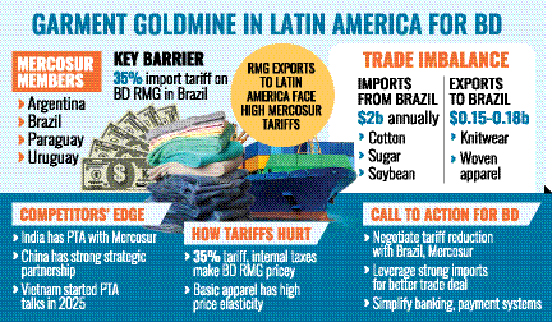
Brazil's 35 per cent import tariff on ready-made garment (RMG) from Bangladesh -- stemming from its Mercosur customs union membership -- severely erodes Bangladeshi apparel competitiveness.
By inflating the final retail prices, this duty restricts market penetration and forces Bangladesh into a structural trade deficit while limiting expansion into Latin America.
Bangladesh imports major agricultural commodities like raw cotton, sugar, and soybean from Brazil (exceeding $2.0 billion annually), while its exports - primarily knitwear and woven apparel -- have hovered around $150-187 million, severely tilting the trade balance.
Because the price elasticity for basic apparel is high, a 35 per cent duty coupled with cumulative internal taxes makes Bangladeshi garments substantially more expensive than locally produced Brazilian goods or items from competitors with preferential trade access.
Despite the recent spikes in bilateral trade, the high tariff continues to act as a ceiling for export growth, preventing Bangladesh from directly capturing a significant share of Brazil's apparel market.
Besides, the complex banking or payment system between Brazil and Bangladesh has held back garment importers and exporters, disrupting the potential bilateral business.
Bruno B Silveira, country manager of Brazilian garment importer RENNER in Bangladesh, tells The Financial Express the Bangladesh government should take steps to convince its Brazilian counterpart and the Mercosur trade bloc to slash tariffs on Bangladeshi products.
Since Bangladesh imports a handsome amount of Brazilian products, it can take steps to reduce trade barriers by establishing a good partnership, he adds.
Sheikh Khaledur Rahman, a Bangladesh-Brazil businessman, tells The Financial Express he has been doing garment business with Brazil for many years and tariffs are the main obstacle to trade expansion.
"Since Bangladesh has no trade deal with Brazil or the Mercosur nations, it has become very difficult to compete with other garment suppliers like India. Besides, they have good relations with China and Vietnam," he says.
"We have met some Brazilian policy-makers, bureaucrats, businessmen, and trade leaders. We suggested they go for establishing a trade relation with Bangladesh and eliminating the tariff barriers. But as we have not got any support from the Bangladeshi embassy in Brazil, we have failed to complete successful negotiations."
Another Bangladeshi businessman in Sao Paulo says they have requested the incumbent Bangladeshi ambassador to Brazil, appointed by the previous Sheikh Hasina government, to press their demands with the Latin American country, but the request has not been considered.
Echoing the same, several other businessmen have told The Financial Express the ambassador, Dr Md Tauhedul Islam, acts like a lord and does not care about the Bangladeshi community in Brazil.
In addition to Brazil, Dr Tauhedul holds concurrent diplomatic accreditation to Argentina, Chile, Uruguay, Paraguay, Bolivia, and Venezuela.
The main export items from Bangladesh include RMG, such as jerseys, pullovers, cardigans, shirts, suits, jackets, trousers, and shorts.
India and Mercosur have an active Preferential Trade Agreement (PTA) that came into force in June 2009.
Vietnam and Mercosur do not yet have any active Free Trade Agreement (FTA), but they officially launched PTA negotiations in late 2025.
China does not have a formal FTA with Brazil or Mercosur.
However, it is Brazil's largest global trading partner, and the two countries operate under major strategic partnerships and cooperation plans.
Brazil has historically vetoed formal Mercosur-China trade talks to protect domestic manufacturing, though Brazilian officials are discussing a possible partial or targeted Mercosur-China trade deal in response to shifting global tariffs.
By 2026, Brazil could become the world's eighth-largest economy with a gross domestic product (GDP) of $2.47 trillion.
A manager at a John Deere brand shop in the Brazilian city of Sao Carlos tells The Financial Express they are interested in importing Bangladeshi apparel and leather products, but tariffs are the major obstacle.
"We know that Bangladeshi garments are recognised worldwide. Bangladesh has a big export base in the US and European Union (EU) countries. We are also interested in importing Bangladeshi products if the barriers are removed."
Former Bangladesh Garment Manufacturers and Exporters Association president Rubana Huq tells The Financial Express that Brazil is one of the big potential markets in Latin America for Bangladesh, but tariff barriers are impeding bilateral trade.
She has urged the Bangladesh government to work with the Brazilian authorities to simplify business since the former country imports products like cotton, sugar, and soybean from the latter with zero duty.
kabirhumayan10@gmail.com
© 2026 - All Rights with The Financial Express

