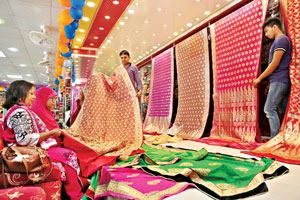
 Buyers choosing a saree at a shop in Benarasi Palli in Mirpur — FE Photo by KAZ Sumon
Indian sarees are gradually grabbing the traditional benarasi saree market at city's Mirpur as local businesspeople can't compete with their Indian counterparts, especially in terms of prices and designs.
Even though there is huge demand for locally-made benarasi sarees, businessmen and weavers fail to supply them as per the demand due to its high production cost, paucity of skilled manpower and working capital, people involved with the trade said.
Besides, artisans are switching to other professions due to poor wages, forcing many weavers to shut down their looms, they added.
Benarasi saree is a fabric made out of silk and zari which is worn by women in India, Pakistan and Bangladesh. Benarasi sarees are woven at Mirpur in Bangladesh, Benaras, Bihar and Uttar Pradesh of India and few places in Pakistan.
The city's Benarasi Palli is located at Mirpur, the centre for traditional Benarasi Katan and Jamdani sarees.
Jahanara Begum, a resident of Shewrapara, came to the palli and bought an Indian dhupian silk saree for Eid.
While talking to the FE last week, she said Indian sarees are cheaper compared to local ones and also have variety in designs.
Abul Kalam Azad, senior vice president of Benarasi Palli Shop Owners Association, said now there are only 10 to 15 per cent shops which have own factories.
Replying to a query, he said shop owners are selling Indian products mainly to sustain and compete with other markets in the capital city as they have made huge investments.
Although locally-made benarasi sarees have huge demand, manufacturers cannot meet the demand as a good number of looms had shut down due to high cost of production and shortage of skilled manpower.
While talking to the FE, the businessmen at the Palli said many of them have small capital for investment and so they cannot pay the weavers much, although the cost of the sarees goes up.
Abdul Kuddus Shawn, a weaver said, six to ten sarees can be made from a 'Tana' that now costs Tk 20,000 to Tk 25,000 which was Tk 3,000 to Tk 3,500 a decade ago.
Benarasi Palli spanning from Mirpur 10 to 11 has now some 1,000 looms, but the number of looms here was more than 3,500 five years back.
The number of artisans also declined to some 1,500 to 2,000 as many of them have switched to other professions due to scarcity of work and low wages, he added.
Depending on work, an artisan earns Tk 800 to Tk 1,000 per saree that takes four to seven days. Also, it takes a month for three artisans to make a party or wedding saree and in such cases, they earn Tk 20,000.
Many of them now pull rickshaws or run tea-stalls, he added.
Shop owners said they make more money by selling cheaper and designed Indian sarees than from employing the weavers for local sarees.
Mr Shawn said no new weavers are joining this profession. There is no way to increase production.
"The plot distribution issue still remains unresolved that also frustrated the weavers," he noted.
Echoing Mr Shawn, Jafar Imam Rony, manager of Tawsif Benarasi Fashion, said business is very dull during the last two years and they are yet to overcome the impact of political turmoil.
According to Benarasi Palli Shop Owners Association, there are about 130 shops in the area. But traders said the number of shops is much higher than the figure varying in size from very small to large. There are many shops which are not associated with the association.
After partition of India in 1947, a good number of artisans from Benaras settled in Mirpur and started making katan and benarasi sarees. Though Urdu-speaking people are mainly engaged in producing and marketing benarasi saree, local people also joined the industry with their weaving skills.
Traders and shop owners, however, failed to specify how much revenues Benarasi Palli generates annually, but some manufacturers and traders opined that each shop earns ranging from Tk 200,000 to Tk 5.0 million a month.
They said customers come mainly to buy sarees for wedding all the year round and business is dull in Ramadan following a less wedding ceremony during the period.
Shopkeepers said apart from Indian products, they had collected sarees from Tangail, Pabna and Narayanganj.
There are different types of sarees available with Mirpur Benarasi Palli and prices of the sarees start from Tk 1,200 and there is no upward limit.
Sarees ranging from Tk 10,000 to Tk 15,000 are common while a simple wedding saree costs Tk 4,000. There are also wedding sarees costing Tk 70,000.
munni_fe@yahoo.com
© 2026 - All Rights with The Financial Express

