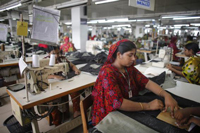
 A worker working in a factory in Savar recently. — Reuters Photo
 Western safety inspectors' erratic decisions pose a new set of problems for Bangladesh's US$22 billion garments industry, whose safety record has been under the microscope since the collapse of a factory near Dhaka that killed more than 1,100 workers last year, reports Reuters.
More than a year after the public outcry that spurred Western retailers into demanding better standards from the factories that make their clothes, it also highlights the practical complexities of improving the conditions of millions of poor workers whilst also safeguarding their jobs.
Export growth in the sector has slowed as buyers turn to India, Myanmar, Vietnam and Cambodia because of concerns over workshop safety, higher wages and political instability.
Now factory owners say they are concerned about arbitrary shutdowns and meeting the cost of demands for remedial work, while workers worry about who will pay their wages if their workplace is temporarily closed.
"We went through inexplicable harassment during this whole process, and I am sure they don't care about that," said Sonia & Sweaters Director Mahabubur Rahman, of his experience of the inspection.
"But with their trigger-happy attitude, I am left wondering if they at least care about the workers, who they are meant to protect, because nobody has to explain to them what the implication of one factory shutdown is."
The garment industry accounts for 80 per cent of Bangladesh's exports, and turmoil in the sector has put at risk the livelihoods of nearly 4.0 million garment workers, mostly women.
The collapse of the eight-storey Rana Plaza building in April 2013 brutally exposed the inadequacy of the safety regime in Bangladesh, where 5,600 garment factories are inspected by different local agencies that often lack sufficient technical equipment and the required expertise.
The disaster led to the creation of the Accord on Fire and Building Safety, an inspection group led by European retailers, and the North American brands-led Alliance for Bangladesh Worker Safety, which together are scrutinising around 2,100 factories.
The groups, which have a mandate to recommend the closure of dangerous factories and demand repairs, are now embroiled in a debate over the inspection process and the question of who pays for upgrades and wages while factories stand idle.
Making the situation worse, almost all global retail brands have opted to stay out of the arguments between inspection agencies and suppliers, according to the industry officials.
When the inspection groups were set up, retailers did not commit to pay for improvements they demanded - some Bangladesh factory owners are very wealthy and politically connected - but agreed to discuss assistance with wages and improvements if owners could not afford them.
Wal-Mart spokesman Kevin Gardner said, as a founding member of the Alliance, the company's contributions have made funds available to help factory owners make necessary repairs and to support workers who may be temporarily displaced.
This includes an initial worker safety fund of nearly $50 million and growing, and more than $100 million in access to low-cost capital funding to improve fire and structural safety. Debenhams declined to comment.
The Western inspection groups, between them, have so far shut 14 factories and asked five factories to partially close, according to the government data.
Senior advisor to the Alliance Ian Spaulding said the group has been careful with the issue of factory shutdowns and has been working closely with the government on the issue. Five factories have been shut down as a result of their recommendations, he said.
The legal authority to shut factories rests with the Bangladesh government, and decisions to do so are reviewed by a government-appointed panel that includes one member each from the Accord and Alliance and two civil engineers from the Bangladesh University of Engineering and Technology (BUET).
That process has led to friction between local and foreign members.
© 2026 - All Rights with The Financial Express

