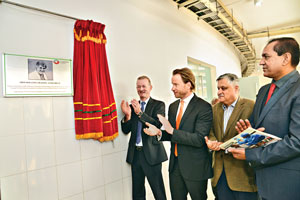
 The Fred Hollows Foundation Chief Executive Officer Brian Doolan (extreme left) along with Australian High Commissioner in Bangladesh Greg Wilcock (2nd from left), Ispahani Islamia Eye Institute and Hospital (IIEIH) Chairperson M Ali Behrouze Ispahani (2n
 Ispahani Islamia Eye Institute and Hospital (IIEIH), the oldest and largest eye hospital in Bangladesh, opened Sunday its new state-of-the-art auditorium and education facilities.
Chief Executive Officer of the Fred Hollows Foundation (FHF), Australia Mr Brian Doolan officially opened 'The Fred Hollows Training Foundation Auditorium and Education Department Complex' at the hospital in the city as the chief guest.
The FHF contributed significantly for providing the world-class facilities which will be used to improve the expertise of the doctors and eye care professionals.
Australian High Commissioner in Bangladesh Mr Greg Wilcock, and Prof Deen Mohd Noorul Huq addressed the programme as the special guests with chairperson of the IIEIH M Ali Behrouze Ispahani in the chair.
In his address, Mr Doolan pointed out how this hospital has significantly contributed to providing quality eye care to all sections of society, especially the poor.
He said there are many eye-related problems including cataract. And IIEIH plays a major role in reducing this backlog of those patients who suffer from curable eyesight problems.
Australian High Commissioner, in his speech, said it is a very good news that thousands of people are taking services from the FHF and IIEIH.
He expressed the hope that both the organisations will continue their services to save people from eye-related problems.
IIEIH chairperson thanked the FHF for extending its hands for improving the IIEIH services.
He said IIEIH will continue its services to the general people.
CEO of IIEIH Dr Steven Roy briefed the audience about the medical, education and training services of the hospital.
IIEIH was established in 1960 by Mr MA Ispahani, well-known industrialist and philanthropist. It was the first specialised eye hospital in Bangladesh and since then, has served millions of patients.
It has become known for the excellent quality of its surgery and is undoubtedly a leading ophthalmic institution in the country.
In recent years, IIEIH has renovated much of the original building so that it can become an internationally-recognised eye hospital serving both the rich and the poor patients, organisers said.
Being a non-profit hospital, the funds generated from those who can pay are used to cover the costs of those who are economically insolvent and thus the latter avail of free or subsidised treatment from the hospital, added the organisers.
© 2026 - All Rights with The Financial Express

