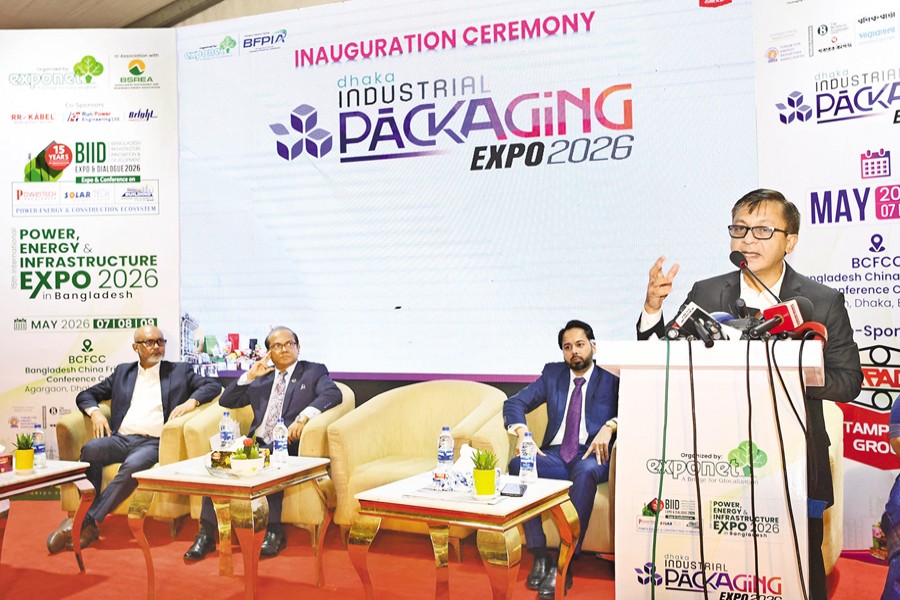
 Commerce, Industries and Textiles and Jute Minister Khandakar Abdul Muktadir addressing the inauguration of the 'Dhaka Industrial Packaging Expo 2026' at the Bangladesh-China Friendship Convention Centre in the capital on Thursday.
 Commerce, Industries and Textiles and Jute Minister Khandakar Abdul Muktadir stressed on Thursday the need to cut bureaucratic red tape, reduce logistics costs, improve port efficiency and unlock idle state-owned assets to make Bangladesh competitive in tomorrow's global economy, reports UNB.
"We cannot move forward by dwelling on old problems. The time has come for pragmatic reforms and swift implementation of commitments," Muktadir said while addressing the inauguration of the 'Dhaka Industrial Packaging Expo 2026' at the Bangladesh-China Friendship Convention Centre in the capital.
The minister said entrepreneurs currently need 25 to 26 separate approvals and licences to start a business in Bangladesh, making the investment environment unnecessarily cumbersome. "To address this, the government is working to streamline the business registration process."
He said that in future, any enterprise completing registration through BIDA or the relevant authority will receive a 'provisional clearance' at the outset, allowing entrepreneurs to begin operations without delay.
Muktadir highlighted that Bangladesh's logistics cost stands at around 16 per cent of GDP, well above the global average of approximately 10 per cent. "Inefficiencies in port management are inflating cargo transportation costs and eroding the country's international competitiveness. To reverse this, internationally recognised foreign operators are being brought in to manage port operations."
He said a Danish company has already begun operating a container terminal, with more international-standard firms to be engaged in port activities going forward.
The minister said Bangladesh is on its path from Least Developed Country (LDC) to developing country status, leaving no room for stop-gap measures. "Sustainable reform must be implemented consistently; there is no shortcut."
On state-owned enterprises, Muktadir said dozens of large industrial units have been lying idle or running at a loss for years, creating a massive subsidy burden on the exchequer. "Around 40 enterprises fall under the Ministry of Industries and another 50 under the textiles and jute sector. The government is gradually opening these units to private investment to bring their vast landholdings and assets into productive use."
"Our goal is to turn these dormant industrial units into hubs of investment and employment within the next one to two years: some will be modernised, some will host new industries, and others will be developed into export-oriented production centres," he said.
He noted that each sugar mill in the country sits on an average of 1,000 bighas of land or more. Developing modern industrial parks or multi-purpose industrial facilities on these sites, he said, could generate substantial investment, employment, and government revenue.
Turning to the packaging sector, the minister urged entrepreneurs to think big. "You cannot reach a big destination with a small vision. The government will provide policy and institutional support, but it is the entrepreneurs who must drive industrial growth."
Muktadir reiterated the government's commitment to expanding domestic industry, creating new jobs, strengthening Bangladesh's presence in international markets, and injecting new momentum into the economy through higher export earnings.
© 2026 - All Rights with The Financial Express

