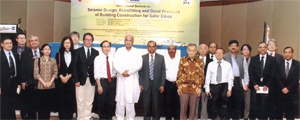
 Housing and Public Works Minister Engineer Mosharraf Hossain along with other guests poses for photograph at the seminar in the city Saturday.
 Housing and Public Works Minister Engineer Mosharraf Hossain called Saturday for using retrofit technology for turning vulnerable public and private buildings of the country's major cities into earthquake resistant structures, reports BSS.
Speaking as the chief guest at a seminar here on "Seismic Design, Retrofitting and Good Practices of Building Construction for Safer Cities" he suggested that the situation shall improve if the architects and structural engineers could work together as well as to enforce the national building code, BNBC.
Project for Capacity Development on Natural Disaster Resistant Techniques of Construction and Retrofitting for Public Buildings (CNCRP), a technical cooperation project between Public works Department (PWD) and Japan International Cooperation Agency (JICA) organized the two-day international seminar at Radisson Blu Water Garden Hotel in the capital.
Experts familiar to the process told the seminar that different kinds of retrofitting technologies can be used to make vulnerable building earthquake resistant as it usually costs 30 to 40 percent of the new construction cost of the targeted buildings.
With Housing and Public Works Secretary Md. Golam Rabbani was in the chair, Chief Representative, JICA Bangladesh office, Mikio Hataeda spoke as the Special Guest while PWD Chief Engineer Engineer Kabir Ahmed Bhuiyan gave the welcome speech.
Additional Chief Engineer, PWD, and Project Director of CNCRP Abdul Malek Sikder and Team leader of JICA Expert Team Fumio Kanko also spoke on the occasion.
Mosharraf Hossain said, "We have formulated the building code in our country, but I have to say that implementations of the code to date has been largely uninspiring. Recently Ministry of Housing and Public Works have updated the building code and decision has been taken to enforce the relevant agencies to follow the building code in future construction."
Mikio Hataeda said JICA is considering extending its support to provide modern building technology to Bangladesh through technology transfer and providing soft loan. "Considering the numbers of vulnerable building here, Building safety issue should be in the main stream of the Bangladesh policy," he said.
Further support from the government of Japan is to be discussed at the Ministerial Meeting scheduled tomorrow between Japanese and Bangladesh Prime Ministers here.
Additional Chief Engineer, PWD and Project Director of CNCRP, Abdul Malek Sikder said in the context of Dhaka where many of the buildings are vulnerable to earthquake, the retrofitting technology is the way to make the capital earthquake resistant.
"At first, we are targeting vulnerable fire stations and hospitals for retrofitting as those are extremely important in any kinds of disaster management, and must be functional for conducting post disaster rescues," he said.
Under the project, local engineers, with the support of Japanese experts have already started working to retrofit the Tejgaon fire station as pilot basis to turn the important public building into an earthquake resistant structure within few months.
During the four-year CNCRP project (from 2011 to 2015), in last three years, the local engineers have been imparted training on different techniques of retrofitting technology from a team of JICA experts.
© 2026 - All Rights with The Financial Express

