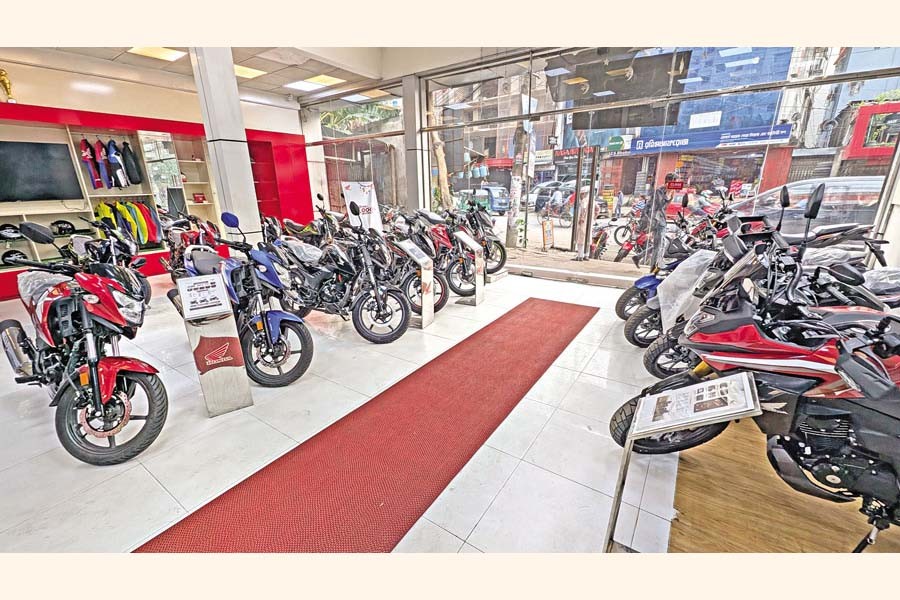
The motorcycle industry in Bangladesh is witnessing cautious consumer sentiment and slowing sales, even as Eid and promotional offers provided a temporary boost to demand.
Industry leaders report that nearly 20 per cent of prospective buyers have postponed purchase decisions, as geopolitical uncertainty and fuel supply concerns dampen consumer confidence.
"Amid the current situation marked by panic buying of fuel, long queues at petrol pumps, and informal rationing in some areas, nearly 20 per cent of new customers have deferred their purchase decisions," said Biplob Kumar Roy, General Secretary of the Bangladesh Motorcycle Assemblers and Manufacturers Association (BMAMA) and CEO of TVS Auto Bangladesh Ltd.
"The prevailing uncertainty has made consumers more cautious, and we are witnessing more conservative buying behaviour across the market," he said.
He warned that prolonged supply chain disruptions -- linked to escalating tensions in the Middle East -- could affect logistics and drive up costs.
"We are closely monitoring developments and will hold meetings with leaders across our sector to assess the situation comprehensively," he said, adding that the industry would engage with the government if policy or logistical support is required.
Retailers acknowledge that special Eid promotions helped cushion the downturn, though overall performance remains below projections.
"We introduced several special offers ahead of Eid. Many customers set a target to purchase motorcycles during the Eid season, which helped us achieve a good number of sales," said Jahidul Alam Rintu, Senior Sales Executive at Honda Café.
"However, despite Eid and the attractive offers, overall sales dropped by around 10 to 15 per cent."
Rintu cautioned that without the seasonal festival boost, the decline could have reached 50 per cent.
"The real market scenario will likely be reflected in April. If the war on Iran prolongs further, the motorcycle industry may face additional challenges," he said.
Fuel availability has emerged as a critical factor.
Mohammad Abu Hanif, Chief Business Officer of Runner Automobiles, noted that sales of their fuel-run Runner Skooty fell by 15 per cent in March alone due to the ongoing fuel crisis triggered by Middle East conflict.
He warned that sales could decline further if the war continues.
A senior official from a leading manufacturer, speaking on condition of anonymity, said that motorcycle sales unexpectedly fell by 4.0 per cent in March compared to February.
"Despite the typical seasonal boost from the Eid holidays, the company saw a decline where they had otherwise anticipated a significant rise in demand," he added.
With over Tk 100 billion invested directly and indirectly, the sector has emerged as a major pillar of economic growth, generating employment for nearly 200,000 people.
Seven major firms, including Japanese brands Honda, Suzuki and Yamaha, Indian manufacturers Bajaj, TVS and Hero, and local company Runner Automobiles, are currently operating at full capacity.
Their combined manufacturing and assembly efforts have brought the country close to achieving self-sufficiency in motorcycle production.
Yet, analysts caution that structural vulnerabilities remain exposed during external shocks.
"Many consumers are deferring purchases amid ongoing uncertainties, while supply chain constraints and rising costs are putting pressure on prices and logistics," said Dr. Masrur Reaz, Chairman and CEO of Policy Exchange Bangladesh.
"Even seasonal boosts like Eid can only partially offset this trend. If the war between the United States, Israel, and Iran prolongs, it could have long-term impacts on fuel prices, import costs, and overall consumer confidence, further affecting sales and growth in the motorcycle sector," he said.
Industry and government stakeholders need to monitor the situation closely and consider targeted support measures to ensure stability and prevent a sharper decline in the market, Dr. Reaz suggested.
According to a 2018 study by the Policy Research Institute, Bangladesh's ride-sharing industry was valued at Tk 22 billion, accounting for 23 per cent of the transport sector.
A report by the Bangladesh Trade and Tariff Commission reveals that the country aims to produce one million motorcycles by 2027 under the government's development policy for the sector.
A Yamaha survey shows that one in 161 people in Bangladesh uses a motorcycle for daily transport, compared with one in 20 in India and one in 17 in Pakistan.
In countries such as Malaysia, Thailand and Vietnam, usage is significantly higher, with one in every four to five people relying on motorcycles.
sajibur@gmail.com
© 2026 - All Rights with The Financial Express

