Local mobile phone manufacturers and distributors on Monday said that the implementation of the National Equipment Identity Register (NEIR) will make smartphones more affordable and help build a secure, lawful and competitive mobile phone market in Bangladesh.
They argued that the system is essential to curb illegal imports, protect consumers, and unlock the full potential of domestic production, which they say is currently underutilised due to widespread grey-market dominance.
 The Mobile Phone Industry Owners Association of Bangladesh (MIOB) made the remarks at a press conference held at Dhaka Reporters Unity, as protests continued from a section of mobile retailers opposing NEIR.
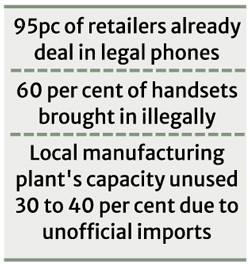
Industry leaders said Bangladesh now has 18 licensed mobile handset manufacturing plants, over Tk 30 billion in investments and more than 100,000 direct and indirect jobs. The sector has the capacity to produce one and a half million smartphones and two and a half million feature phones per month, but around 30 to 40 per cent of this capacity remains unused due to unofficial imports.
MIOB President Zakaria Shahid said nearly 60 per cent of handsets sold in Bangladesh are brought in illegally, depriving the government of over Tk 20 billion in revenue annually and harming both consumers and legal businesses. "Imported illegal and cloned handsets compromise national security, cyber safety and fair competition. NEIR will ensure that only verified devices operate in Bangladesh, as already practised in many countries," he said.
He added that allegations of syndication were "baseless and politically motivated", noting that the market is competitive, with 18 manufacturers operating freely. He also dismissed claims that NEIR would create hardship for expatriates or buyers of used phones, saying any legally listed IMEI number could be deregistered, transferred and resold without issue.
Industry representatives argued that once grey imports are eliminated, customers will be able to buy genuine premium smartphones at lower prices due to economies of scale and reduced unfair competition. Some manufacturers stated that official factory prices may even drop below international procurement rates after NEIR enforcement.
MIOB also clarified that the fifty seven per cent VAT on completely built unit (CBU) devices was introduced in 2019 and has not been increased by the current government. They said the government was considering revising the rate to support the growing manufacturing ecosystem.
Xiaomi Bangladesh's Country Head Ziauddin Chowdhury said those protesting NEIR were benefitting from loopholes, not protecting consumers. "We are building what could become a globally competitive export sector. But misinformation risks killing it before it matures," he said.
Rahul Kapooria from the distributors' association said more than 95 per cent of retailers already deal in legal phones. He urged traders and the public to verify claims spreading on social media.
MIOB leaders assured that those currently selling unofficial devices could legally transition to the formal supply chain and be offered up to ten per cent commission for cooperation.
Despite protests by some shop owners in Bashundhara City and Jamuna Future Park, MIOB said most of the country's estimated twelve thousand phone shops remain open.
Concluding the briefing, the Association reiterated that NEIR is not merely a regulatory tool but a "national safeguard" vital for securing revenue, protecting consumers, reducing crime linked to stolen phones, and enabling Bangladesh to position itself as a competitive electronics manufacturing hub.
Government authorities have stated that NEIR is scheduled to come into effect on December 16.
bdsmile@gmail.com
© 2026 - All Rights with The Financial Express

