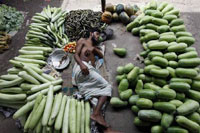
 A vegetable vendor takes a nap during a hot summer afternoon at Karwanbazar in Dhaka on July 19, 2010. — Reuters File Photo
Production of summer vegetables is declining in the country due to lack of stress-tolerant seed varieties, which officials and experts fear worsening nutrition deficiency.
Experts suggested reintroducing stress-tolerant local seed varieties to increase production and secure seed availability.
They said when the winter vegetable production has been showing a gradual increase for the last few years, the summer vegetables production is on the wane.
An official at the Agriculture Wing under the Bangladesh Bureau of Statistics (BBS) told the FE that output of 18 summer vegetables declined to 1.256 million tonnes in the financial year 2013-14, which was 1.282 million tonnes in fiscal 13.
The acreage also decreased by nearly 1,500 hectares during the period as 0.181 million hectares came under cultivation in the last financial year, he said.
He said production of summer vegetables was 1.32 million tonnes in the fiscal 2012.
The official said that production of pumpkin, pointed gourd, ridge gourd, teasel gourd, clocasia stem (kochu loti), long been etc declined while green papaya, green banana and brinjal output remained static.
He said that many of the vegetable growers switched to cereal production as they saw more benefits.
He said changing climatic condition is also affecting the summer vegetable production, which needs increased attention.
The official said that lands of vegetable have declined in Dhaka and Rajshahi agronomical regions.
Seed specialist Dr M A Sobhan said that 80 per cent of the farmers use foreign or local hybrid seeds, many of them do not give good production in odd climatic condition.
He said summer vegetables need more care compared with winter vegetables considering irrigation, fertilisation and seed selection.
Farmers are now totally dependent on the private sector for vegetable seeds both of hybrid and inbreed varieties, he said.
The annual demand for vegetable seeds is now nearly 2,800 tonnes, of which summer vegetables comprises more than 1,200 tonnes, he said.
Dr Sobhan said that decline in vegetable production might further increase vegetable deficiency.
He said the country's per capita vegetable deficiency is more than 30 gram.
Ethno-biologist Pavel Partho said 'uncontrolled" use of hybrid seeds has created seed insecurity in the country.
Many of the farmers across the country still have local seeds, he said.
The government can boost local seed production involving the Department of Agriculture Extension (DAE) and the farmers.
The indigenous varieties are much more stress-tolerant compared with those of alien or hybrid varieties, he said.
The country's total vegetable production was above 9.09 million tonnes in fiscal 2014 including both winter and summer vegetables, according to the DAE.
tonmoy.wardad@gmail.com
© 2026 - All Rights with The Financial Express

