Bangladesh's ongoing power and fuel crisis is pushing the country's mobile network infrastructure towards a critical tipping point, with industry estimates suggesting that up to 60-70 per cent of mobile users could face partial or complete service disruption if the situation persists.
Data compiled from operators and a recent emergency letter sent by the Association of Mobile Telecom Operators of Bangladesh (AMTOB) to the Bangladesh Telecommunication Regulatory Commission (BTRC) indicate that prolonged load-shedding and fuel shortages are rapidly eroding network resilience across the country.
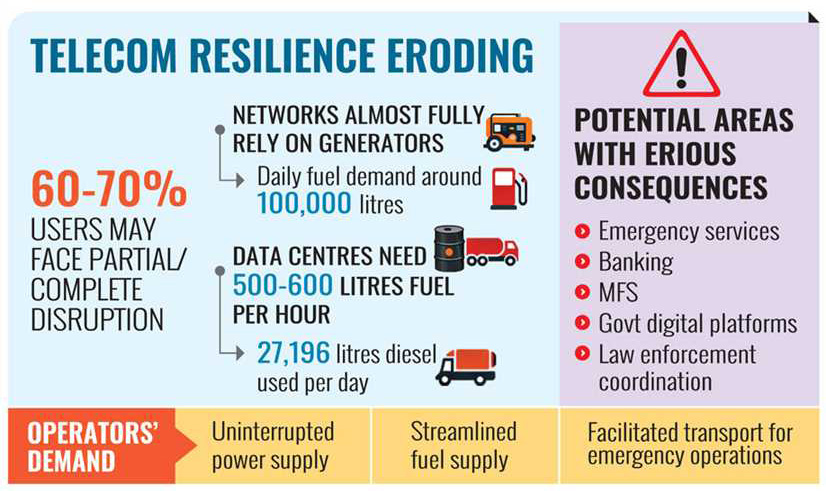
With grid electricity unavailable for five to eight hours daily in many areas, mobile operators have become almost entirely dependent on generators to keep networks running.
Industry figures show that more than 72,000 litres of fuel are being consumed every day to operate base transceiver stations (BTSs), while data centres and core network infrastructure require a further 27,000 litres of diesel daily.
The total daily fuel demand is therefore approaching 100,000 litres, raising serious concerns about sustainability.
Against this backdrop, in its letter to the regulator, AMTOB underscored that, in addition to fuel shortages, logistical challenges are compounding the crisis.
Disruptions to inter-district fuel transportation and the lack of direct supply from depots have left many critical telecom sites with dangerously low reserves.
The association warns that if these constraints persist, the country could face a major network disruption with serious consequences for emergency services, banking operations, mobile financial services, government digital platforms, and law enforcement coordination.
Operators maintain that without swift and coordinated intervention, the situation could deteriorate rapidly from slower data speeds and increased call drops to partial or even full network blackouts.
In their assessment, the issue has now moved beyond a sectoral challenge and represents a broader threat to Bangladesh's digital economy, public service delivery, and overall economic resilience.
Robi Axiata has warned that network resilience is already being stretched to a critical threshold.
Its Chief Corporate and Regulatory Officer, Shahed Alam, says the current situation represents a "breaking point" for operations, as prolonged outages force operators into an unsustainable reliance on fuel.
He cautions that without a dependable fuel supply mechanism and improved grid reliability, temporary disruptions could evolve into persistent "black zones", particularly in rural and semi-urban areas where backup capacity is limited and fuel logistics are more fragile.
Alam further observes that although telecommunications are formally recognised as an essential service, implementation gaps at the operational level continue to undermine that status.
In his assessment, disruptions in fuel transport and the absence of priority power supply to telecom infrastructure point to coordination challenges among the relevant authorities, reflecting a disconnect between policy commitments and execution on the ground.
Addressing this gap, he suggests, would require clearer directives, stronger inter-agency coordination, and accountability in implementation.
The vulnerability of data centres - widely regarded as the "brain" of the network - has emerged as a central concern.
These facilities require around 4 megawatts of electricity daily, and in the absence of grid supply, each hour of operation consumes between 500 and 600 litres of fuel.
Operators, including Grameenphone, Robi Axiata, and Banglalink, collectively use around 27,196 litres of diesel every day to keep these centres operational.
AMTOB Secretary General Lt Col (retd) Mohammad Zulfikar warns that any disruption at the data centre level would have immediate and far-reaching consequences across the entire network.
He says a shutdown or even partial disruption at these facilities could rapidly cascade into widespread service failures, affecting voice calls, internet connectivity, and messaging services simultaneously.
Emphasising the centrality of these facilities, he describes data centres as the command hubs through which all network traffic is routed and controlled.
If this "brain" stops functioning, the entire network effectively comes to a halt, he says.
While operators maintain backup systems, he expresses uncertainty about how effective those contingencies would be under the current scale of the crisis.
According to data from the BTRC, Bangladesh has more than 185 million mobile subscribers.
Industry assessments suggest that the risks are already materialising in phases.
Users in rural and peripheral regions, where infrastructure is comparatively weak and fuel supply chains are more vulnerable, are likely to be affected first, with around 40-50 per cent of subscribers facing degraded connectivity or intermittent outages.
If the situation persists, disruptions are expected to spread into urban areas, potentially placing up to 60-70 per cent of total users, equivalent to more than 110 million people, at risk of partial or complete disconnection.
Stakeholders have also highlighted the broader economic implications of a potential network breakdown.
Shahed Alam pointed out that telecommunication infrastructure underpins critical economic functions, including supply chain coordination in the ready-made garment sector and the daily financial transactions of millions who rely on mobile financial services.
Any prolonged disruption, he warns, could affect production timelines, export commitments, and financial inclusion, creating cascading impacts on livelihoods and overall economic stability.
Echoing these concerns, Grameenphone's Chief Corporate Affairs Officer Tanveer Mohammad says while operators appreciate the ongoing government support, the evolving nature of the crisis requires more timely and targeted interventions.
He stresses the need for uninterrupted power supply to critical telecom infrastructure, including data centres, switching facilities, and base stations, alongside streamlined fuel supply arrangements and facilitated transport for emergency operations.
Without such measures, he cautions, maintaining uninterrupted connectivity for millions of users would become increasingly difficult.
Similarly, Banglalink's Chief Corporate and Regulatory Affairs Officer Taimur Rahman says the growing dependence on fuel is becoming increasingly unsustainable and the sector's designation as an essential service must be reflected in practice.
He argues that telecommunications should be treated as a priority utility, with assured electricity supply for critical infrastructure and simplified access to fuel.
These steps are essential not only for maintaining network continuity but also for safeguarding the country's digital backbone, he notes.
bdsmile@gmail.com
© 2026 - All Rights with The Financial Express

