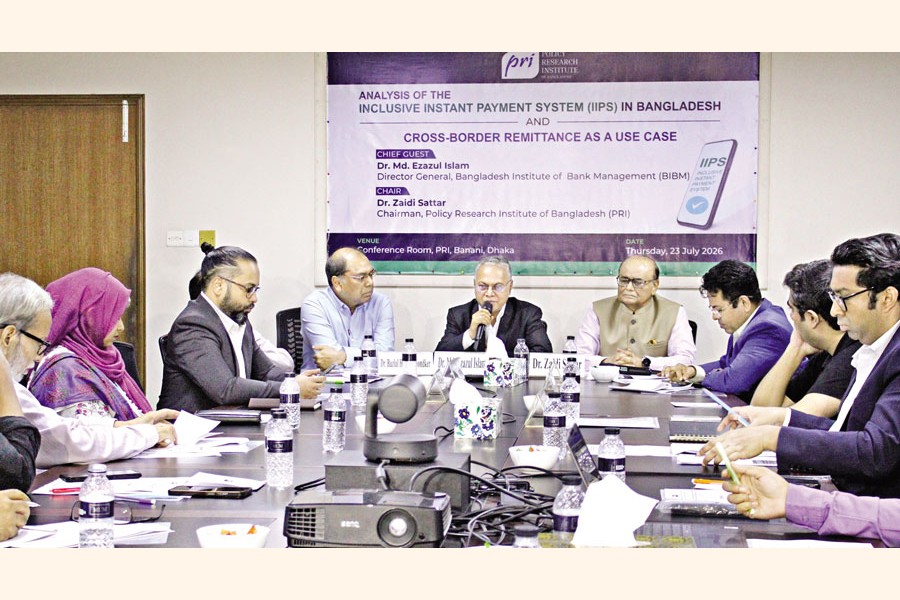
 Dr Md Ezazul Islam, Director General of the BIBM, speaks at a workshop on Analysis of the Inclusive Instant Payment System in Bangladesh held in Dhaka on Thursday. PRI Chairman Dr Zaidi Sattar chaired the event. — FE Photo
 The Policy Research Institute (PRI) of Bangladesh has proposed the development of an Inclusive Instant Payment System (IIPS) to connect the country's fragmented digital payment ecosystem, arguing that a low-cost, interoperable platform could significantly reduce remittance costs, strengthen financial inclusion, and accelerate Bangladesh's transition towards a cashless economy.
The proposal was unveiled at an inception workshop titled "Analysis of the Inclusive Instant Payment System (IIPS) in Bangladesh and Cross-Border Remittance as a Use Case" and organised by PRI with support from the Gates Foundation in its conference room in the capital on Thursday.
The event brought together policymakers, Bangladesh Bank officials, financial sector representatives, mobile financial service providers, and researchers to examine how an interoperable instant payment infrastructure could expand access to affordable, secure, and efficient digital financial services, with cross-border remittances identified as the most impactful use case.
Chairing the session, PRI Chairman Dr Zaidi Sattar said remittances accounted for around 6 per cent of Bangladesh's gross domestic product and should increasingly be channelled into productive investment rather than consumption.
He also highlighted the country's digital financial divide, noting that a large number of Bangladeshi migrant workers continued to rely on the informal "hundi" networks instead of formal financial channels.
Citing Oman as an example, he said many of the country's approximately 700,000 Bangladeshi migrants still preferred informal remittance methods despite the expansion of digital financial services.
The keynote study was jointly presented by PRI Research Director Dr Bazlul Haque Khondker and PRI Director Dr MA Razzaque.
Dr Khondker said the proposed IIPS would provide a shared payment infrastructure linking banks, mobile financial service (MFS) operators, and other payment providers, enabling instant and interoperable bank-to-bank, wallet-to-wallet, and bank-to-wallet transactions alongside QR payments, merchant payments, government disbursements, and cross-border remittances.
He said Bangladesh's rapidly expanding MFS sector dominated by bKash, Nagad, and Rocket had successfully diversified into salary payments, government transfers, and remittance services but largely remained a collection of closed-loop systems, preventing seamless transfers between providers.
According to the study, previous interoperability initiatives, including the Bangladesh Faster Payments (BFP-B) programme implemented between 2017 and 2020 and the ICT Division's Binimoy platform, which was discontinued in 2024, achieved limited success because participation remained voluntary, giving dominant providers little commercial incentive to interconnect their platforms.
The study proposed building the IIPS on the open-source Mojaloop platform, allowing Bangladesh to develop a customisable and low-cost payment infrastructure aligned with the National Financial Inclusion Strategy and the Sustainable Development Goals.
Dr Khondker said research would assess Bangladesh's existing payment infrastructure, regulatory framework, market incentives, and consumer behaviour while drawing lessons from successful international instant payment systems.
The findings would be used to recommend a shared, low-cost payment rail capable of promoting financial inclusion, digital commerce, and transparent remittance flows.
Presenting the remittance component of the study, Dr Razzaque said formalising remittance flows could strengthen household resilience, deepen financial inclusion, and improve Bangladesh's foreign exchange position.
He said the study would investigate why migrant workers continued to choose informal channels by examining factors like transfer costs, exchange rates, speed, trust, documentation requirements, and recipients' access to financial services.
A survey covering Bangladeshi migrants in six major destination countries will estimate the scale of informal remittance transfers and identify barriers to preventing greater use of formal digital payment channels.
The study highlighted remittances as the single largest potential benefit of an interoperable payment system.
Bangladesh received 30.3 billion US dollars in formal remittances during the fiscal year 2024-25.
However, despite record overseas employment in the previous fiscal year, formal remittance growth stagnated as many migrants continued to use hundi, attracted by lower costs and faster settlement.
While the global average cost of sending remittances remains around 6.5 per cent, the study pointed to successful instant payment links such as the Singapore-Thailand PayNow-PromptPay corridor, where transaction costs have fallen below 1 per cent.
Based on those experiences, PRI estimated Bangladesh could potentially save between 250 million and 400 million US dollars annually through low-cost interoperable cross-border payment corridors.
The researchers said their analysis used panel fixed-effects modelling based on Global Findex and World Bank World Development Indicators covering between 87 and 107 middle-income countries, comparing a hypothetical 2026 implementation of IIPS with a business-as-usual scenario through 2030.
The study has been structured into four stages - international benchmarking against systems such as India's UPI, Brazil's PIX, Pakistan's RAAST, and Thailand's PromptPay; ecosystem assessment and survey design; impact modelling; and policy
recommendations.
Dr Ezazul Islam, director general of the Bangladesh Institute of Bank Management (BIBM), said the Inclusive Instant Payment System could substantially reduce digital payment costs while strengthening financial inclusion and improving the efficiency and competitiveness of Bangladesh's payment ecosystem.
He said the wider adoption of digital payments would encourage greater use of formal financial channels, improve transaction traceability, and contribute to higher tax compliance and a more transparent economy.
However, he cautioned that the long-term success of IIPS would depend on robust governance arrangements, appropriate commercial incentives, sustainable pricing, effective dispute resolution mechanisms, sound settlement risk management, and a comprehensive assessment of costs and benefits.
During the panel discussion, Mohammad Jahid Iqbal, additional director of the Payment Systems Department at the Bangladesh Bank, said the central bank was already developing the Inclusive Instant Payment System using the open-source Mojaloop platform.
He said the initiative aimed to lower transaction costs while allowing local customisation and creating an integrated digital payment infrastructure connecting banks, payment service providers, and eventually microfinance institutions.
According to him, the system, launched in November 2025, was designed to support feature-phone users, simplify account opening procedures, reduce failed transactions, and strengthen fraud prevention through the Tazama fraud detection toolkit.
Sayed Shaikh Ibna Jilany, vice-president for remittance, financial services and commercial at bKash, shared the mobile financial service industry's perspective on integrating private-sector platforms into an interoperable payment ecosystem.
He discussed both the opportunities and implementation challenges, emphasising the importance of consumer protection, affordability, user trust, and commercially viable participation for service providers.
Participants also discussed interoperability, regulatory readiness, consumer protection, affordability, and ways to make remittance transfers faster, cheaper, and more accessible, particularly for underserved populations.
Delivering the closing remarks, Dr Ahsan H Mansur, a distinguished fellow at PRI, said financial inclusion, the Inclusive Instant Payment System, and Bangladesh's transition to a cashless economy should be pursued as a single integrated national strategy.
He noted that the Bangladesh Bank currently spent around Tk 200 billion annually on cash management and that the cost continued to rise each year, making digital payments increasingly important from an economic perspective.
Besides, he argued that reducing digital transaction costs would be essential for wider adoption and said temporary incentives or subsidies supporting digital payments could deliver greater long-term economic benefits than continuing large-scale subsidies in other sectors.
Dr Mansur also stressed the need to make smartphones and internet services more affordable to narrow the digital divide, while restoring public confidence in the banking system to encourage greater use of formal financial services.
He further pointed to the untapped investment potential of the Bangladeshi diaspora, suggesting that dedicated investment mechanisms for non-resident Bangladeshis could facilitate the repatriation of an estimated 2 billion to 3 billion US dollars through formal channels.
bdsmile@gmail.com
© 2026 - All Rights with The Financial Express

