The private sector's share in seed business has gradually been increasing as it is expanding fast following continued rise in crop production.
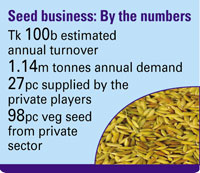
The country's demand for seeds, a fundamental agro input, reached 1.14 million tonnes, of which the private sector alone contributed more than a quaerter in recent years, insiders said.
The total seed business turnover is now nearly Tk 105 billion (excluding farmers' share), according to the Ministry of Agriculture (MoA) and the Bangladesh Seed Association (BSA).
Experts said development of stress-resistant seed in a changing climatic condition will be the key challenge in the current century for Bangladesh's seed sector--both at the public and private levels.
Director General of Seed Wing under the MoA Anwar Faruqe said the public sector and the farmers (informal private sector) are still dominating the seed market, especially that of rice, wheat, spices and potato while the private businesses have captured the overall vegetable seed business.
He said the total seed demand reached approximately 1.143 million tonnes in the country, of which rice comprises 0.214 million tonnes, potato 0.6 million tonnes, wheat 0.064 million tonnes, spice seed 0.155 million tones and maize 6,500 tonnes.
He said the BADC and informal private players (farmers) now hold major share of the seed demand.
"As the private sector will lead the seed business in the coming days, the government is giving all necessary supports for the growth of the sector," he said.
Chairman of the Bangladesh Agricultural Development Corporation (BADC) Md Shafiqul Islam Laskar said they supply nearly 0.145 million tonnes of cereal seeds, of which rice has 0.113 million tonnes.
He said farmers themselves hold 30 per cent and the formal private sector now supplies 20 per cent of rice seed.
General Manager of the Seed and Horticulture Wing Md Aminul Islam said annual sale of seed under the BADC was 0.143 million tonnes worth Tk5.0 billion in the financial year 2014-15.
Vegetable seed market is now almost dominated by private seed businesses and the sector has marched forward to capture a notable share of cereal seeds, businesses said.
Bangladesh Seed Association (BSA) Secretary Syed AKM Asadul Amin told the FE that the contribution of the private sector to overall seed supply increased to 26-27 per cent in 2014, which was 20-21 per cent in 2012.
The sector's annual turnover is now nearly Tk 100 billion, a four-time rise in a decade, he said.
He said: "We are dominating almost 98 per cent of vegetable seeds both of hybrid, inbreed and open pollinated (OP) varieties out of 4,500 tonne demand."
He said the private sector is now developing both hybrid and inbreed (inbreeds supplied by the Bangladesh Rice Research Institute or BRRI) rice seeds.
The private sector share of rice and potato seeds is also increasing-nearly 20 per cent and 25 per cent respectively.
"We are selling 8,000 tonnes of hybrid rice seed which is 90 per cent of the national demand", said the Secretary of the BSA which represents nearly 1,000 seed companies.
He said the private sector is dominating the market share of maize seeds with 6,000 tonnes.
He told the FE that hybrid vegetable seed demand in the country has expanded to 1,500 tonnes.
National Sales Manager of Lal Teer Agro Ltd, G M Faruque told the FE that his company now supplies 70 per cent of hybrid vegetable seeds of the national demand.
"We are marketing 131 varieties of 33 vegetable crops in the country of which 55 are hybrid and 76 OP varieties."
He also informed that they are in a final stage to export hybrid rice seeds to some neighbouring countries.
However, Syngenta and Brac, two other companies, are leading the maize seed business, while Supreme Seed Company Ltd is dominates the hybrid rice seed market, according to the BSA.
Md Mahtab Uddin, director of the company, said his company is focusing on hybrid rice, vegetable, potato, cotton and maize.
The company is contributing more than 40 per cent of the total hybrid rice market share which stand at 3,000-3,500 tonnes.
ACI Seed, a sister concern of the ACI Ltd, is supplying more than 40 per cent of water melon hybrid seed in brand name 'Sugar Emperor'.
The company ACI is now contributing 300 tonnes of vegetable seeds, mostly inbreed.
ACI is also marketing 1,000 tonnes of hybrid rice seed in brand name ACI-1, ACI-2, Razkumar, Shampad etc during Boro season, an official said.
The company has started delivering foundation seeds of local high-yielding rice varieties (HYV) that include Brridhan-28, 29, 11, Bina-8, BR-16 etc, an official said.
When asked, BSA Secretary AKM Asadul Amin said export of seeds, specially that of rice, potato and spices seed is mainly done through informal sector (farmer-to-farmer level) in the border areas.
He said according to the study done by the association, nearly 0.1million tonnes of seeds worth Tk 10 billion are exported to neighbouring India.
When contacted, director of Plant Quarantine Wing under the Department of Agricultural Extension Chhabi Haridash said the quarantine okayed 3,448 tonnes of seed imports of which maize was 3,262 tonnes and vegetable 518 tonnes in January- September 2014 period.
However, private seed traders said apart from the formal import, a good quantity of import is done through informal channel in the same way like export.
Former president of the BSA F R Mallik said the country imports more than 60 per cent of jute seed out of the 4,500 tonnes of demand which is being met through informal channel.
Director General of Bangladesh Rice Research Institute (BRRI), Dr Jibon Krishna Biswas said salinity and inundation in the coastal districts and drought in the northern and north-western regions have been increasing due to both natural and man-made disasters.
Submergence, salinity and drought-tolerant seed varieties should be developed to cope with such environment.
"The challenge of agriculture in the current century is to develop climate-friendly seeds," he said.
Seed scientist Dr MA Sobhan said the private sector is still dependent on import especially for hybrid rice and vegetable seeds.
He said hybrid varieties are highly stress- intolerant which can't be an option in changing climatic condition.
He said rice varieties of Aus season were globally famous for their stress-resistant quality.
The BRRI should remove the local disaster- tolerant Aus and Aman rice seeds from the germplasm centre, where nearly 8,000 varieties are available.
tonmoy.wardad@gmail.com
© 2026 - All Rights with The Financial Express

