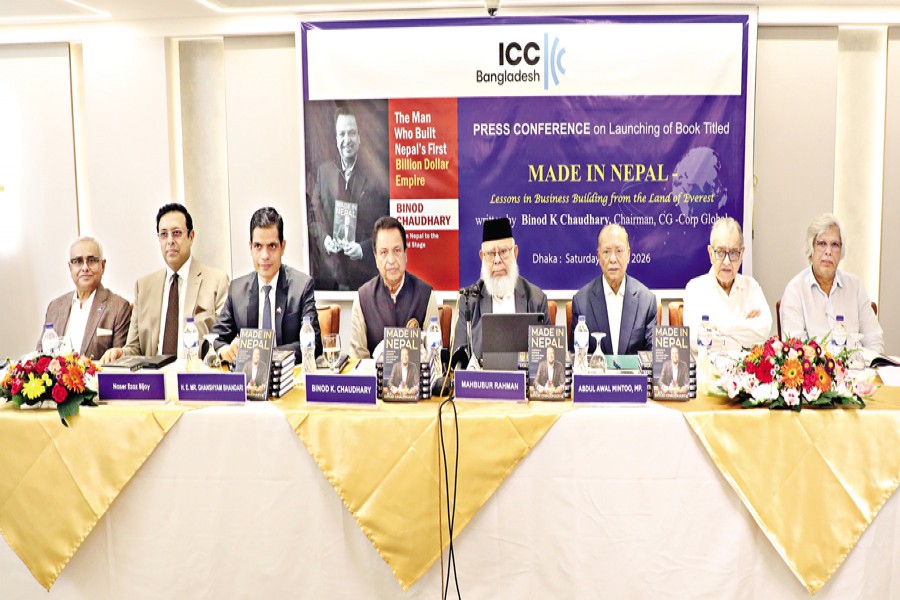
 Environment, Forest and Climate Change Minister Abdul Awal Mintoo, ICC Bangladesh President Mahbubur Rahman, and Binod K. Chaudhary, author of a book titled 'Made in Nepal', along with other guests at a press conference organised by ICC Bangladesh in the city on Saturday, marking the launch of the book.
 Stronger regional cooperation, political stability and bold entrepreneurial risk-taking are essential to unlock South Asia's vast economic potential.
Business leaders and policymakers made the remark at a press conference held in the city on Saturday to mark the launch of a new book, 'Made in Nepal', by Nepali industrialist Binod K. Chaudhary.
They underscored that South Asia's growth trajectory hinges on deeper regional integration, improved infrastructure and stronger political-economic alignment.
Referring to Chaudhary's journey as Nepal's first billionaire, the speakers said his experience demonstrates how businesses from developing economies can compete globally despite structural constraints.
They expressed hope that his new book would serve as both inspiration and a practical guide for entrepreneurs, policymakers and academics.
The event, organised by International Chamber of Commerce (ICC) Bangladesh at the Platinum Grand in Banani, formally introduced 'Made in Nepal - Lessons in Business Building from the Land of Everest', a memoir chronicling Chaudhary's rise from modest beginnings to building a global conglomerate.
Presiding over the programme, ICC Bangladesh President Mahbubur Rahman said the book goes beyond a personal success story, offering practical lessons on resilience, innovation and long-term vision in emerging economies.
He noted that the International Chamber of Commerce, founded in 1919 and headquartered in Paris, represents more than 45 million companies across over 170 countries and works closely with global bodies such as the United Nations, G20 and WTO to promote open markets and responsible business conduct.
He added that ICC Bangladesh, established in 1994, has been instrumental in advocating policy reforms, strengthening trade facilitation and enhancing Bangladesh's integration into global economy.
The organisation, he said, continues to act as a bridge between the private sector and the government, helping ensure the country's competitiveness in a rapidly evolving global landscape.
Mr Rahman emphasised that the book, 'Made in Nepal', reflects not only an individual success story but also the broader evolution of entrepreneurship in emerging economies.
It demonstrates how businesses can thrive even in challenging environments through perseverance, adaptability and strategic foresight, he said.
Drawing a parallel with the Himalayas, he noted that business journeys are often marked by obstacles, but they also present immense opportunities for those willing to take calculated risks.
He observed that for countries like Bangladesh and Nepal-both rich in human capital-the lessons outlined in the book are particularly relevant.
Global success, he said, is no longer confined to developed markets; rather, it can emerge from South Asia through determination, innovation and cross-border collaboration.
Amid current global uncertainties, including supply chain disruptions, financial volatility and climate challenges, Mr Rahman said, such success stories provide both guidance and inspiration.
He reaffirmed ICC Bangladesh's commitment to promoting knowledge-sharing, innovation and regional cooperation, adding that initiatives like this book launch align with its broader mission to inspire entrepreneurs, policymakers and young professionals.
Speaking at the event, Binod K. Chaudhary reflected on his transition into politics, arguing that meaningful, large-scale change often requires engagement in governance.
He described Nepal as a "highly resilient economy", noting that despite political transitions, its entrepreneurs have continued to expand globally and generate confidence.
He highlighted early progress in Bangladesh-Nepal energy cooperation, particularly electricity exports from Nepal to Bangladesh, calling it a "small but positive beginning". However, he said that broader collaboration -- especially in trade and connectivity -- remains limited.
Mr Chaudhary also stressed the need for a functional transit corridor through Bangladesh, noting that existing arrangements are constrained by infrastructure gaps and require coordinated efforts involving India.
Environment, Forest and Climate Change Minister Abdul Awal Mintoo linked economic growth to political stability, remarking that "politics and economics are like twin brothers" that cannot thrive independently.
He stressed that employment generation is central to reducing inequality and poverty, warning that Bangladesh has struggled to create sufficient jobs for its youth population.
He also highlighted the role of private sector leadership, noting that entrepreneurs must often take risks even in less-than-ideal business environment.
Referring to Adam Smith's 'The Wealth of Nations', the minister noted that national prosperity is closely tied to trade with neighbouring countries, particularly India, which he described as a crucial economic and geographic partner for Bangladesh.
Ghanshyam Bhandari, Nepal's Ambassador to Bangladesh, described bilateral relationship as "organic", drawing a connection between the Himalayas and the Bay of Bengal through shared rivers and historical ties.
He urged both countries to pursue their own development paths rather than relying on external perceptions.
Former ambassador Farook Sobhan offered a more cautionary outlook, warning that Bangladesh and Nepal are navigating one of the most challenging geopolitical and geoeconomic periods in their histories.
He called on the business community to take a leading role in revitalising regional cooperation.
Sobhan also pointed to environmental degradation as a growing barrier to investment and tourism, noting that poor air quality in major cities like Dhaka is becoming a serious deterrent.
bdsmile@gmail.com
© 2026 - All Rights with The Financial Express

