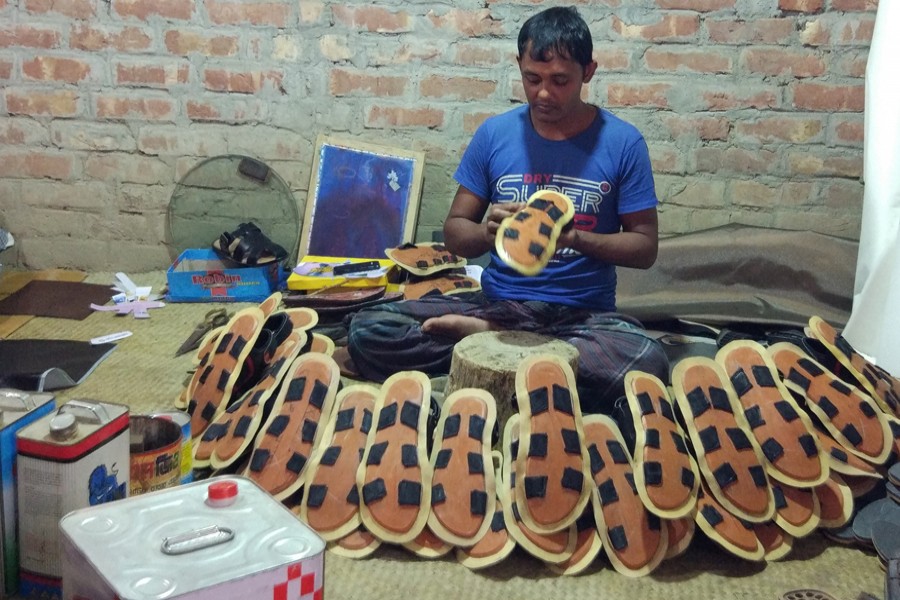
 A worker busy making shoes at a factory in Kaluhati village of Rajshahi — FE Photo
 Shoe-making businesses, a major earning source of many families in Kaluhati, a small village in Rajshahi, can grow to a higher level, if they are provided with financial and technical supports, people involved in the trade said.
The village under Charghat upazila has gained fame for its small-scale footwear factories and is popular with businessmen from different parts of the country, they said.
During a recent visit by the FE correspondent to the village, nearly 20 km away from the Rajshahi city, it was found that the villagers are running small-sized footwear factories and shops almost everywhere.
The business started expanding in the village more than 30 years ago, but the growth has picked up since 2010 when Small and Medium Enterprise foundation (SMEF) came forward to promote the sector, Kaluhati Footwear Business Owners Cooperative Society's Secretary Md Shohel Rana said.
"There was a few small factories in the village in the 1980's. The number of factories increased to 65 at present from only 15 in 2010," he said.
The footwear manufacturing businesses created about 7,000 direct and indirect employments in the village, and a significant number of workers are women, he added.
The villagers mostly make footwear from leather and synthetic fabrics using traditional method, he said, adding that raw materials are sourced from the capital city.
He said the industry has created opportunities for women as around 2500 women are now involved in the shoe-making activities.
Even some women have become successful entrepreneurs like Marzina Khatun who has been running her own business for the last three years.
"I started my own business in 2015 after I have learned the technical know-how while working for another entrepreneur," Marzina said.
She now runs the business after managing household chores in her five-member family.
"Today, I have not only become self-reliant but also created employment opportunities for 10 or 12 women," she said.
The region witnessed a radical change in the last seven years on the back of successful footwear business, President of the Cooperative Society Abdul Mannan said.
The factories churn out around 0.23 million to 0.25 million pair of shoes a month, he said, adding that a number of backward linkage service like printing and packaging are also growing in the region centring on footwear manufacturing.
Mentioning the excellent skills level of workers, he said: "If we are given required support, we can export our goods."
About the SMEF's patronisation, he said the foundation is helping them in various ways such as organising training programme, providing low-cost credit facility and creating market linkage.
He said the factory owners are mostly small entrepreneurs, who used to run their business by themselves in a scattered manner.
"Officials of SMEF organised us by forming an association to run respective businesses in a more effective way," Mannan said, adding that 117 business owners and workers have become members of the association so far.
Identifying lack of access to credit facility as the key barrier to the growth of the business, he said some entrepreneurs receive credit from micro-finance institutes at as high as 35 per cent interest rate.
"If we are given money from a bank at lower interest rate, we can run our business at much wider scale and create employment opportunities for many people," he said.
Some of the entrepreneurs received group loan of Tk 4.6 million from a private commercial bank in 2011, with recovery rate of almost hundred per cent, he added.
Recently, Dhaka Bank's Rajshahi Branch has given credit facility of Tk 5.8 million to the businesses, he said.
Abu Monjoor Sayeef, Assistant General Manager of SMEF, said the foundation has identified 177 clusters across the country as part of its goal to promote the small and medium entrepreneurs.
"Kaluhati shoe cluster is one of our priority clusters," he said, adding that: "We identify a region as a cluster if there are more than 50 business units of a specific sector within five kilometre areas."
Low-cost fund without any collateral is a major challenge for the SME businesses in the country, he said.
SME foundation is arranging group loans from banks without collateral and at an affordable interest rate, he added.
"Footwear businesses in Kaluhati have successfully utilised the first phase of loan provided by a bank," he said.
Besides, their success would encourage other clusters to grow, said Mr Sayeef, who works closely with the cluster-based SMEs.
saif.febd@gmail.com
© 2026 - All Rights with The Financial Express

