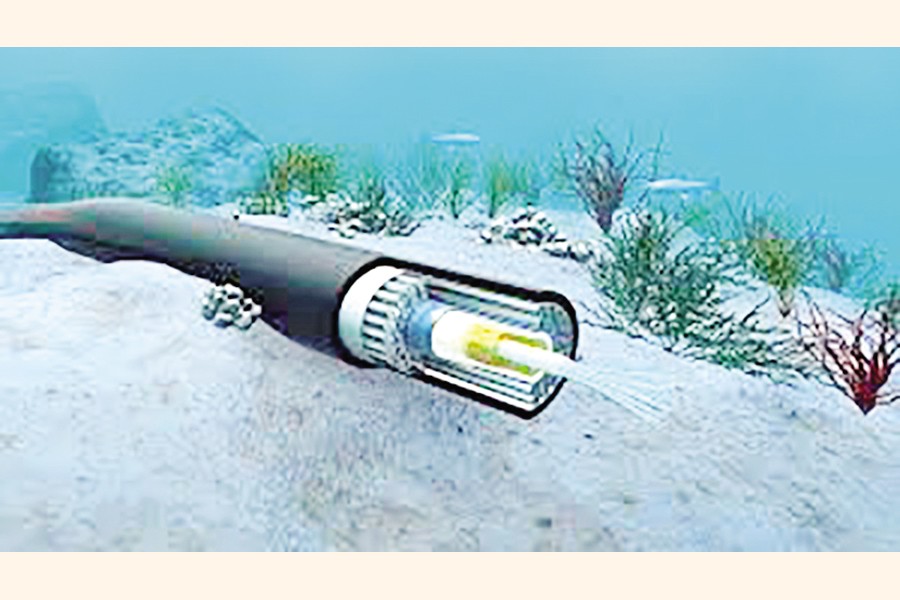
The government has approved a substantial cost escalation for Bangladesh's third submarine cable project, aiming to enhance the country's international telecommunication infrastructure.
Under the latest revision, the total cost of the project titled "Expansion of Bangladesh's International Telecommunication System through Installation of the Third Submarine Cable (Proposed 2nd Revised)" has been increased to Tk 12.85 billion, compared to the original allocation of Tk 6.93 billion. The first revision had earlier raised the cost to Tk 10.55 billion, reports UNB.
The project is being implemented by Bangladesh Submarine Cables PLC (BSCCL) under the Post and Telecommunication Division.
According to the second revision proposal, Tk 4.76 billion will be funded by the government while Tk 8.09 billion will come from BSCCL's own resources.
Along with the cost, the timeline of the project has also been extended.
Initially slated for completion between January 2021 and June 2024, the deadline was first extended to June 2025.The timeline has now been extended to June 2027.
The project will establish a submarine cable link from Singapore through Mumbai by sea, via Bahrain to Yanbu in Saudi Arabia by land, and from Yanbu to France via Egypt.
Bangladesh's branch will connect to the Cox's Bazar landing station through the Bay of Bengal.
According to the project paper, reasons behind the cost enhancement are extension of project timeline leading to higher salaries, allowances, foreign currency fluctuations and alternative routing through territorial waters.
So far, the project has achieved 73.81% financial progress, with expenditures reaching Tk 7.78 billion as of June 2024, while the physical implementation stands at 75%.
The Planning Commission noted that once completed, the third submarine cable will act as a backup for the country's first and second submarine cables (SEA-ME-WE-4 and SEA-ME-WE-5), ensuring uninterrupted internet and telecommunication services even during maintenance or outages.
The project is expected to increase the country's submarine cable capacity by at least 13.2 Tbps, supporting the growing demand for bandwidth and boosting the export potential of IT-enabled services such as call centres, data entry, and software development.
The Physical Infrastructure Division of the Planning Commission recommended the project for approval by the Executive Committee of the National Economic Council (ECNEC) following a Project Evaluation Committee (PEC) meeting held on May 25 and the ECNEC approved the project in its last meeting.
© 2026 - All Rights with The Financial Express

