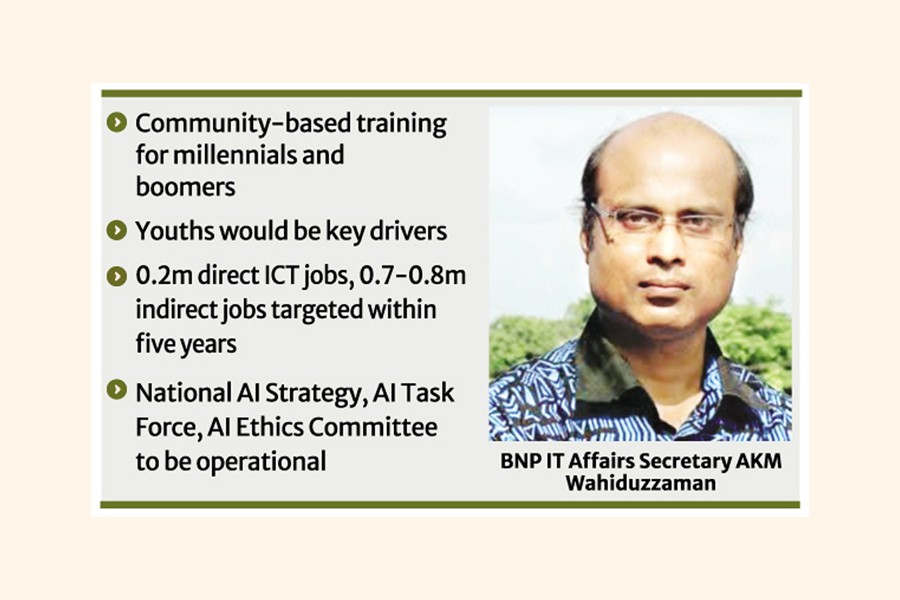
The Bangladesh Nationalist Party (BNP) has stepped up preparations for the upcoming parliamentary election and is shaping its election manifesto with a sharper focus on digital transformation and artificial intelligence.
In a recent interview with The Financial Express, the party's IT Affairs Secretary AKM Wahiduzzaman said BNP would prioritise tripartite partnerships among the public sector, private sector and universities to build AI research labs, data centres and innovation hubs if it forms the government after the 2026 polls.
He said AI is reshaping the global economy, "but Bangladesh is behind," adding that BNP wants to avoid hype and instead focus on foundational elements: data readiness, infrastructure readiness and practical applications. "That is how you build an AI-capable country sustainably," he noted.
On digital literacy, he said BNP will adopt a segmented approach. For young people, the priority will be exposure, structured skill-building through education and nationwide upskilling programmes. For older citizens and those unfamiliar with technology, BNP plans community-based inclusion initiatives using local digital centres and outreach platforms--not training for training's sake.
Addressing concerns that AI will replace jobs, he argued that AI should be seen as an enabler, not a competitor. Some repetitive tasks will be automated, he said, "but that is where productivity comes from. If we equip our workforce to use AI properly, they can move up the value chain."
BNP, he said, views AI as a "cross-cutting catalyst" and aims for practical deployments in education, agriculture, healthcare and public services, rather than slogans.
The party also plans to introduce a national AI skills framework with tiered training: basic awareness for the public, applied skills for professionals and advanced research for engineers and scientists. "We are not trying to make everybody an AI engineer," he said.
Education reform will begin with introducing AI and digital basics at the school level, followed by professional upgrading in high-demand areas and specialised research tracks at universities. He said universities will lead applied training and research, while a future ICT ministry will assist when needed.
To ensure inclusion, especially for technology-naive millennials and older generations, he emphasised the need for developing a Bangla Large Language Model (LLM) so that AI interfaces work in Bangla. "People should not be excluded because English is a barrier." However, he warned that building a Bangla LLM will be challenging and will require the mass digitisation of Bangla books, archives and knowledge sources.
On regulation, he said Bangladesh's current digital laws are flawed and were weaponised by the previous government. BNP's approach is to formulate a National AI Strategy, overseen by an AI Task Force, with clear ethical safeguards.
"The policy mandates an AI Ethics Committee to address privacy, bias and accountability, aligned with OECD and UNESCO principles but tailored to Bangladesh's reality," he said. BNP also plans to draft Bangladesh's first AI policy in consultation with civil rights groups, academics, domain specialists, the private sector, social-media platforms and political stakeholders.
Bangladesh's dependence on foreign AI tools is another concern. BNP's response begins with infrastructure: AI-ready data centres, specialised computing capacity (GPU/TPU-class), reliable data pipelines and low-latency cloud systems. Its "Bangladesh Reimagined: The Tech Decade" blueprint includes building the country's first AI-enabled Data Centre Campus.
Connectivity, he added, is a prerequisite. BNP plans to start reforms by offering free internet access where necessary, before ensuring nationwide affordable, high-quality internet services. For homegrown AI applications, BNP is targeting education and healthcare first-through AI-enabled connected schools, learning-management systems and electronic health-record platforms. "If we play it right, we can deliver the most impactful results in these sectors," he said.
On building an innovation ecosystem, he said BNP strongly favours public-private-academic partnerships, with government acting as an enabler rather than a grant-distributing patron. Sustainable ventures, shared responsibility and shared risk will be the model-whether for innovation hubs, data centres or research labs.
On employment, he said BNP is adopting a holistic view. In a converged global economy, "job creation cannot be measured in binaries like AI versus non-AI." BNP targets 2.0-5.0 per cent point GDP contribution in its first term from the digital push, 0.2 million direct ICT jobs, and an additional 0.7-0.8 million indirect jobs if the impact is fully realised. "Our objective is not noise--it is scale, sustainability and economic contribution," he said.
tonmoy.wardad@gmail.com
© 2026 - All Rights with The Financial Express

