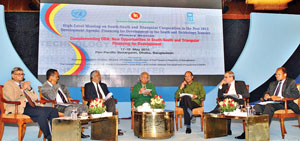
 Atiur Rahman, governor of the Bangladesh Bank, addresses a high-level meeting on \'Complementing ODA: new opportunities in South South and Triangular Financing for Development\' at a city hotel, held Monday. — Focus Bangla Photo
The South-South trade, bolstered by trade liberalisation, technological advancement, increased connectivity and dispersed production network, has recently surpassed the North-South flow.
Despite gains, speakers at a high-level meeting on "South-South and Triangular Cooperation in the Post 2015 Development Agenda" observed that benefit of South-South cooperation is not evenly distributed across the countries and sectors in the South.
To overcome the impediments, participants at a technical session on complementing ODA (Official Development Assistance) stressed the need for more cooperation among countries of the South, especially in the field of science and technology and developing public-private partnership in achieving the universally-designed sustainable development goals (SDGs) in post-2015 period.
They also pleaded for developing alternative sources of financing as Official Development Fund (ODA) from traditional donors has started declining. "ODA is not a panacea for all," said a participant from an East African country who sought strengthening of South-South cooperation.
PKSF Chairman Dr Qazi Kholiquzzaman, who moderated the session on complementing ODA, however, said that ODA is still essentially necessary especially for Least Developed Countries (LDCs) and Low Income Countries. "But we have to mobilise our own resources with more cooperation among countries of the South," said the PKSF Chairman.
"The South-South cooperation is highly essential for the region characterised by lack of good governance, political instability and conflicts with a huge displaced population," said State Minister for Finance MA Mannan while addressing the technical session on Monday.
He, however, expressed the hope that formation of BRICS Development Bank, by the BRICS states (Brazil, Russia, India, China and South Africa) and the Asian Infrastructure Investment Bank (AIIB) by China will open up a new horizon for the region.
The banks, according to speakers, an alternative to the existing US-dominated World Bank and International Monetary Fund, will foster greater financial and development cooperation among the countries of the South.
Bangladesh Bank Governor Dr Atiur Rahman also warned against illicit outflows of money from developing economies in the South to the North.
Effective plugging of illicit outflow is also important for augmenting investment resources, he added.
He called for building up and strengthening South-South cooperation among Financial Intelligence Units, anti-corruption, tax and revenue authorities to stop illicit outflows through trade mis-invoicing, transfer pricing and various other means.
Held at the Pan Pacific Sonargaon Hotel, the session was addressed among others by Ethiopia's State Minister for Finance and Economic Development Ahmed Shide, UNDP Resident Representative in Turkey Kamal Malhotra, Guyana's permanent representative to the United Nations George W. Talbot and Lebanon's permanent Representative to the UN Nawaf Salam.
Public-private partnerships (PPP) and South-South cooperation (SSC) were the focus of another technical session on Alternative Models of Financing for Development. Speakers at the session mainly discussed the issues of alternative sources of financing for development.
Four panelists Rubana Huq, Managing Director of Mohammadi Group, Capt JM Pathania, Director of Urban Development, Himachal of India, Ahmet Alper Age, DG, Turkey Social Sectors and Coordination Ministry of Development and Ruksana Pervin Sweety and President of Community Housing Development Fund, Sirajganj narrated their experiences.
Speakers at the session stressed the need for low-cost housing financing under PPP for the poor urban slum-dwellers.
Ms Haque said that her company is building a housing project for garment workers at Gazipur with only 2.0 per cent interest from the central bank. "Workers are good paymasters. If you give them the feeling of ownership they are ready to pay," she said adding that more such initiatives should be taken.
The experts discussed issues of using private financing for service delivery, public funding participation in development projects and community financing and mobilisation and motivation of people in these projects.
Summing up the discussion, Public-Private Partnership Office Chief Executive Officer (CEO) Syed Afsor H. Uddin noted that around US$ 1.0 trillion is needed every year for infrastructure development in developing countries.
"An additional US$ 200-300 billion are required annually to make it environment friendly," he added.
For big projects, he said, PPP is better. He stressed the need for making projects more sustainable and environmentally viable.
Planning Commission member Arastoo Khan, who chaired the session on Alternative Models of Financing for Development: Strengthening Public, Private and Community Partnership" also highlighted the urgency for undertaking more housing projects for rural as well as urban poor under the PPP as he said, ODA may not be available now-a-days to support such projects. Senior fellow of the Institute of Strategic and International Studies HK Yong moderated the session.
mzrbd@yahoo.com
© 2026 - All Rights with The Financial Express

