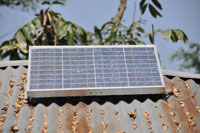
Implementation of the billion-dollar solar energy programme faced a setback for lack of coordination among the entities involved in electrification programme and 'wrong strategy' of the financing agency, raising the number of defaulters in monthly installment payments by beneficiaries, reports UNB.
Overlapping of conventional and non-conventional energy programmes in the same areas while the gradual increase in loan interest rate were said to have stood in the way of the solar power campaign.
According to the industry insiders, these two issues are pushing the private sector partner organisations (POs) towards a disastrous situation for which many are now feeling 'discouraged' to continue their investment. Some of them are now directing their field staff to refrain from expanding the programme to new areas.
Official sources said the government has set a target to increase the solar-based power production to 500MW by 2015. Under the government's Vision 2021 programme, the government also targetted to raise the renewable energy's share to 5 per cent by 2015 and 10 per cent by 2020.
Under this target, the state-owned the Infrastructure Development Company Limited (IDCOL) has taken up a new programme to install 3 million more solar home systems (SHSs) across the country in addition to its existing 3 million ones. But now duplication has shattered their future investment plan and about the existing programme, they said.
Reports have it that Rural Electrification Board (REB) is expanding its electrification programme with conventional power supply system in those areas where the IDCOL has already installed SHS. As a result, the private organisations which are the IDCOL's partner organisations are facing big trouble.
Under the IDCOL-financed programme up to 30 watt-peak solar system, a consumer has to pay 15 per cent of the total cost as down payment while the rest 85 per cent comes from the credit. Of this 85 per cent credit, the IDCOL provides 60 per cent as loan (which is 51 per cent of the total cost) while system seller PO provides rest 40 per cent as equity (which is 34 per cent of the total cost). The consumer pays back the credit within maximum 36 months through instalment.
In many areas, where the IDCOL has implemented solar home system programme, now REB or other utilities are expanding their grid-based conventional power supply system overlapping the existing SHS. As a result, the consumers are uninstalling the SHS and receiving the conventional power connections.
The free distribution of solar home system under Kabikha or other social safety net programmes has been making the situation worse, creating a perception that solar power is a free product.
"When we launched SHS programme, we had to count only 6 per cent interest in receiving IDCOL fund, but now we have to pay 9 per cent. This is pushing us to a dangerous point," said a top official of PO of the lending agency.
At present, about 10-12 large POs are working in the SHS programme under IDCOL-sponsored financing. These include Grameen Shaki, Rural Services Foundation, and Solarian.
"We've submitted the lists of our areas in detail with clients' particulars, where REB is overlapping with grid line on IDCOL's SHS programme, but no action is seen," said another official.
Contacted, IDCOL chief financial officer and head of operation Monirul Islam admitted that the POs are experiencing some adverse situation due to duplication and free distribution of solar system by different government and private organisation.
Chairman of Sustainable and Renewable Energy Development Authority of Bangladesh (SREDA) Tapos Kumar Roy told the news agency that no such matter of duplication came to his knowledge but said he has learned about the free distribution of solar under Kabikha and other government programmes.
"As soon as we came to know about it we proposed the Ministry of Disaster Management and Relief to accommodate their solar distribution programme under IDCOL umbrella for better coordination," he said.
© 2026 - All Rights with The Financial Express

