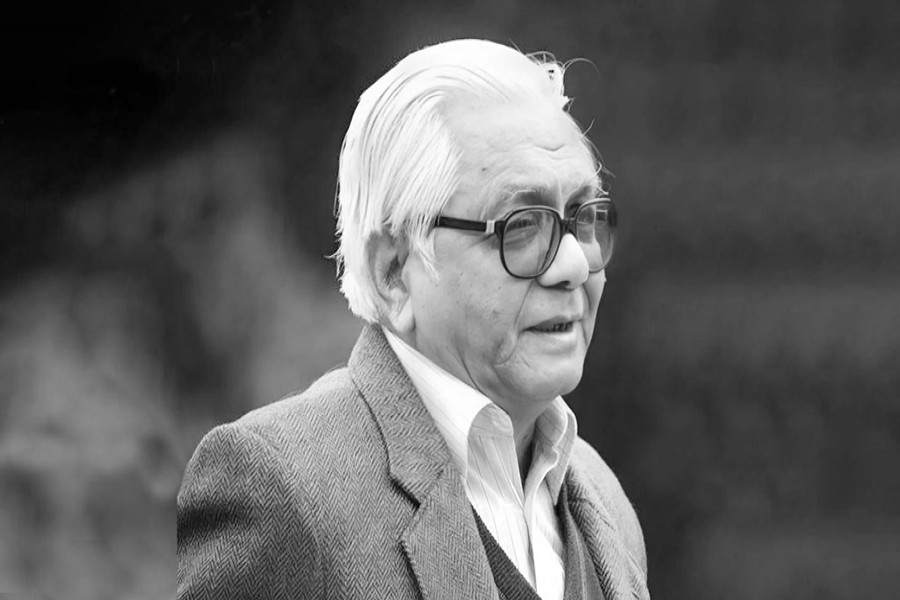
 Badruddin Umar (1931-2025)
 The 2025 demise of Badruddin Umar is not simply the loss of an individual, but the muting of a conscience. For over half a century, Umar was a relentless critic of power — state, capital, and ideology. As a thinker, writer, and public intellectual, his work cut through the cloud cover of official versions, never giving in to compulsions of opportunism or accommodation. When too many settled into convenient complacency at the cost of truth, Umar stood on principles — unbending in his criticality, unwavering in his inquiry, and unbending in his quest for justice.
This is a history of Badruddin Umar’s work and life — the early ferment in the language movement, his first work in political theory on the left, class-conscious historiography, and anti-authoritarianism in all hues. This is a tribute, yes, but it is a study as well as a reflection on why the work and the spirit of Umar are still relevant in the current period — when truth is threatened afresh, and space for critical dissent is reduced by the day.
Early influences and the life that created a Marxist: Born in 1931 in the Bengal Presidency within British India, Badruddin Umar was brought up in a family with a public service and learning tradition. His father, Abul Hashim, was a prominent intellectual in the Muslim League and Pakistan movement. However, while many contemporaries strayed from the paths of inherited political identity early in life, Umar’s own did so early in his own lifespan. Having been a Presidency College, Kolkata, and later Oxford University student, Umar was familiar with a broad array of intellectual currents — from European Marxism through anti-colonial nationalism.
His early disillusion with the post-partition course of Pakistan, most prominently the Bengali-speaking and identity deprivation in East Pakistan, provided the background for his future work in progressive politics. The awakening was in the 1950s and early 1960s as he became educated among left intellectuals and activists, and also became open to Marxism as a theoretical tradition, but most profoundly as a prism through which to perceive the structural unfairness that was present in postcolonial South Asia.
Unveiling class, power, and state formation through scholarship and works: Badruddin Umar published during a career spanning more than forty years and authored some of the most original work on Bangladeshi social and political theory. His masterpiece, Samajik Biplob O Bangladesher Rajniti (Social Revolution and the Politics of Bangladesh), is a seminal work that chronicles the class conflicts and contradictions animating the birth of nationalism and state formation in Bangladesh. In it, Umar delivers a scathing critique of the bourgeois nationalist ruling elite who, in his opinion, hijacked the liberation movement in their own interests.
Equally noteworthy is his three-part history, Language Movement in East Pakistan, which remains, by now, one of the most authoritative and well-documented histories of the Bengali Language Movement, 1948–1952. Umar places the movement in larger frames of cultural hegemony, political disenfranchisement, and linguistic nationalism. Unlike state-sponsored accounts that focus on the entry into a question of identity, Umar places its class and ideological nature first and foremost. He demonstrates how the movement was as much a field of contestation being played out among the subaltern masses and the ruling class.
His other books, among which are Muktijuddher Artha-Naitik Itihas (The Political Economy of the Liberation War) and Bangladesher Samajik Shongkot (The Social Crisis of Bangladesh), deal with post-independence state contradictions, the accumulation of class power, and left failings.
Activism: From the language movement to the people’s struggles: Even though he was globally revered for his intellectual contribution, Badruddin Umar was in no way an armchair intellectual. He was fully involved in the political activism of present-day Bangladesh. He was directly involved in the students’ and workers’ agitation in the 1960s against the military regime of Ayub Khan. The participation in the movement over the language and in anti-imperial uprisings were the pillars on which he envisaged a socialist Bangladesh.
Following the 1971 liberation, Umar was a foremost critical voice among the freshly emerged elite class that took control of the polity following the liberation war. Be it Sheikh Mujibur Rahman’s dictatorial one-party regime, General Ziaur Rahman’s militarization of politics, or the later authoritarian turns, never did Umar remain silent. His refusal to associate himself with all the major political parties kept him out of the elite clubs but also protected his legitimacy among grassroots activists, trade union activists, and left intellectuals. He wrote and campaigned through the 1980s and 1990s, notably through the Sramik-Krishok Shongram Parishad (Workers and Peasants’ Struggle Council), calling for structural change, agrarian reform, and workers’ rights.
Legacy: The pursuit of a remembered self: That Badruddin Umar’s book remains up-to-date today, transcending its historical critique to its present political consciousness. In a world in which intellectuals in South Asia are regularly co-opted by the state, NGOs, or business think tanks, Umar was never co-opted. His critique of capitalism, authoritarianism, and homogenisation of culture previewed many of South Asia’s problems today — whether it is the compression of democratic space, religious nationalism, or commodification of education.
The history of Umar testifies to the fact that ideas do count, theory must be in the service of practice, and intellectuals ought to speak truth to power. His work remains popular among students, activists, and scholars in large numbers as it contains a radical alternative both against and outside the existing neoliberal orthodoxy.
In the opinion of the late Professor Anisuzzaman, “Badruddin Umar is one of the very few who chose conscience over comfort, and principle over popularity.”
Carrying the torch forward: Badruddin Umar’s death is barely the last page in the life of a brilliant thinker — it is a call to the rest of us, left, who still believe, who still resist. Even as he can no longer walk among us, his words will continue to ignite our collective resistance, resonating with conviction and defiance. In a world in which the machinery of power becomes increasingly malevolent — where truth gets warped, dissent stifled, and memory erased—Umar’s life remains a badge of resistance and integrity.
To mourn Badruddin Umar is to acknowledge the magnitude of all we’ve lost: a courageous mind, a voice uncompromised, and a spirit that could never be domesticated. But to remember him well is to take on the challenge that he has left us. There was no radicalism from the armchair, but a lived commitment to justice —a willingness to resist empire, elitism, and authoritarianism in all their guises.
We have now to adopt his cause — not lightly, but with a sense of emergency. Read him as a man out of the past, but as a product and mirror of our time, and a harbinger and guide to the future. Let his bravery embolden ours, his discerning spirit sharpen our judgment, and his gentleness temper our radicalism.
As Badruddin Umar once wrote, “Revolution is not a moment; it is a lifetime of principled resistance.” May we follow that path with equal indomitable moral sense —with unbowed heads, unbroken voices, and unwavering hearts.
Dr. Serajul I. Bhuiyan, Professor at Savannah State University,
contributes regularly to U.S. and South Asian news outlets.
Contact at sibhuiyan@yahoo.com.
© 2026 - All Rights with The Financial Express

