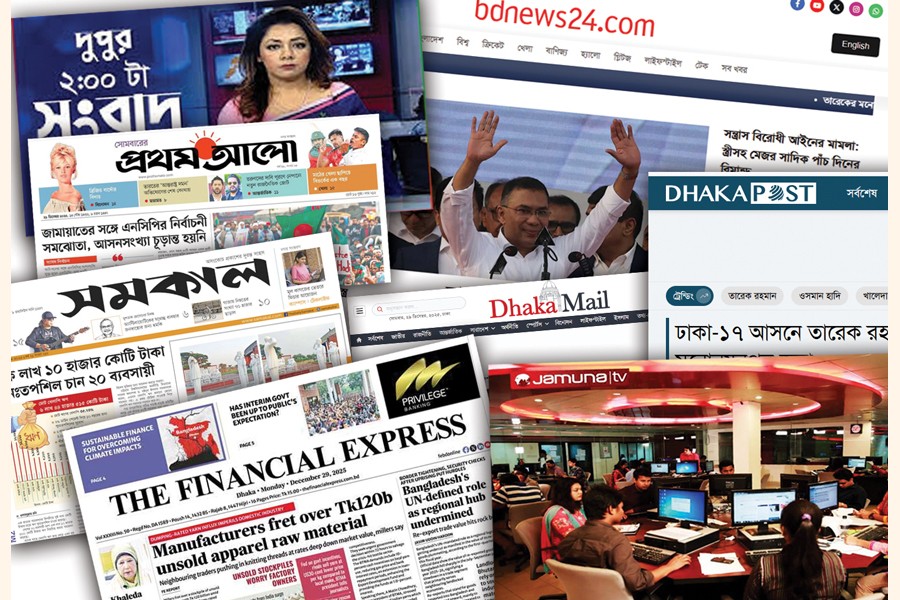
The print media in Bangladesh is going through one of the most critical periods in its history. Advertisements shrinking in number, production costs rising, and readership dwindling have pushed newspapers, especially ones that carry serious and public interest-based content, to the point of extinction. Nevertheless, this is not a problem of a shrinking industry but a problem of democracy in decline. When newspapers suffer, the public realm declines.
This crisis has manifested itself despite the fact that the Media Reform Commission formed by the Interim Government has already made a comprehensive diagnosis of the problem and has already indicated appropriate cures. Unfortunately, however, these have yet to be implemented. Thus, a historic opportunity for a democratic renewal might become a missed chapter one for future generations to judge.
It is at such a crossroads that Bangladesh currently finds itself at this critical juncture. Indeed, the 36th Revolution that came about in July went further than the collapse of an authoritarian government, and it was nothing short of the awakening of a nation's collective conscience that demanded justice, transparency, and their rights and dignity. It was at this point of transition that faith rested with Nobel Peace Prize Laureate Muhammad Yunus, whose leadership stands out for its ethics and integrity, thereby signifying much change from the past. A transformed and viable media is needed for its sustenance.
The Interim Government is pressed into taking strong action on the one hand towards ensuring its place in history as a democracy and on the other towards saving the newspaper industry from the point of no return. The government needs to implement at least two economic steps before the reform can succeed.
First, government advertisement rates must be increased notably, as already recommended and approved in principle by the Media Reform Commission. Advertising is the lifeblood of newspapers. Without a fair and current rate structure that reflects today's economic reality, even the most reputable news organisation will not be able to survive.
Second, there should be focused and distinct policy support for English-language newspapers. Such papers are of utmost importance in projecting Bangladesh to the international community. Having to operate in a smaller market and facing greater threats to freedom, these papers should receive special support to remain alive and independent.
Media reforms must not be restricted to mere documentation and speeches. Failure to implement recommendations diminishes their relevance, leaving visionary suggestions empty and hollow. Bangladesh newspapers and the democratic system they preserve must survive and thrive as a result of immediate action and not because of a wait-and-watch attitude.
MEDIA REFORM AS A DEMOCRACY IMPERATIVE: Indeed, Bangladesh is again faced with lessons drawn from the shadows of the past, but is looking forward to a bright future. The July 36 Revolution was not only the retreat of autocracy but also the resurgence of a new vision of democracy that was founded on justice, dignity, and integrity. It was at this crossroads that the people of this nation entrusted their destiny to Dr. Yunus, who brings to the leadership a paradigm shift in governance grounded in ethics and international respect.
Having an ethical media sector rebuilt is at the heart of all of this. For so long, the media has been warped by censorship, propaganda, and politics. Fixing the media is not some sideshow aspect of rebuilding a democracy.
It is a function much more extensive than that of a mere disseminator of information. The media is the conscience of democracy, a watchdog of society, a voice for the marginalized. Without fearless, independent, and diverse media, the democratic ideals born of July 36 could well become shallow.
Here are six reform steps that needs to be undertaken immediately to ensure democratic media and to solidify the legacy of Prof. Yunus.
TRANSPARENCY IN MEDIA LICENSING AND OPERATIONS:
A moratorium should be called pending a forensic audit of existing licenses before new licenses are issued. This is not to hold up progress, but to eliminate the graft before moving forward.
At the same time, an Independent Media Regulatory Authority (IMRA) must be established through legislation. This entity needs to be shielded from any kind of pressure from the political class, corporations, and the bureaucracy.
Licenses granted on the basis of corruption, political influence, fraud, or deliberate misinformation should be rescinded. Their presence creates an environment of impunity and distrust.
Ownership transparency represents a core value of ethical journalism. News media reform constitutes a new beginning, a departure from the manipulation of media for political purposes, and a reaffirmation of media spectrum ownership rights belonging to the people, rather than politicians.
FAIR ACCESS AND MEDIA PLURALISM: Obligatory reporting on ownership, funding sources, and advertising relationships should be strictly enforced across all media platforms. Anti-monopoly laws should prevent the concentration of media ownership across multiple platforms and the use of shell corporations created specifically to circumvent media ownership laws.
At the same time, institutional support for regional, indigenous, and ethnic media is equally important. There is too much of a Dhaka perspective in the media narrative of Bangladesh. Awards and funding should begin to recognise community media in various languages, given the nation's diverse nature.
Media pluralism is necessary in order for democracy to speak with multiple voices, not merely those of the elite.
PROTECTING JOURNALISTS AND MEDIA WORKERS: Even after the political transition, intimidation, violence, and judicial harassment continue to affect journalists in Bangladesh. Shielding them is both a moral and democratic responsibility.
A Journalists' Protection Act must therefore be passed to ensure protection for sources and whistleblowers, and to grant immunity for public-interest journalism. Journalism must be recognized as a protected activity under a democratic order, not a form of dissent.
There should be a rapid-response legal unit that probes threats and attacks against journalists, composed of legal professionals, forensic analysts, and human rights professionals.
The Journalists' Emergency & Welfare Fund should include provisions for legal aid, counseling, rehabilitation, and financial support.
The protection of media personnel is equivalent to the protection of democracy.
DIGITAL INCLUSION & COMMUNITY MEDIA EMPOWERMENT: The community radio needs to be developed and equipped, especially in rural areas. Community radios remain important platforms that convey people's sentiments.
The national digital literacy campaign will ensure that women, young people, and marginalised social groups have key media literacy skills. Media literacy should be incorporated into education and rural learning centers.
The Women and Youth Media Empowerment Fund shall fund community media, indigenous-language journalism, mobile journalism, and web start-ups.
Democracy cannot flourish if millions of people are excluded in the digital era. Inclusivity guarantees every citizen gets a chance to have their say in the national conversation.
REJUVENATING STATE-OWNED MEDIA AS PUBLIC SERVICE BROADCASTERS: The government-controlled media have traditionally served as propaganda tools. Turning such media into public service broadcasters would certainly be one of the most visible accomplishments for the Interim Government on its path towards democracy.
Bangladesh Television (BTV), Bangladesh Betar, and BSS should instead be managed by a separate Public Broadcasting Trust that has an independent board.
An enforceable National Public Broadcasting Charter needs to include provisions for editorial independence, neutrality, cultural diversity, and accountability.
Content reform should promote collaboration among these and other organisations, such as universities, NGOs, youth organisations, and independent producers, in areas including education, health, the environment, women's rights, and indigenous culture.
A reputable public service broadcast is an indicator of a society's political maturity and helps to bring national media back to truth and honor.
ENSURING IMPLEMENTATION THROUGH INDEPENDENT OVERSIGHT: Reforms won't work if they aren't implemented or derailed by bureaucrats and the forces of the old system.
Implementation needs to be monitored by a high-level task force reporting directly to the Chief Adviser. Red tape needs to be prevented.
These should be available in public domains through quarterly progress reports either from or from the local authorities.
Oversight helps ensure that the reforms that are brought about are transformative, not symbolic.
Conclusion: These six pillars of reform are more than just recommendations for protecting journalists and democratising access to information. They represent a call to action that would transform the country into a truly viable democracy.
History will show whether this opportunity was seized or lost. If these plans bear fruit, Muhammad Yunus's name will be remembered as the leader who freed the media from fear and turned it once again into a servant of society.
The voice of history beckons. Bangladesh must respond.
Dr Serajul I Bhuiyan is a Professor of Journalism and Mass Communications at Savannah State University, Georgia, USA. sibhuiyan@yahoo.com
© 2026 - All Rights with The Financial Express

