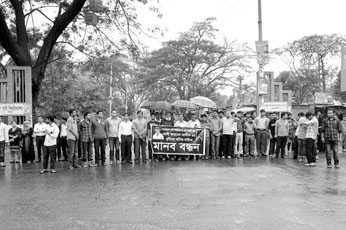
 A student of the Sher-e-Bangla Agricultural University was killed by a speeding bus on March 03, 2015. Teachers and students of the university formed a human chain next day demanding punishment of the culprits.
Transport accidents in Bangladesh have assumed a dangerous shape. It will not be an exaggeration to say that Bangladesh has become a failed state as far as the transport discipline is concerned. Hardly a day passes, when at least a dozen people do not die in transport accidents. So, the present horrible situation, caused by transport accidents, reminds us of Golgotha-- the common name of the spot where Jesus was crucified. Another tragedy is that the accidents in Bangladesh are not confined to a particular sector only. The situation is grave on rail routes, roads and waterways. Of late, the air routes also have lost the immunity with two accidents occurring in quick succession. There has been tremendous expansion of road networks after the Independence. In 1972 the motor roads measured 4,175 km. The figure rose to 21,454 km in 2014. This includes national highways as well as regional and feeder roads. Obviously, this attracted huge private investments in the road transport sector. Since simultaneously there has been a decline in the railway sector both in terms of carrying passengers and goods. For, no government after 1975 took any interest in the railway sector. Rather the representatives of the road transport sector in the cabinet surreptitiously worked against the railway. The railway ministry was abolished and made surrogate to the communication ministry. This apathy continued until 2011, when Prime Minister Sheikh Hasina created a separate ministry for the railway sector. However, it is yet to gain momentum.
As there has been a sharp rise in road mileage, there has been a sharp increase in the number of vehicles of all types. So, it is likely to cause more road accidents, but a serious look into the matter will indicate some deeper causes. A few days back on the Barisal-Faridpur highway a bus accident cost 25 lives and left a large number of people injured. They are groaning on hospital beds. The vehicle dashed into a roadside tree. All the survivor passengers of the ill-fated bus spoke in one voice that the driver was driving at a very abnormally high speed. Before that, another bus accident occurred on the Tangail highway and five people died and many were injured. The bus hit a loaded truck which was standing beside the road. Another bus accident caused death to about 12 passengers on the Jessore-Benapole road. The driver fell asleep and so lost control of the vehicle. It indicates that the driver was either overworked or intoxicated. A few years back more than 40 primary students lost their lives in an accident on the Feni highway. It was reported that the driver was talking over mobile phone. In all these cases the accidents was caused either by human negligence or irresponsibility, not any mechanical failure.
Before issuance of any driving licence no serious test is held to ascertain the skill, and/or the mental alertness, of the driver. The licence is issued in a different way. Even the licence holder is not required to go to the BRTA office. Lack of good governance in the BRTA office is highly and solely responsible for the chaotic situation in the road transport sector. Probably two years ago a pedestrian was sandwiched between two buses in the capital as they were vying with each other for moving ahead. In December 2014 renowned journalist Jaglul Ahmed Chowdhury was thrown away from a moving bus by the conductor while he was requesting to get down at Karwanbazar. Most of the road transport workers are unruly as they enjoy impunity which is provided to them by a group of politicians masquerading as transport labour leaders. So, discipline cannot be restored in the sector without goodwill and cooperation from the concerned politicians.
In the river transport sector the situation is worse. Cargo vessels have been continually torpedoing trawlers carrying passengers. As a result, it has been the daily phenomenon that a trawler hit by cargo vessel will sink and a number of people will die to rest in their watery grave. Though a licence is required to run a cargo vessel, yet there is none to enforce this vital rule. So, the cargo vessel owners enjoy free ride. The shipping ministry does not take any measure for preventing launch accidents. It appears that the Ministry of Shipping is in a state of torpor. The government machinery is seen to be quick in responding to one thing. As soon as an accident occurs, the government officials will rush there, have a photo session and then declare compensation amounting to Tk 10,000 for every death. It is a sheer mockery. Payment cannot be less than Tk 100,000 for every death and Tk 50,000 for every person injured, let alone the free medical treatment. As the tradition goes, as soon as an accident occurs the government forms an inquiry committee that is directed to submit a report within a specified period, but the report does not see the light of the day. The railway department which suffered deprivation for more than three decades is yet to reach the stage it saw during the pre-Liberation period. Most of the train engines are in a dilapidated condition and they break down at any stage of running on a route.
Recently a very interesting thing happened. This scribe is not sure about whether it will enter the Guinness Book of World Records or not. A train ran 25km backward without a driver. This is a unique example of irresponsibility and callousness. A large number of railway gates remain unguarded and open. This results in a fatal collision between a road transport and a train.
The administration of the railway department is taken care of by a senior civil bureaucrat having no experience in the concerned discipline. Moreover, a large number of posts have been lying vacant for long. So, the department is understaffed. In the budget speech for the fiscal year 2014-2015 it has been mentioned that the railway department will be converted into a corporate one. The current fiscal is at its fag end. But yet no step has been taken. We hope the budget for the next fiscal will mention something more positive about it. The accidents in the railway sector can be easily reduced with improvement of the railway administration.
The problem of road and waterway accidents is gargantuan one. Roads and Bridges Minister Obaidul Quader has very rightly said any widening of a road will not be enough to reduce road congestions and address other issues like road accidents.
It requires the attention and sincere efforts from all concerned. First of all, both BRTA and Marine Department will have to enforce the ground rules without any fear and favour. It is true that they are to respond to the ugly and illegal pressure from the politicians. As the road accident syndrome has reached a dangerous level, politicians need conscientious awakening that can help heal the malaise and they should rather cooperate in getting things back to the normal. Road transport owners have also important roles to play. The road transport sector is highly paying off and that has made some of then extremely greedy. There should be an end to this greed. Transport owners should now opt for services to the humanity, instead of madly running after money. They should see that the drivers are not overworked and behave properly. The government officials, transport owners and concerned NGOs should arrange for making transport workers and the people aware and responsible. Trade union leaders should also exclusively sit with the transport workers to gauge the level of their sense of responsibility.
rezaulparvaz@live.com
© 2026 - All Rights with The Financial Express

