Asif Reza Akash and Farzana Afrin | October 03, 2014 00:00:00
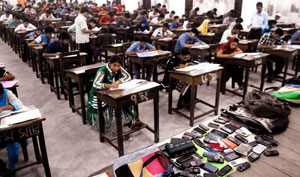 Students appearing in the admission test at the Dhaka University on September 26.
 Following the overwhelming success of students in terms of pass rates and higher grades in the Higher Secondary Certificate (HSC) examination, admission tests in the public universities have become the instruments for measuring their merit. Since the public universities are autonomous, they hold the right to set question papers on their own and judge the students about their standards in specific subjects.
Empirically, there is a huge difference in the curriculum of HSC and the university admission tests. After the HSC examination, unlike the recent one, students get around 6 months time for preparing themselves for admission tests. This is like a 'merit-war', albeit a tough one, as students have to cover difficult and diversified topics that are often beyond the HSC syllabus. But definitely, this preparation time adds value to the candidates. However, seats in the public universities are limited and they cannot accommodate all the students who score even the highest grade in the HSC exam. The worrisome matter is that most of the students with the highest grade in HSC cannot even qualify in the admission tests. This obviously raises questions about the quality of our higher secondary education.
Improvement in the quality of our education is slow. The problem is our mind set and our ethical practices as a nation. We seek success at any cost, even if we do not deserve that. It results in higher pass rates, happy students, happy parents and indeed happy government. Due to this mindset, giving away money to the coaching centres seems to many as the best option, and hacking questions is the second best one. Let us go back a little. It has transpired that some 'creative questions' in the last HSC exams were really difficult. Yet the Grade Point Average (GPA) in such subjects went up. An analysis of the Dhaka Board results showed that scores in English, physics, chemistry and mathematics contributed to the surge in pass rate this year. Leaked questions are perhaps the reason for such a paradox. Our existing education infrastructure, through these incidents, teaches us that knowledge is altogether unimportant; cues are given that one can achieve success among his peers if he can only do the right thing at the right time, regardless of sincerity and quality. This mindset is there and we all know about it. Did our education system ever address this decaying syndrome?
It is alleged that the government sometimes manipulate the public exams in favour of higher passing rates to demonstrate its accomplishment in the education sector at home and abroad. If it is so, then the purpose has not been achieved this time as criticisms of all hues are galore following the Dhaka University admission test debacle. Many newspapers reported about leaked questions but the education minister continuously denied those and obviously no actions have been taken so far. Reportedly, in 2014, the questions of Primary School Certificate (PSC), Junior School Certificate (JSC), Secondary School Certificate (SSC) and Higher Secondary Certificate (HSC) exams have been leaked through Facebook and other sources. Faced with the situation, the authorities were compelled to reschedule the date of a HSC exam.
In 2014, the pass percentage in the SSC and equivalent exams was 91.34, with 1,42,276 securing GPA-5. The pass percentage in the HSC and equivalent exams was 78.33 and 70,602 got GPA-5. According to a report published in a local English daily, this year, 21.50 per cent students passed the Ka-unit (Science) admission test of the DU. It was 39.45 per cent in 2013, 31.88 in 2012, 41.01 in 2011, 45.04 in 2010 and 46.20 per cent in 2009. The steady decline should be noted. Only 16,840 out of 61,155 passed in the Ka-unit admission test. A total of 1,640 will get admission to different departments of the Ka-unit. In the Kha-unit (Arts), 90 per cent students failed, with the pass rate being 9.55 per cent; in the GA-unit (Business Studies), only 20.61 per cent managed to pass the admission test. Talking to newsman, Emeritus Professor Serajul Islam Chowdhury of the English Department, DU, said those appearing for the SSC and HSC exams are faring well and getting Golden GPA and GPA-5, but they lack the quality required for higher studies. Absence of quality classroom teaching, according to him, is primarily responsible for this, and as result, students are more inclined to attending coaching centres to acquire the tricks for obtaining higher grades, and besides, the answer papers are evaluated liberally. In fact, our classrooms hardly provide the students any scope for interactive learning.
The government has the highest spending on the educational sector, but the growth of education sector, which in simpler terms means more books and more institutions, often does not guarantee a corresponding outcome in quality achievement. This has policy implications to attract research and studies. Economics theory says, in a developing country of rising per capita, inequality also rises. Hence, more money spent on coaching centres has become apparent among the wealthy class. Reportedly, coaching business in Bangladesh fetches a fortune of Tk 320 billion annually.
So, who is to blame for this failure? Have we overrated our students? Or, are we fostering a faulty education system? Definitely, the government is the guardian of the country's education system. So, if there are any internal problems, a thorough analysis of the situation should be made towards finding remedies. Otherwise, the damage will be so high that the entire nation will suffer in the long run.
The writers are pursuing MBA at the University of Dhaka.
asifreza@live.com, mou871@live.com
© 2026 - All Rights with The Financial Express

