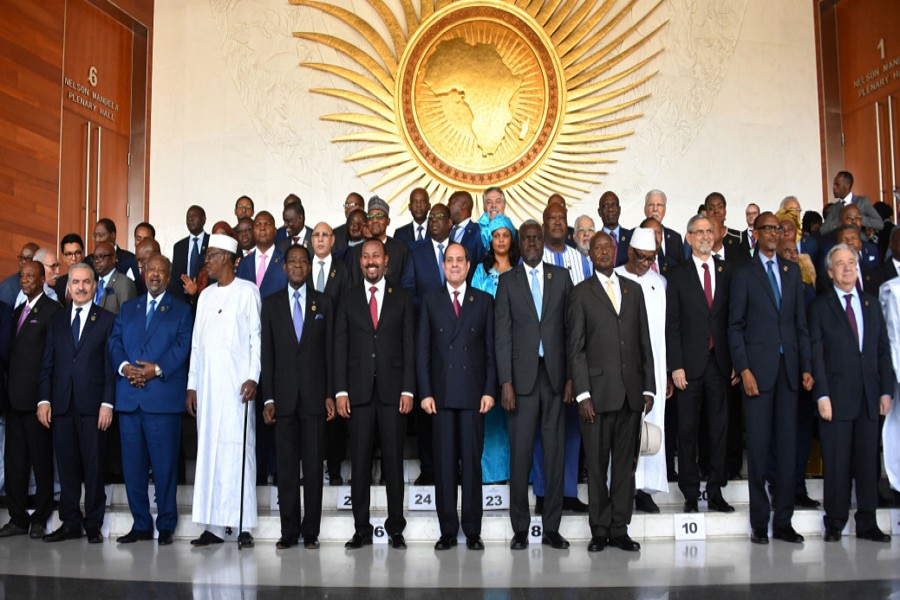
 As hostilities between Iran and Israel intensify, African countries issue a range of responses —Photo: Collected
 Analysts in South Asia including Bangladesh need to carefully ascertain how African institutions are trying to overcome the terrible difficulties being created because of the Mid East war imbroglio.
This includes a careful analysis by Claver Gatete, the Under-Secretary-General and Executive Secretary of the UN Economic Commission for Africa. In this context, Gatete has underlined that "the choice is clear; the window is narrow; and the time to prepare Africa's workforce for the frontier economy is now". Such an approach has also observed that time has come for Africa to be "transformative". In this regard it has been suggested that for "genuine gains in productivity and innovation" labour needs to move out of subsistence agriculture into higher-productivity manufacturing and modern services. This is indeed an good-natured suggestion with important dimensions for South Asia to carefully analyze and follow for the nearly two billion people that inhabit this area.
The recently concluded Africa Business Forum convened in Addis Ababa has left a clear message. It has been underlined that if Africa is to create the tens of millions of quality jobs its young people need in the coming decade, it must "move decisively from input driven growth and embrace an innovation-led growth powered by data and frontier technologies". Analysts in Africa and also some in South Asia and South East Asia feel that the only plausible course to flexible, inclusive and sustainable development amidst climate shocks, tightening financing conditions and geopolitical challenges need rapid technological change.
In this regard Claver Gatete has observed that "frontier technologies, from artificial intelligence and advanced data analytics to clean energy solutions are already reshaping value chains in agriculture, manufacturing, services and public administration". This is assisting in transformation.
In this regard, socio-economists in most of Africa, India, Bangladesh, Malaysia and Singapore feel that there is absolute need for overcoming the growing skills challenge. This is so, because enrolment in technical and vocational education remains low; and tertiary enrolment lags far behind global averages. Such a scenario has consequently pointed out that countries need comprehensive national skills, foundational learning and digital literacy to be part of their economic strategy. It has also been suggested that data literacy, large-scale teacher upgrading and robust partnerships between Universities are a must for ensuring movement forward with required training to meet the growing demand of the labour market.
Over the past few weeks we have observed similar aspirations in Bangladesh.
In this regard Claver Gatete has drawn attention to some African countries who have been taking important steps in this regard. In Kenya for example, the digital innovation ecosystem - from mobile money to platform-based logistics and e-commerce - is creating new jobs in fintech, digital marketing, data services and platform management that barely existed a decade ago. Rwanda has also positioned itself as an African test bed for emerging technologies, investing heavily in broadband, digital public services and coding academies to build a workforce ready for data driven and AI enabled jobs. In Egypt, Morocco, and South Africa, apparently, automotive and renewable energy value chains are spawning new roles in advanced manufacturing, battery technology and solar and wind engineering.
These are excellent examples for us in Bangladesh. It clearly shows that when countries bring into line education, industrial policy, and digital strategy, they can start to bend their labour markets towards the industries of the future.
However, African socio-economists have also noted that skills alone will not deliver the jobs dividend. Workers will also need productive firms to hire them, and firms need an enabling ecosystem to innovate. In particular, in agriculture, the jobs of the future will be in climate smart farming, Agri data services, precision input distribution and digital extension. However, in Bangladesh, we also need to understand that taking advantage of such potential will require investment in irrigation, rural broadband, data platforms, and support for agritech start ups that can tailor frontier tools.
In this regard it would obviously be useful if within the paradigm of manufacturing; governments use industrial parks and special economic zones to attract firms deploying automation, smart logistics and advanced materials, while negotiating technology transfer and local supplier development that expand skilled employment.
We must all understand that construction a data economy that creates jobs means investing in data centres, cloud infrastructure, high performance computing and secure connectivity, while developing clear rules on data governance, privacy, cross border flows and competition. It also means that measures must be taken to equip young people with the skills to work as data engineers, analysts, ethicists and product managers. Such a scenario has been successful in Japan, Republic of Korea and Canada where data is treated as a strategic economic asset.
African economists also believe that the financing model for innovation and jobs must also change. One important step has to be creation of blended finance facilities, innovation bonds, public venture funds, and regional credit lines that can assist in private capital being used for high productivity sectors.
While all the economic dimensions are being considered against the background of digital transformation, the African Union Commission and the Economic Commission for Africa has announced an emergency plan to respond to the impacts of the Middle East conflict.
Analyst Busani Bafana reporting from Morocco has drawn attention to the growing fear of how the Middle East war could drive millions into hunger and cripple economies, Africa's leading institutions are consequently drafting a strategy to mobilise domestic and "innovative" finance and harness national competitiveness to stabilize food, fuel, and fertilizer supplies. The African Union Commission (AUC), the Economic Commission for Africa (ECA), the African Development Bank (AfDB) and the UN Development Programme (UNDP) are also attempting to create a plan to cushion countries from energy shocks triggered by the Middle East war.
We have also noted in Bangladesh how since February 2026, fighting between Iran, the United States, Israel, and their Gulf allies has disrupted oil, gas, and fertilizer supplies, with prices surging after the collapse of peace talks.
Gatete has noted that the war threatens food security, especially in Sub-Saharan Africa, where over 80 per cent of fertiliser is imported, risking higher farming costs and reduced yields. With the planting season underway in many countries, farmers are in fear of a sharp rise in input costs because of disruptions to global fertiliser and fuel markets. Africa is a major importer of fertilisers, mainly nitrogen and phosphate.
We have also been noticing the serious impact of the war in the matrix of agriculture in Bangladesh.
This scenario has persuaded many analysts to carefully follow how Africa is trying to accelerate Africa's long-term push towards energy security, food sovereignty, and financial self-reliance. According to a policy brief issued jointly by AUC, ECA, AfDB, and UNDP, the war that has triggered trade shocks could soon become a cost-of-living crisis across Africa as a result of high fuel and food prices.
The proposed joint strategy is divided into immediate, medium and long-term responses.
Short term: Activate contingency import financing, pooled fuel procurement, emergency food corridors and diversified fertilizer sourcing, backed by international and regional lenders. Countries will deploy targeted social protection for the vulnerable, avoiding broad subsidies that risk fiscal strain.
Medium term: Bolster energy security, social protection and intra-African trade via the African Continental Free Trade Area (AfCFTA). Protect and rebuild fiscal space through strong domestic resource mobilisation, targeted social protection, and buffers. Build African financial safety nets by deepening domestic capital markets, reforming the African financial architecture, and developing shock-response instruments such as crisis facilities and debt-service swaps.
Long term: The African Union will champion the Continental Crisis and Resilience Compact for energy and food security, financial safety nets, and trade autonomy. Operationalise the African Financial Stability Mechanism (AFSM) via reserve pooling, reallocated SDRs and liquidity backstops. Strengthen AU mechanisms for geopolitical unity, multilateralism, and non-alignment; diversify partnerships; and craft continental fuel and fertilizer strategies.
African institutions are also apparently crafting an emergency response plan to counter the impact of the Middle East war. Under the plan, the ECA will handle macroeconomic coordination, debt analytics and a continental dashboard tracking trade, inflation, debt services, and reserves. The AfDB will provide countercyclical financing, trade guarantees, and emergency support for energy, fertiliser, and food chains. In addition, it will support reforms to Africa's financial architecture. The UNDP has also been tasked with leading country vulnerability mapping and digital targeting systems for social response.
African Union Commission Chairperson Mahmoud Ali Youssouf has correctly observed that the continued escalation of the war worsens global instability, with serious implications for energy markets, food security, and economic resilience. This is increasing economic pressures not only in Africa but also in developing countries like Bangladesh.
In this context it has been accepted by African economists that the currencies of 29 African countries have already depreciated, and this trend is increasing the local currency cost of servicing external debt and making imports more expensive, according to a report by the African Development Bank.
Interestingly, Youssouf said there is a case for African countries to push for a new allocation of Special Drawing Rights (SDRs) from the IMF, similar to the support provided during the Covid-19 pandemic.
We in Bangladesh also need to study the emerging ramifications carefully.
Africa's response to the Mid East War should help us in trying to resolve our growing problems in Bangladesh.
Muhammad Zamir, a former Ambassador is an analyst specialidsed in foreign affairs, right to information and good governance. muhammadzamir0@gmail.com
© 2026 - All Rights with The Financial Express

