 As Bangladesh approaches the end of 2025, the country faces one of its most serious socio-economic crises in decades. The decades-long trajectory of steady growth and poverty reduction is now under threat. Economic slowdown, rampant inflation, political instability, and climate-related shocks are combining to push millions of households-many of which had only recently escaped poverty-back toward deprivation.
Over the past two decades, millions of families in Bangladesh have moved just above the poverty line, through hard work, access to education, microfinance opportunities, and targeted social programmes. However, this progress is fragile. Economists describe a vulnerable group as the "New Poor"-households that can be pushed back into poverty by even minor economic shocks. The rise of this group highlights the precariousness of the country's social and financial gains.
The resurgence of poverty has implications far beyond household incomes. It threatens social stability, undermines the country's demographic dividend potential, and risks slowing long-term inclusive development. The middle class-traditionally the engine of ambition, investment, and economic growth-is particularly at risk. With rising costs, shrinking employment opportunities, and rapidly depleting savings, many middle-class families are now vulnerable to falling into poverty.
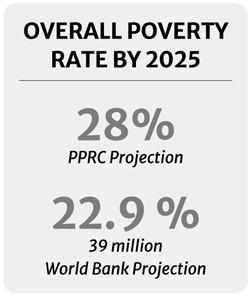
Bangladesh has long been a global success story in poverty reduction. However, the gains achieved since the 1990s are now under threat. Government estimates indicate that over 21 per cent of the population-roughly 36 million people-currently live below the poverty line, a significant rise from 18.7 per cent in 2022, according to the Bangladesh Bureau of Statistics (BBS). Independent research by the Power and Participation Research Centre (PPRC) paints an even grimmer picture, suggesting the overall poverty rate may have reached 28 per cent, with extreme poverty exceeding 9 per cent. Millions of people now survive on less than $2.15 per day, raising urgent questions about food security, access to healthcare, and human development.
This resurgence is not the result of a single factor but arises from a combination of economic, political, and environmental forces. Political instability following the regime change in 2024 created prolonged uncertainty, undermining investor confidence and financial planning. Annual GDP growth has fallen below 3 per cent, compared to the sustained 7 per cent growth experienced in the previous decade. Sluggish growth has slowed policy implementation, disrupted long-term planning, and limited domestic and foreign investment.
Inflation has consistently exceeded 12 per cent, sharply reducing household purchasing power. For low- and middle-income households, rising costs of food and essential goods mean that a larger portion of income is spent on survival, leaving less for health, nutrition, and education. The fragility of the banking system, burdened by non-performing loans and weak regulatory oversight, further limits credit supply and deters investment, hampering job creation and industrial growth.
The labour market has been particularly hard hit. The ready-made garment (RMG) sector, a backbone of Bangladesh's economy employing millions, faces declining global demand alongside rising domestic production costs. By 2025, over 150,000 jobs in this sector alone are at risk. Across other sectors, wages have failed to keep pace with inflation, while volatility in remittances-critical for rural household income-has further destabilised livelihoods.
Recent World Bank projections highlight the severity of Bangladesh's growing poverty problem. The national poverty rate is expected to climb to 22.9 per cent by the end of 2025, up sharply from 18.7 per cent in 2022. Extreme poverty, measured as living below $2.15 per day, is projected to reach 9.3 per cent, putting an additional three million people at risk. Beyond these figures, approximately 62 million individuals remain at risk of slipping below the poverty line due to minor economic or natural shocks.
By the end of 2025, the total population living below the national poverty line is projected to reach 39 million, exceeding previous estimates of 36 million. Economic growth remains slow, with GDP projected at only 3.3-4.0 per cent, far below the sustained growth of over 6 per cent seen in the previous decade. Employment losses are substantial: two million jobs were lost in 2023-2024, with another eight million projected for 2025. Women and youth are disproportionately affected, while wages are declining in real terms.
Income inequality is rising, particularly in urban areas, reflecting the concentration of economic gains among the wealthiest households. Social safety nets, intended to protect the poor, are failing: in 2022, 35 per cent of programme beneficiaries were from non-poor families, while half of the very poor did not receive support. These indicators underscore a multifaceted crisis that combines rising poverty, fragile employment, weak social protections, and growing inequality.
The middle class, long considered Bangladesh's engine of development, is particularly affected by this economic stress. An estimated 62 million people lived just above the poverty line in 2022, and many of them are now facing declining income and depleted savings. If the middle class continues to weaken, domestic demand will shrink, social stability may erode, and the country's pool of skilled workers will diminish, undermining long-term growth prospects.
Rural areas, historically cushioned by improvements in agriculture, microfinance, and infrastructure, are now increasingly vulnerable to climate-related disruptions. Floods, cyclones, river erosion, and saltwater intrusion are reducing agricultural returns and increasing uncertainty. Regional disparities are stark: according to the 2025 Multidimensional Poverty Index, poverty ranges from 15.22 per cent in Khulna to 37.70 per cent in Sylhet. Areas hardest hit by climate shocks continue to experience the highest poverty levels, highlighting the importance of climate resilience in poverty reduction.
Urban poverty, which had been steadily declining, is now rising. By 2022, nearly one in four poor Bangladeshis lived in cities, and this proportion had increased significantly by 2025. Job creation in manufacturing, informal services, and construction has slowed, trapping urban migrants in precarious work. Rising rents, transportation costs, and food prices further strain urban households, particularly daily wage earners and informal sector workers.
Women and children are disproportionately affected by this resurgence. Despite Bangladesh's top ranking in South Asia on the Global Gender Gap Index (77.5 per cent), deep social and structural vulnerabilities persist. Women, particularly in rural areas, face limited access to wage employment, credit, and resources. Economic stress increases unpaid care responsibilities, reduces labour market participation, and heightens the risk of domestic violence. Female-headed households and ethnic minorities are particularly vulnerable due to weak social protections and limited bargaining power.
Children are especially impacted. When families must choose between food and medical care, expenditures on nutrition, education, and healthcare decline. Rising malnutrition and school dropouts, alongside engagement in hazardous work, threaten the long-term human capital of the country and reinforce intergenerational cycles of poverty.
Tackling this complex crisis requires immediate and well-coordinated action across multiple fronts. Employment generation must take centre stage, with a focus on high-value, technology-driven sectors such as light engineering, IT-enabled services, and green industries. Large infrastructure projects, while visible, often create limited job opportunities and cannot address the pressing need for sustainable livelihoods. Expanding sectors that generate quality employment is critical to protecting vulnerable households and stimulating inclusive growth.
Equally urgent is the need to control inflation and implement financial sector reforms. Coordinated fiscal and monetary policies are essential to stabilise prices and restore household purchasing power. At the same time, the banking sector must be strengthened through greater transparency, reduction of non-performing loans, and improved credit availability, ensuring that both businesses and individuals can access the financial resources necessary for economic recovery.
Modernising social safety nets is another vital step. Targeting must be precise, coverage expanded, and delivery streamlined through digital platforms to reach those most in need. Programmes such as unemployment insurance and conditional cash transfers can provide immediate relief to households vulnerable to economic shocks, preventing millions from slipping deeper into poverty.
Climate resilience must also be mainstreamed into poverty reduction strategies. Policies should promote disaster-resilient agriculture, adaptive infrastructure, and subsidised insurance for low-income households, helping communities withstand increasingly frequent climate shocks while safeguarding livelihoods.
Finally, good governance and accountability form the foundation of any successful intervention. Transparency, strong regulatory oversight, and anti-corruption measures are essential to ensure that social protection resources reach the intended beneficiaries. Restoring investor confidence through effective governance will also support long-term economic stability and inclusive growth, creating conditions for sustained poverty reduction. With decisive policy action, stronger social safety nets, and a renewed commitment to inclusive development, Bangladesh can regain its previous trajectory of poverty reduction and socio-economic progress.
Dr Matiur Rahman is a researcher and development professional.
matiurrahman588@gmail.com
© 2026 - All Rights with The Financial Express

