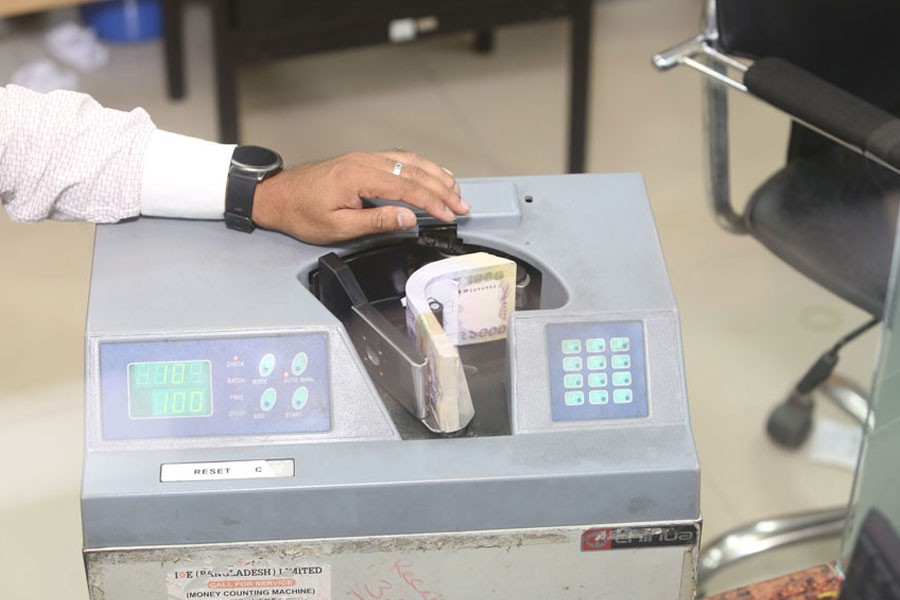
For many years, financial progress in Bangladesh was measured by counting the number of new bank branches opened. When a branch appeared in a rural bazaar, people took it as proof that development had arrived. This way of thinking shaped policy for decades. State banks expanded into rural areas, private banks followed commercial centers, and microfinance institutions filled the remaining gaps. Financial inclusion meant geographic inclusion, and the map of development was literally a map of branches.
Today that map has almost stopped changing. Bangladesh Bank data show that between December 2018 and July 2025 the total number of bank branches increased from 10,281 to 11,388, a rise of barely 11 per cent in nearly seven years. But the total hides an important shift. Rural branches actually peaked around mid-2023 at roughly 5,347 and have since fallen to 5,172, while urban branches continued to climb. The system is not just slowing down in the countryside. It is pulling back. For a village that loses its branch, the loss goes beyond services.
Yet financial activity did not slow. It grew through channels that did not exist a decade ago. Over the same period, mobile financial service (MFS) accounts more than doubled from 68 million to 146 million. Agent banking accounts rose tenfold, from 2.5 million to 24.6 million. Internet banking customers grew from barely two million to 11.6 million. Issued debit cards tripled to 44 million, while prepaid cards went from 243,000 to 9.8 million. Monthly MFS transaction volumes tripled from 210 million to 625 million, and the value flowing through them rose nearly fivefold from Tk 321 billion to Tk 1,486 billion. Internet banking transactions grew twenty-three-fold in number and thirty-fold in value. None of this required new buildings in new places.
But the slowdown in branches does not mean the system stopped investing in physical infrastructure. It stopped investing in one particular kind. Point-of-sale terminals nearly tripled from 48,000 to over 134,000. Cash recycling machines went from 126 to more than 7,600. Agent banking outlets tripled from about 7,000 to over 20,000. Large fixed structures gave way to smaller, cheaper devices placed in retail shops, pharmacies, and local markets. Calling this a shift from physical to digital misses what actually happened. The same services moved into spaces people already visited for other reasons. The branch did not disappear because distance stopped mattering. It became unnecessary because banking functions spread across ordinary commercial life.
Much of this migration had a clear starting point. Between December 2019 and July 2020, monthly MFS transactions jumped from 236 million to 319 million and never came back down. Government-to-person transfers through MFS, which had been running at a few hundred million taka per month, reached Tk 11.8 billion in July 2020 as emergency payments went out digitally during the pandemic. What normally takes years of gradual adoption happened in months because everyone faced the same constraint at the same time. After normal activity resumed, branch expansion did not restart. Meanwhile, electronic fund transfers at scheduled banks grew from 1.6 million to 7.5 million per month and the value of real-time gross settlement transactions went from Tk 966 billion to over Tk 5,000 billion. The shift was not just in how people transacted. It reached how banks settled with each other.
All of this raises a question about productivity. Branch numbers barely grew but the volume of transactions running through the financial system multiplied several times over. Output per unit of physical banking infrastructure clearly rose. But whether this counts as productivity growth in the banking sector depends on where you draw the boundary. The agent at a local shop who processes fifty cash-out transactions a day is doing work that used to require a teller in a branch, but no one counts herlabor as banking sector employment. The question has not been carefully examined.
But growth in access did not bring matching depth. School banking accounts grew from 1.6 million to 4.5 million, yet the average balance per account dropped from roughly Tk 9,000 to about Tk 4,700. If parents opened accounts to meet a program requirement but withdrew the balance when household expenses pressed, the account survives in the statistics but the saving habit never forms. Special accounts for farmers and social safety net recipients tell a similar story: 17 million accounts grew to 25 million, but the average balance remains below Tk 3,000. The system is good at opening doors. Whether anyone stays inside the room is a different question.
The MFS transaction data show the same pattern. The system now moves Tk 1.5 trillion per month, up nearly fivefold from 2018, and the uses have diversified. Person-to-person transfers, salary disbursements, utility payments, and merchant payments have all grown several times over. But the total balance sitting in MFS accounts is only Tk 129 billion. Money passes through. It does not stay. For the person using the account, this makes sense. Why leave money in a mobile wallet that earns nothing when you could hold cash, repay a neighbor, or buy inventory for a small shop? The question is not why people cash out. It is why we expected them not to, given what the accounts actually offer.
This is where the real gap lies. The financial system clearly works as a way of moving value. It does not yet work well as a way of holding or managing value across time. Saving, borrowing against bad times, investing in something productive, all of these require money to remain in the system longer than a single transaction. If accounts work mainly as conduits, the financial system handles payments well but manages risk poorly. A medical emergency can still push a family into debt not because they lack an account but because that account is empty when the emergency arrives.
Credit tells a similar story. Debit cards tripled and prepaid cards grew forty-fold, but credit cards barely doubled from 1.3 million to 3 million over seven years. The system built instruments for receiving and spending but not for borrowing. Why not? Is it regulatory caution, product design, or something about how households think about formal credit compared to borrowing from people they know? When a garment worker borrows from a relative, there is no interest rate but there is a relationship that adjusts to circumstances, a flexibility that a standardized loan product cannot easily match. We do not yet have the evidence to tell these explanations apart.
One finding in the data that gets less attention involves gender. Female MFS accounts doubled from 31.5 million to 63.5 million between December 2018 and July 2025. In agent banking, female accounts went from 841,000 to 12.1 million, reaching and slightly passing the male total. Women entered the financial system primarily through agents and mobile channels, not through bank branches. This may not be surprising. An agent operating out of a local shop that a woman already visits is a different experience from walking into a bank, speaking to an official, signing papers, and waiting. A phone is private in a way a bank visit is not. Whatever the precise mechanism, this is one of the largest expansions of female financial participation in Bangladesh's history, and understanding what made these channels work for women could help in designing services that still skew heavily male.
Even the replacement infrastructure is showing its own limits. Agent banking outlets tripled from 7,000 to about 20,000 between 2018 and 2022 but have barely grown since. When every market town already has an agent, adding another one does not extend the reach. It only splits the business. Yet the deposit base has grown from Tk 30 billion to Tk 457 billion, with rural deposits accounting for Tk 380 billion, and inward remittances through agents reached Tk 27.8 billion per month, up from Tk 2.7 billion. Agent banking is doing something rural branches never managed at this scale. But if the outlet network has levelled off, where does the next phase of rural financial deepening come from? The people who remain underserved are not those without a nearby access point. They are those for whom the existing access point does not yet do enough.
What the data reveal, taken together, is that Bangladesh has completed a transition that was never formally announced. The binding constraint on financial development is no longer physical distance. It shifted, over roughly five years, to something harder to fix: the fit between how financial services are designed and how households actually manage their economic lives. Most financial products assume stable monthly income and regular repayment schedules. Much of Bangladesh does not work that way. Earnings move with seasons, with opportunity, and with the composition of the household. Expenses show up irregularly. Obligations are social as much as contractual. Under these conditions, an account may be useful as a channel but hard to use as a reserve. The gap between what the system offers and what daily life demands is not a failure of access. It is a problem of design.
Several questions follow that the existing data can raise but not answer. If branch expansion has ended and agent outlets have levelled off, what is the next form through which financial depth can grow? Why has formal credit remained so shallow relative to the growth in transactions and accounts? And is the growth of female participation in agent banking durable, or does it remain limited to receiving transfers? These are not questions that administrative data alone can settle. They require understanding how households actually manage money, and that calls for a different kind of evidence.
The plateau in branch growth should not be read as failure. It marks the end of one stage of development. Bangladesh has largely solved the problem of reaching people. The harder problem is understanding why being reached has not yet meant being served. Infrastructure can be built by decision. How people relate to their money changes only when institutions pay attention to how households actually plan, cope, and get by. The data tell us clearly where Bangladesh has been. Where it goes next depends on asking better questions about what the numbers still cannot show.
The author is an independent researcher and former professor of economics at East West University. syed.basher@gmail.com
© 2026 - All Rights with The Financial Express

