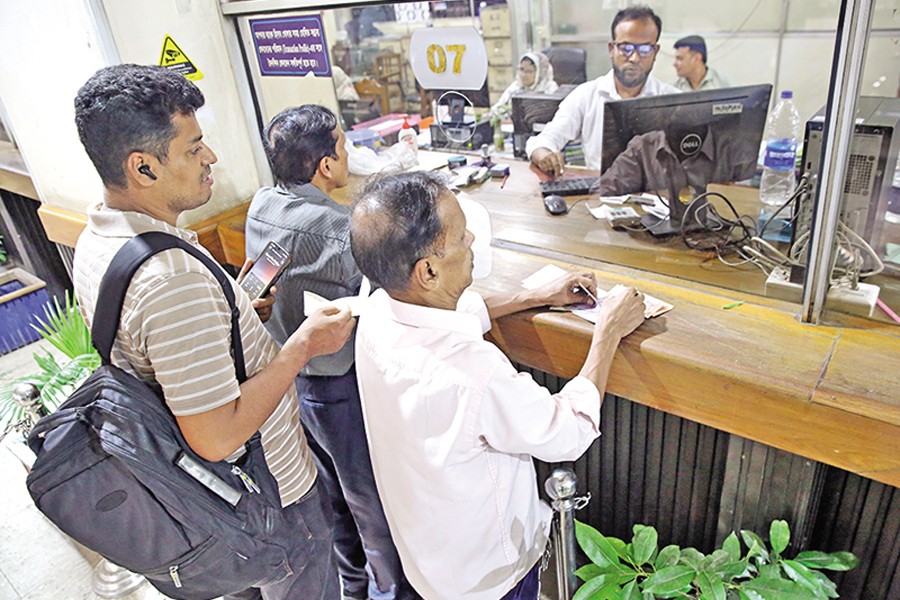
 Customers at a bank counter in Dhaka —FE File Photo
 The recent national election in Bangladesh has delivered a decisive political message. The Bangladesh Nationalist Party secured a huge majority. This is not an ordinary mandate. It reflects public frustration with economic instability and a strong desire for institutional reform. Voters have placed visible confidence in the new government to restore discipline in the banking sector and stability in the wider economy. Such a mandate brings authority, legitimacy, and expectation at the same time. Public confidence is high. Expectations are even higher. The central demand is clear. Use the power of the people to strengthen the power of the economy. Take the reforms forward and deliver outcomes that restore credibility in financial institutions.
The interim government stepped in at a time of deep economic strain. Inflation was elevated. Foreign exchange reserves were under pressure. The financial sector showed visible stress. Distressed assets had risen sharply. Several banks were technically weak, and some depended heavily on regulatory support. Public confidence had declined significantly. During the interim period, several banking and financial sector reforms were undertaken across different areas. Stabilisation measures were introduced. Governance changes were made. Regulatory frameworks were revised. Structural corrections initiated. These initiatives helped avert immediate crisis and prevented systemic breakdown. However, the true outcome is yet to be fully realised. The system has stabilised, but it has not fully regained strength. Common people still expect visible improvement in credit flow, service quality, and financial discipline.
The first phase of reform focused on macroeconomic stabilisation. Monetary policy was tightened to contain inflationary pressure. Exchange rate flexibility was introduced to ease external imbalances. Clear reform signals were communicated to markets and international partners. These measures reduced panic and provided breathing space for the economy. Stabilisation restored order and reduced immediate risk. Yet stabilisation alone cannot ensure credibility. Without structural correction and institutional strengthening, temporary calm can quickly reverse. The newly elected government, backed by a strong and capable leadership team, now has the opportunity to convert stabilisation into sustainable improvement.
Governance reform followed as a necessary corrective step. Compromised bank boards were removed. Oversight structures were strengthened. Hidden losses were disclosed through stricter audits and asset quality reviews. Transparency was uncomfortable but essential. Without acknowledging the true scale of weaknesses, reform cannot move forward. Exposing vulnerabilities marked a shift from denial to accountability. However, governance reform is not a one-time intervention. It requires continuous monitoring, professional management, and strict enforcement of standards. Capable people must be placed in key roles with the right incentive framework. Boards must be independent and skilled. Senior management must be evaluated on performance and integrity. Institutional culture must shift from political patronage to professional discipline.
Structural measures were also introduced. Merger initiatives were undertaken to consolidate distressed institutions with the objective of creating stronger banks supported by improved governance and management discipline. In theory, consolidation reduces systemic risk and improves efficiency. In practice, the outcome depends on leadership quality, operational autonomy, and strong supervision. These mergers are still evolving. Their success will depend on whether professional management is empowered and political interference is restrained. The newly elected BNP government, with its commanding mandate and administrative experience, now carries the responsibility to ensure that consolidation strengthens the system rather than postponing weaknesses.
The crisis in non-bank financial institutions required firm intervention. Insolvent entities were liquidated in an orderly manner. Asset recovery processes were initiated. Depositor protection mechanisms were strengthened through a modern framework with higher coverage and faster payouts. This reform was crucial for rebuilding trust. Depositors must feel secure if confidence is to return to the system. At the same time, the non-performing loan problem remains central. Stricter loan classification rules exposed hidden bad loans. Risk-based supervision was strengthened. Banks and boards were made more accountable. Legal action against major defaulters began. Yet recovery of large loans remains slow. Judicial reform is necessary to make enforcement effective and predictable. Without visible consequences for wilful default, credit discipline cannot improve, and public trust will remain fragile.
Another important pillar of reform has been strengthening central bank autonomy. Operational and financial independence were reinforced in law, and governance structures aligned with international standards. Central bank autonomy supports price stability and credible regulation. It protects monetary policy from short-term political pressure and enhances supervisory authority. However, autonomy must be balanced with accountability and transparency. Independence without oversight can create new risks. Strong internal governance, professional leadership, and clear reporting mechanisms are essential. Protecting central bank's credibility, while ensuring accountability, will be a defining test for the new administration, which has both the mandate and political space to safeguard institutional integrity.
Despite these corrective measures, an expectation gap remains visible. Citizens expect tangible improvement in economic conditions. Businesses require reliable access to credit at reasonable cost. Investors seek policy consistency and regulatory predictability. Stabilisation is not the same as revival. The interim reforms laid a foundation, but the structure remains incomplete. Reform momentum must now be sustained through a comprehensive and coherent financial sector roadmap. Parliamentary backing can anchor key reforms in law and protect them from reversal. Policy coordination across fiscal, monetary, and regulatory institutions is essential. Fragmented initiatives will weaken impact and delay results.
State-controlled commercial banks require deeper governance reform. If they are to function as commercial banks, they must be allowed to operate commercially with professional autonomy. Political influence must give way to transparent decision-making and merit-based management. Risk management systems must be modernised. Performance accountability must be enforced rigorously. Prudent credit growth should be restored with priority to productive sectors such as manufacturing, agriculture, and export industries. Stronger credit appraisal and monitoring frameworks are essential to prevent recurrence of bad loans. Digital banking presents opportunity, but inclusion must remain central. Financial literacy programmes can strengthen responsible participation and expand formal finance. As Bangladesh approaches post-LDC graduation, the implications for the banking industry are significant. Graduation will gradually reduce preferential market access and concessional financing. Compliance standards for trade, capital adequacy, anti-money laundering, and financial reporting will become more demanding. Banks will need stronger capital buffers, improved risk management, and more advanced technological systems. Export diversification will require sophisticated trade finance and foreign exchange capabilities. The sector, already under stress, must prepare strategically to meet these higher standards.
At the same time, it is important to recognise that most reforms so far have been bank biased. The broader financial ecosystem has not received equal attention. A comprehensive planning approach is now necessary to align all subsectors, including non-bank financial institutions, capital markets, insurance, microfinance, and digital finance. Policymakers must clearly identify where the financial sector should move over the next decade. It is crucial to reduce excessive burden on the banking industry by diversifying financial intermediation. Non-bank financial institutions should receive the right regulatory incentives and supportive frameworks to function effectively. Before taking reforms further, a realistic assessment of the current development stage and structural capacity of each subsector is essential. A balanced and coordinated financial architecture will reduce systemic concentration risk and promote sustainable growth.
Employing the right people in the right place is therefore critical. Technical competence, integrity, and professional autonomy must guide appointments in banks, regulatory bodies, and supervisory institutions. Capable leaders must be empowered to make difficult decisions with confidence and clarity. Incentive structures should reward performance and penalise misconduct. Training and succession planning should ensure continuity. The new government, supported by a strong public mandate and political confidence, has the capacity to prioritise merit over patronage. This is a moment to build institutions that are resilient, forward-looking, and trusted by citizens and investors alike.
The current status reflects cautious stabilisation. Immediate systemic risk has been reduced. Transparency has improved. Some structural reforms are underway. However, asset quality challenges, weak enforcement, and uneven credit growth remain concerns. With its strong mandate, the BNP government has a rare opportunity to institutionalise reform and convert public confidence into economic strength. Ownership now means consolidating progress, accelerating judicial reform, strengthening supervision, modernizing state banks, diversifying the financial architecture, and protecting institutional autonomy. If stability is preserved, capable leadership is empowered, and reform momentum is sustained, Bangladesh can move from crisis management to durable financial credibility.
Dr. Shah Md Ahsan Habib is Professor, Bangladesh Institute of Bank Management (BIBM); and Chairman, Dnet (finbislesh.com). ahsan@bibm.org.bd
© 2026 - All Rights with The Financial Express

