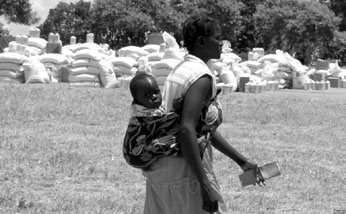
 A Zimbabwean collects her monthly rations of food aid from Rutaura Primary School in the Rushinga district of Mount Darwin, north of Harare, March 7, 2013. — Reuters photo
 All eyes are now fixed on Russia and Ukraine, more so, on its likely impact on global food trade. The BRICS (Brazil, Russia, India, China, South Africa) is getting disturbed and so the G8 (France, West Germany, Italy, Japan, the United Kingdom, the United States and Canada). In a situation where farm sector is supposed to take up higher responsibility and undergo positive process of change, happenings on this front have not been smooth globally.
Can we simply allow one-third of the total food we produce to go waste or be lost because of inappropriate practices, when 870 million people go hungry every day? FAO observes the waste of a staggering 1.3 billion tonnes of food every year is not only causing major economic losses but also wreaking significant harm on the natural resources that humanity relies upon to feed itself. Each year, food that is produced but not eaten guzzles up a volume of water equivalent to the annual flow of Russia's Volga River and is responsible for adding 3.3 billion tonnes of greenhouse gases to the planet's atmosphere. Beyond its environmental impacts, the direct economic consequences of food wastage run to the tune of $750 billion annually. Close to 870 million people continue to suffer from chronic malnutrition.
Is it not a fact that the world produces enough food to feed everyone despite a 70 per cent population increase? Despite that growth and development have been lopsided and hence the fruits of growth have not been reaching to all.
FAO called upon the international community to work closely with dryland countries to break the cycle of hunger, admitting that "we are losing the battle against hunger in Africa and the Near East. The number of hungry people in the regions has increased by 83 million to 275 million since the early 1990s. Natural resources degradation in dry land countries threatens more than two billion people".
The target set at the 1996 World Food Summit was to halve the number of undernourished people by 2015 from their number in 1990-92. The estimated number of undernourished people in developing countries was 824 million in 1990-92, whereas in 2010 the number climbed to 925 million.
That is to say in the overall sense the world is not making progress toward the World Food Summit goal, although undeniably there has been progress in Asia, Latin America, the Caribbean as well as Africa.
Though recurrent drought and volatile food prices have led to countries in Africa and the Near East in a hunger trap, prospect is definitely there. Even in Africa yields can be dramatically increased provided farmers have access to improved technologies and markets. Exploiting this potential on a large scale would require a quantum increase in public investment in agricultural research and rural infrastructure, partnering with private firms to strengthen input-supply systems and food grain markets.
This, in turn, would generate many productive jobs in agriculture side by side with aiding poverty reduction. The process would further enable farmers to free up land and labour for more profitable ventures, increase local demand for higher-value foods and non-farm goods and services, and cater growing domestic demand for industries.
Newer avenues must be located so that the growth and development wheels should move simultaneously and the existing gaps could be bridged temporally. For example, in Bhutan about 65 per cent of population is rural people who depend on renewable natural resources sector for their livelihoods. Though a trend of positive growth in fruit and vegetable crops has been there, both high values, yet a decline in staple crops like cereals has been noticed. As of now 50 per cent of rice consumed in the country is imported. They have no option because there is not sufficient land and soil fertility can not go beyond certain levels. As a result the country will have to continue to import food. Bhutan must work more exploring its comparative advantages including off-season high value fruits and vegetables to diversify rural income. Investment flow to these newer directions is a must so that the overall growth is ensured over time.
More importance is needed to the cooperative sector. Cooperatives help to generate employment, boost national economies and reduce poverty. Cooperative units have been particularly important for farmers in the developing world. Agricultural cooperatives provide small-scale food producers with what may be their best chance to compete in global cooperatives. It can also help small and medium scale farmers and fishermen add value to their production and gain access to wider markets. It is good to note that FAO has been taking active interest on this score. FAO expressed commitments to fostering the growth of agricultural cooperatives around the world, develop approaches, methodologies and training tools on organisational development and policy, as well as contribute to the global plan of action.
And then the warning bell from the World Bank: all nations will suffer the effects of a warmer world, but it is the world's poorest countries that will be hit hardest by food shortages, rising sea levels, cyclones and drought. It is definitely good to note that the global development lender has since launched a more aggressive stance to integrate climate change into development: In a recent report the World Bank observed, "We will never end poverty if we don't tackle climate change. It is one of the single biggest challenges to social justice today." The report highlights the devastating impact of a world hotter by 4 degrees Celsius (7.2 Fahrenheit) by the end of the century. In this hotter climate, the level of the sea would rise by up to three feet, flooding cities in places like Vietnam and Bangladesh. Water scarcity and falling crop yields would exacerbate hunger and poverty. This is likely to happen if not all countries comply with pledges they have made to reduce greenhouse gas emissions. Even assuming full compliance, the world will warm by more than three degrees by 2100. Despite all these adversities FAO says "...if we can find sustainable ways to ensure food security in dry land areas, then we will be well on our way to achieving a 'zero hunger' world".
The crucial need is thus to develop principles for responsible investment in agriculture. Appropriate action is required urgently specifically in the three areas to feed into future policies, strategies and investments to boost agricultural production and increase resilience to future prices shocks. Priority is to be assigned to supporting sustainable management of land and water resources; adapting crop production that goes with climate change, and building resilience in rural communities, and finally strengthen global food security governance.
Let us, at the same time, keep a close watch on happenings in Ukraine and Russia to ascertain the probable impact on global food trade.
Dr B K Mukhopadhyay, a Management Economist, is Principal, International Institute of Management Sciences, Kolkata. m.bibhas@gmail.com
© 2026 - All Rights with The Financial Express

