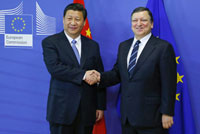
 European Commission President Jose Manuel Barroso welcomes China\'s President Xi Jinping (L) at the EU Commission headquarters in Brussels March 31, 2014. Xi is the first Chinese leader to visit the European Union\'s headquarters since Brussels establishe
 The European Council President Herman Van Rompuy recently welcomed Chinese President Xi Jinping to Brussels. This was the first time a Chinese President had visited the European Union (EU) headquarters. The trip was however a little bit more than just making history. It revolved round reaching agreement and closing business deals with different European firms. Xi, during his visit, was accompanied by more than 200 Chinese business leaders. Some of them signed multi-billion Euro agreements to buy airplanes and cars as the contingent swept first through France and Germany and then to Belgium.
China's ultimate goal on the trip was to reach a wide-ranging trade agreement with the EU. In turn, the EU hoped to persuade China to open its markets to foreigners and attract more direct investment.
The first round of the talks took place in January, but the Chinese seemed eager to advance the negotiation much further this time around. In this context, before embarking on the tour, Chinese Foreign Minister Wang Yi told the National People's Congress that he hoped to "speed up the negotiation toward the investment agreement."
It would be important to note here that more than $588.6 billion worth of goods are traded between the EU and China every year -- $1.6 billion every day, according to the latest data from European Commission. However, Europe sells a lot less to the Chinese than it buys from them. Last year the European Union's trade deficit with China was $180 billion.
This current scenario is no longer acceptable to European investors. They now want not only to take advantage of China's growing middle class but also make available diverse new items that would enable them to export more. In this regard, analysts from the EU Commission's Trade Department have particularly noted in the CNN that "every year, 20 million Chinese households pass the threshold of household income of $13,500 at which middle class families become able to afford key consumer goods and services, like cars". To achieve this, the EU is pushing for less regulation in the Chinese market.
Economists from the European Commission have nevertheless pointed out that despite the large volume of trade, mutual direct investment is still relatively low, with just over 2.0 per cent of EU foreign direct investment going to China. This is despite the fact that for years, European companies have been seeking to benefit from cheap labour by building factories in China.
The shoe is now apparently on the other foot. Today, that trend is reversing. Chinese investors are now eyeing Eastern Europe and the Mediterranean, where the Eurozone crisis has pushed labour costs down and created hunger for foreign investment. China, in fact, has now announced an ambitious plan to invest $100 billion per year into Eastern European countries by 2015. It has already opened its first factory -- a Great Wall Motor assembly line -- in Bulgaria in 2012. This was done because that country gave the Chinese automaker duty-free access to the European market. Consequently, experts are now saying that Chinese money will help Europe out of the current economic slowdown. As an example, it is being mentioned that although the Greek economy has been devastated by the global financial crisis, the Chinese-run port of Piraeus has stayed afloat and is becoming one of Europe's main shipping hubs.
Europe's trade relationship with China has not always been very stable. It suffered setbacks over dumping accusations last year. It may be recalled that the EU tried to hit Chinese solar panels producers with high import duties, accusing China of dumping solar panels way below a fair price. In a tit-for-tat move, China then launched its own anti-subsidy probe into European wine imports. Although both disputes have now been resolved, only 1.0 per cent of imports from China are covered by EU's anti-dumping measures.
There has been a bit of thaw in trade relations but controversy still remains. The EU says that China still imposes several para-tariff barriers on foreign investors, who do not have access to sectors China deems as strategic, including transport, telecommunication and healthcare. This is considered as unfair. As such the latest visit of the Chinese leadership was interpreted as critical. Both sides, tried to establish symmetric market relations through understanding -- meaning that European and Chinese firms should have equivalent access to each other's markets. China, it is understood, also agreed in principle to re-visit the rules associated with the setting up of joint ventures, expanding the list of sectors that are open to foreign investment and also the limits pertaining to foreign ownership. This will be done to ensure that business opportunities are not lost by foreign investors.
Marie Julie Chenard, an expert in the field of Europe's economic relations at the LSE Ideas think tank, thinks that any investment treaty is unlikely to cover an important area for foreign investors in China: "concerns about bribery and corruption, the reliability of business partners and the enforcement of intellectual property rights." Chinese analysts have termed such an assumption as being very subjective.
Before, during and after the visit, several reports in the electronic and print media tried to highlight the importance of EU's trade with China. It has been pointed out that China is EU's second biggest trading partner, trailing only behind the U.S. Two-way trade of goods between the two has also quadrupled since China joined the World Trade Organisation (WTO) in 2001, reaching nearly $590 billion in 2013. The EU is China's biggest source of imports and its biggest export destination. European companies are fulfilling Chinese hunger for cars, planes, chemicals and luxury goods, while Europe imports $385 billion worth of textiles, electronics and other goods from China. With some expecting China to become the world's biggest economy by 2030, It is also felt that there will be a lot more within the equation.
It would be worthwhile to record here that China is poised to become the world's top trading nation, a position long held by the United States. Latest Chinese statistics point out that its total trade for 2013 reached $4.2 trillion, a sharp increase over the previous year. For the first time the world's most populous country cleared the $4-trillion barrier, a feat accomplished despite lacklustre numbers for the final month of that year.
Not all critics have, however, accepted the Chinese data. Some among them have pointed out that China's trade data are sometimes notoriously unreliable, skewed by invoices filed to evade capital controls. Despite this scepticism, it would only be fair to note that there can be no argument regarding China's growing trade prowess having been fuelled by economic growth of around 10 per cent a year in the past three decades. Sustained progress has propelled the country up the list of biggest economies and also generated wealth for its growing middle class and boosted its share of global trade. It would also be pertinent to record that, China once known only for its production of textiles and light industrial products has now made the switch to sophisticated products including the latest tech gadgets. This transformation has now resulted in the U.S. doing almost as much trade with China as Canada. This movement upward in manufacturing capacity, consistent with higher Chinese exports, has resulted in China overtaking the U.S. as the biggest importer of oil late last year, amid rising demand for fossil fuels.
REBALANCING OF CHINESE ECONOMY: Any overview of the current dynamics of the Chinese economy will, however, remain incomplete without noting that the rebalancing of this economy is now seeing consumption through retail sales outpacing industrial production. Rural incomes are also growing more quickly than urban incomes, which is reducing the rural-urban income gap and improving the consumption prospects of half of the Chinese population.
Rising incomes in China's rural and urban areas are helping to boost personal consumption economic growth of 7.4 per cent in the first quarter during this financial year. This has been in line with China's 2014 annual year-on-year target of about 7.5 per cent growth. Chinese economists and planners have explained that the slowdown from the 7.7 per cent GDP growth registered in the past two years has partially been caused by the government trying to rebalance the economy, shifting away from credit-fuelled investment towards more consumption supported by income.
The Chinese National Bureau of Statistics (NBS) has reported in this context that the growth figures have largely been consistent with expectations, particularly pertaining to growth in incomes. Rural incomes, according to them, have risen by 10.1 per cent from a year ago, while urban incomes have increased by 7.2 per cent. That is being seen as an achievement. This increase in incomes has contributed to retail sales growing at 12.2 per cent, which is a sign of growing consumption - and that is what the European Union is trying to exploit.
The writer, a former Ambassador and Permanent Representative to the EU,
is specialised in foreign affairs, right to
information and good governance.
mzamir@dhaka.net
© 2026 - All Rights with The Financial Express

