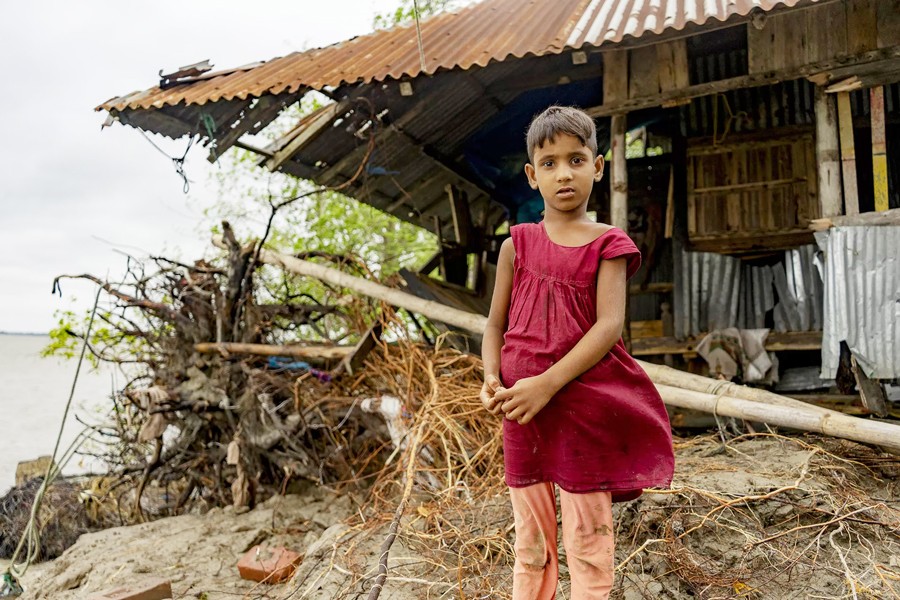
 A girl in front of her home that shattered during a cyclone —UNICEF Photo
 Bangladesh is often portrayed as a global hotspot for climate vulnerability. Rising seas, intensified cyclones, heatwaves, and river erosion dominate headlines. Yet amidst this environmental narrative, one of the most urgent human consequences remains largely invisible: children being pushed into hazardous labour as families struggle to survive climate-induced shocks. Climate change is no longer just an environmental challenge-it has become a social crisis, particularly for the country's youngest citizens.
Recent data underscore the severity of this overlooked issue. According to the International Labour Organisation (ILO) and UNICEF, Bangladesh is not on track to eliminate child labour by the 2025 target, with a child labour rate of about 4.4 per cent in 2022. Most of these children work in informal sectors under hazardous conditions, facing health risks, exploitation, and limited prospects for education. Poverty, intertwined with disrupted access to schools, remains the primary driver.
In 2024, climate crises severely disrupted the education of around 33 million Bangladeshi children. Heatwaves, floods, and cyclones caused prolonged school closures across the country. In Sylhet, for example, recent floods resulted in up to eight weeks of lost schooling, thereby increasing the risk of dropouts. For families grappling with damaged homes and lost livelihoods, sending children to work often becomes a grim necessity rather than a choice.
Education disruption is not just a short-term inconvenience; it is a gateway into exploitation. Children who miss school due to climate events often find themselves entering the informal labour market-working in agriculture, brick kilns, fisheries, or domestic work-to support their families. Once in labour, children rarely return to formal education, perpetuating intergenerational cycles of poverty and vulnerability.
The 2022 National Child Labour Survey paints a concerning picture: approximately 1.78 million children aged 5-17 are engaged in child labour, and 1.07 million of them are involved in hazardous work. Around 61 per cent of working children are employed in agriculture, a sector susceptible to climate shocks such as floods, droughts, and salinity intrusion.
The social-environmental interplay is stark. Climate-induced disasters degrade livelihoods, displace communities, and push children into labour. Families, struggling to recover from repeated shocks, see children's labour as a necessary survival strategy. In disaster-prone regions, this has become a systemic problem rather than an exception.
The coastal belts of Khulna, Satkhira, or Barisal, or the charlands of Jamuna and Meghna expose the undeniable human impact of climate change. Cyclones Sidr, Aila, and Amphan destroyed homes, uprooted families, and undermined local economies. Children, already vulnerable, are forced to leave school to work in shrimp processing units, tea stalls, or as domestic help in cities. In the chars, river erosion displaces entire communities, and children are thrust into agricultural labour or day-to-day survival work.
This is not anecdotal. Studies show that climate-vulnerable districts exhibit disproportionately high rates of child labour compared to national averages. Yet, climate adaptation funding rarely integrates child protection measures. While embankments are strengthened and cyclone shelters constructed, education continuity and child protection remain underfunded.
Bangladesh has policies aimed at eliminating child labour by 2025, including the National Child Labour Elimination Action Plan. There are also strategies for climate adaptation, such as the Bangladesh Climate Change Strategy and Action Plan (BCCSAP). However, these frameworks primarily operate in silos. Child labour programmes focus on enforcement, awareness, and social protection, whereas climate adaptation programmes prioritise infrastructure, technology, and disaster preparedness. The result is a disconnect that leaves children vulnerable in the face of climate shocks.
Conditional cash transfers, school retention incentives, and post-disaster livelihood programmes remain inadequately linked. This fragmentation allows climate-driven child labour to persist despite apparent policy efforts. Without integrated approaches, Bangladesh risks leaving its most vulnerable citizens-children-trapped in cycles of exploitation.
Data from 2022-2025 confirms a worrying trend: climate change acts as a multiplier of vulnerabilities for children. Floods, cyclones, and heatwaves increase socioeconomic pressures, directly sustaining child labour. Agricultural dependency makes children in rural and disaster-prone regions especially vulnerable. Families facing repeated crop loss or fisheries destruction have little choice but to rely on their children for supplementary income.
Consider the coastal shrimp farming regions, where salinity intrusion has made rice cultivation impossible. Families displaced by cyclones like Amphan often migrate to urban centres, only to find children working long hours in hazardous environments, far from schools. In the chars, erosion and flooding force relocation and expose children to exploitative labour in brick kilns or seasonal agriculture. These patterns are not isolated-they reflect systemic vulnerability shaped by climate change and poverty.
Breaking the climate-child labour link requires more than rhetoric. It demands a child-centred approach to both climate adaptation and social protection. Integrating child protection into climate budgets is essential, with adaptation programs explicitly including measures such as ensuring continuity of education, establishing child-friendly shelters, and providing psychosocial support.
Conditional cash transfers can further support this effort by offering families financial assistance tied to keeping their children in school, particularly in the aftermath of disasters. Community-based monitoring, led by local committees of teachers, parents, and social workers, can help track children at risk of entering the labour market due to climate-related events.
Effective policy coordination is also critical, requiring collaboration among the ministries of labour, education, and climate change. Donors should also mandate reporting on the impacts of child labour when funding adaptation projects. Finally, including the voices of children in planning processes ensures that adaptation strategies address real-life vulnerabilities rather than merely abstract metrics.
Protecting children from climate-driven labour is both a moral obligation and a developmental necessity. A generation forced into work instead of school risks perpetuating cycles of poverty, underdevelopment, and social inequality. Sustainability cannot be measured merely in embankments or disaster preparedness-it must be measured in the lives and opportunities of children.
Bangladesh has made commendable progress in climate adaptation and poverty reduction. However, if policies fail to address the intersection of climate vulnerability and child labour, the country risks losing an entire generation to hazardous work. The SDG targets for education, decent jobs, and poverty reduction will remain hollow promises if climate-driven child labour persists.
Policymakers, civil society, and international partners must act decisively. Integrating climate resilience with child protection is not optional-it is essential. Conditional cash transfers, climate-resilient schooling, post-disaster child protection, and community-based monitoring are practical solutions that can be scaled nationally.
The stakes are high. Each flood, cyclone, or heatwave threatens a child's right to education, safety, and opportunity. Sustainability is not only about surviving environmental shocks-it is about protecting children from the human consequences of climate change.
Bangladesh stands at a crossroads. Will it continue to treat climate change and child labour as separate issues, or will it pioneer a truly child-centred approach to sustainability? The answer will define the country's development trajectory for decades. Ensuring children remain in school and out of hazardous labour is not just an ethical duty-it is the foundation for a resilient and just society.
Time is running out. Climate resilience without child protection is incomplete. The future of millions of Bangladeshi children-and of the nation itself-depends on immediate actions.
Dr Matiur Rahman is a researcher and development professional.
matiurrahman588@gmail.com
© 2026 - All Rights with The Financial Express

