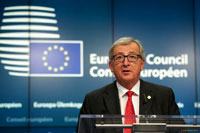
 EU Commission President Jean-Claude Juncker: NATO is not enough, EU needs an army.
 Serious discussion has been initiated among European analysts following the recent call by the new President of the European Commission for a common European army.
Andrea Frontini of a Brussel-based think-tank has drawn the attention of the world-wide audience to the interview of the President of the European Commission, Jean-Claude Juncker with the German newspaper Welt am Sonntag on March 08. Frontini points out that, Juncker has "strongly advocated a common European army to consolidate peace in Europe, react to security threats both within the continent and in its neighbourhood, defend European values vis-à-vis aggressive powers, notably Russia, and create economies of scale by consolidating demand for military equipment".
This view has been suggested before also. The concept of creating a joint European military structure can be traced back to the efforts undertaken before 1960 to the creation of European Defence Community (EDC). The political vision of an autonomous European 'hard power' has re-merged once again and efforts have been made over the past decade to further European integration. In-depth discussions have taken place in the European Parliament about its technical, political, economic and strategic implications.
This time round, President Juncker's views have been carefully focused upon in the European media and beyond, with practitioners, politicians and experts immediately reacting to the general proposals put forth by the chief of European Union (EU).
Andrea Frontini has correctly mentioned that "Juncker's bid for a European army needs to be contextualised via the 'W5' formula: what, where, who, when and why".
The first connotation relates to the word, "what". We need to understand what Juncker's view is about. One could interpret the President's comments as a disappointment at the top level about the generally agreed decline of European military capacities. Many strategists over the past three years have indicated that European defence resources have been one of the principal victims of the on-going combination of austerity-driven and uncoordinated budgetary cuts, unsustainable financial patterns and persisting fragmentation along national lines.
It is true that some high-level political gatherings such as the European Council in December 2013 and the NATO Wales Summit in September 2014 discussed and later committed to reverse, or at least reduce, such worrisome trends. This was done because of the emerging awareness that Europeans were struggling to introduce a major change of their long-standing efforts towards 'de-militarisation'. From that point of view, the European Commission President's emphasis on common defence will be seen as a reminder that European security must not be overlooked.
The next connotation that needs to be given is the geographic focus of the word, "where". This is pertinent in the consideration of where the EU Commission President wants the focus to be for the creation of a potential European common army. One would think that Juncker is worried about the eastern frontier of the European Union and the continuing Ukrainian crisis and its possible wider political impact on European Union's relations with Russia.
Political analysts are aware of Juncker's references about Moscow's alleged aggressive posture and the need for further encouraging intra-European cohesion at a time of high uncertainty. Like many others in the European Union, Juncker views the prospects of the Ukrainian conflict against the perspective of EU's overall stance vis-à-vis the Kremlin, particularly through its sanction policy. The Commission President has made it clear that any future European army "should not be used immediately". This implies that any potential military tool would be meant as a component of a more complicated interaction with Russia that would balance EU member-states' differing interests and perceptions on this issue.
It would also be pertinent to note here that Juncker, by referring to Europe's international responsibilities beyond Ukraine, has interestingly added the overarching question about the future relevance of 'hard power' in a fast-changing and increasingly multi-polar global environment - one that Europeans will necessarily have to address if they are serious about their future influence on international politics. The significance of this has assumed a separate dynamics after the participation of European troops in the Allied efforts undertaken in Afghanistan over the last few years.
The question that arises now is how Juncker's remarks and views will be perceived by some of the actors who have also been associated for a long time with European security interests.
The NATO leadership has been aware for a long time about Juncker's personal views about the need to create a progressively federalist model for Europe. They also realise that his role as head of the Commission allows him to address European defence from a distinctively integrationist perspective. This is seen as having been derived both from the Berlaymont's [the Berlaymont is an office building in Brussels, Belgium, that houses the headquarters of the European Commission] role of 'guardian of the treaties', including the Lisbon Treaty's still dormant clauses on Common Security and Defence Policy (CSDP), and, as mentioned by Andrea Frontini, its "increasing but still contested involvement in some defence-related issues - essentially limited to the market and industry domains - in cooperation with other players such as the European Defence Agency (EDA)".
It is however quite clear that within the evolving European policy-making context, EU member states are being considered as the focal points of Juncker's statement. This is so because of their deep-rooted divisions on the ultimate ends of European defence and their general reluctance to loosen their sovereign competences in this policy area. From this aspect, Juncker's latest interview will provide another opportunity to several European capitals to clarify their intentions and to convey their separate political messages on this topic - from United Kingdom's clear rejection of any such possibility to Germany's positive, but conditional, support. The French are understood to be treating this possibility with caution.
In the European political arena, questions have also emerged regarding the time when this proposal was formulated. Analysts know that timing is crucial in any political game, and Juncker's views are being analysed within that paradigm.
It is being recalled that following the 'CSDP Summit' in December 2013, EU leaders had agreed to re-discuss the state of European defense next June. The High Representative/Vice-President Federica Mogherini has recently launched a review process of the 2003 European Security Strategy (ESS). It is clear that contrary to his predecessor, Juncker has decided to devote more of his personal attention to this topic. To facilitate the process, he has already appointed the former European Commissioner Michel Barnier as his Personal Adviser on European Defence and Security.
Juncker is trying quite clearly to raise the bar with his re-affirmation of this provocative idea. It is generally agreed that time has come for both the European Commission and the European Parliament to give more attention to this significant policy frontier.
Juncker's call for a common European army can obviously be treated only as a nascent exercise. It is still at an embryonic stage while strategic experts involved with European military integration are preoccupied with the prospect of sub-regional cooperation formats and the need to create a solid division of labour between CSDP and NATO which remains the cornerstone for the security of most EU member states, notably in the area of territorial defence.
Nevertheless, the current European equation cannot overlook the prospect of a long-term European defence integration. Such a development would re-affirm European political solidarity and foreign policy effectiveness.
From that point of view, President Juncker's statement and idea should be seen as a multi-faceted and thought-provoking political message that will help to build EU's still developing common defence project as a significant measure for Europe's political integration and international relevance.
Muhammad Zamir, a former Ambassador, is an analyst specialised in foreign affairs, right to information and good governance. mzamir@dhaka.net
© 2026 - All Rights with The Financial Express

