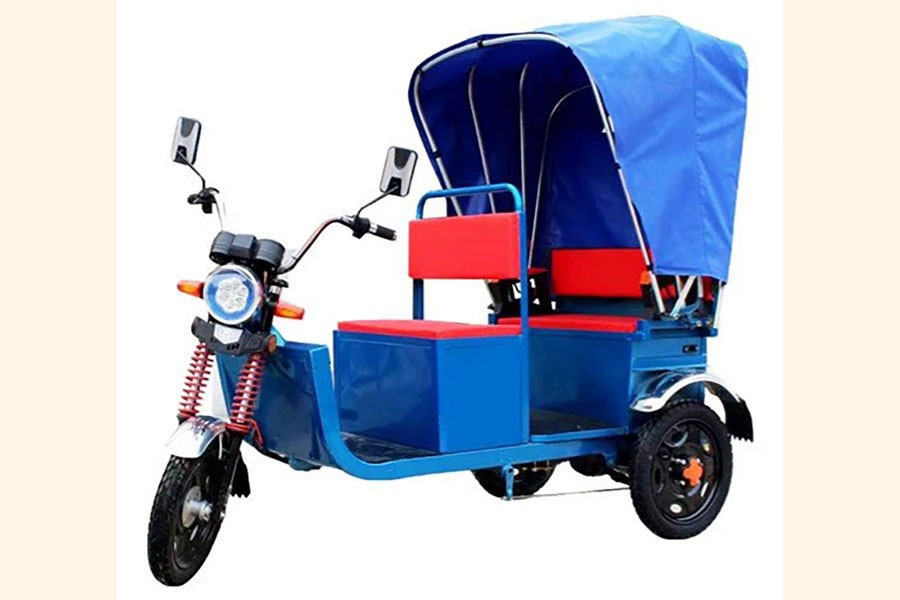
"I am happy now as I can support my family of three dependents, including two daughters," boasted Ruhul Amin, a disabled Dhaka e-rickshaw driver, hailing from Jessore district, who lost one leg in a bus accident. "After the accident, I used to plead for help from relatives and friends, but I don't to do it anymore," added Amin. This short testimony captures why these vehicles matter. They put cash in pockets and food on tables. E rickshaws are now integral to Dhaka's transport system, providing direct jobs for more than a million poor people, facilitating last mile connectivity, yet blamed for traffic chaos, also creating huge environmental and safety challenges. The task for policymakers is therefore to formalise and improve the sector quickly, pragmatically, and humanely.
Cycle rickshaws have been part of Dhaka's streets for decades (believed to be introduced in 1930s). The motorised boom began in the late 2000s when Chinese motors and lead acid batteries were fitted to pedal frames. That shift produced a new, informal industry: local workshops assembling vehicles, rental markets that let drivers operate without capital, and a sprawling battery charging and recycling ecosystem. An older traffic study, conducted in 2010, found that rickshaws accounted for 38 per cent of trips, with buses at 28 per cent, walking 20 per cent and private cars per cent. This underscores the importance of rickshaw as a mode for short, intra neighbourhood travel.
Because most e rickshaws operate informally, fleet counts vary. Best estimates put the number between hundreds of thousands to one million. An estimate suggests that over five million people (six times the population of Bhutan) depend directly or indirectly on the sector. This estimate uses a conservative figure of 800,000 rickshaws and a multiplier of 6.5 (1.6 direct plus 4.9 indirect livelihoods per vehicle). This scale explains why abrupt removal would be socially and politically explosive.
E rickshaws created a new urban livelihood model. Drivers-predominantly low income people, often migrants from rural districts, mainly rent these vehicles. Typical daily net earnings reported are Tk. 900-1,000 for e rickshaw drivers after rental charges, compared with Tk. 500-600 for traditional pedal rickshaw drivers. Daily rental fees are roughly Tk. 400 for e rickshaws and Tk.100 for pedal rickshaws. Ownership carries costs-repayment, repairs, charging and battery replacement-estimated at about Tk. 9,800 per month (Tk330 per day) for a retrofitted e rickshaw. The higher the initial rickshaw price, the higher the ownership costs that might lead to increase in daily rental charges, reducing driver's net income.
This economics explain two policy priorities: (a) increase the share of owner drivers to improve incomes, and (b) ensure any safer vehicle standard that remains affordable or is supported by finance so drivers do not lose net earnings.
Although e-rickshaws have been providing affordable last-mile mobility to Dhaka residents and are responsible for creating many jobs, there are several major challenges faced by them:
• Traffic management. Unregulated stopping, ad hoc stands and mixed routing create local congestion and complicate traffic control on major corridors.
• Vehicle safety. Most existing e rickshaws lack appropriate brakes, robust frames and lights, increasing road safety risks.
• Battery pollution. Lead acid batteries produce large volumes of used lead acid batteries (ULAB). Informal collection and open air smelting release lead dust and acid that contaminate soil, water and food chains and cause severe health impacts, especially for children.
• Energy demand. Large fleets impose charging loads on the grid; without planned infrastructure, this encourages unsafe charging and electricity theft.
BUET has developed a redesigned e rickshaw addressing many mechanical failings with a tubular frame, three-wheel hydraulic braking, mirrors and indicators. The prototype improves operational safety but retains lead acid batteries, leaving the environmental problem unresolved. It is also larger compared to the existing e-rickshaws (occupying 80 per cent more road space; length - 320cm vs. 238cm; width - 150 cm vs. 110cm) and costlier (reported cost of Tk150,000) than existing models (Tk60,000-90,000), raising concerns about road space use, affordability and driver incomes. The prototype's maximum speed (30 km/h) also prompts debate about appropriate speed limits for Dhaka's dense urban streets.
The practical lesson is clear: technical fixes matter, but design choices must balance safety, compactness, cost and energy technology to avoid unintended harms.
Meanwhile, Dhaka North City Corporation (DNCC) has already taken steps to bring the BUET-designed rickshaws to Dhaka roads including:
• Pilots and training. DNCC has piloted BUET designed rickshaws and provided driver training; trained drivers are to receive licences and number plates.
• Operational controls. City corporations are designating operational areas, stands and fare structures and planning phased replacement of unsafe vehicles.
• Draft national policy. A draft Electric Three Wheeler Management Policy 2025 proposes registration, geographic operation limits, ownership caps, design regulation, migration timelines to safer models, charging station rules and driver training.
• Battery pilots. Environmental projects, with development partner's support, are testing safer battery collection, licensed recycling and battery swap models.
These steps are in the right direction: combine vehicle safety, operational order and battery chain reform.
There are a number of challenges in the implementation of the city administration's e-rickshaw plan, including:
• Affordability vs safety. The BUET prototype improves safety but raises costs and road space use. Revisiting the design to remove non essential features and target a lower price (suggested ceiling of Tk.120,000) would protect driver welfare.
• Ownership structure. Increasing owner drivers improves incomes but requires accessible soft loans and safeguards against fraudulent ownership.
• Phasing and enforcement. Replacement must be phased over years, tied to production capacity, financing, training and scrapping schemes; abrupt enforcement risks mass livelihood loss.
• Battery transition. Moving away from lead acid requires a national ULAB policy: mandatory collection points, licensed recyclers, buy back funds and incentives for battery swap and gradual adoption of lithium ion, starting in dense corridors.
• Political economy. Any plan must manage resistance from informal owners, scrap dealers and other stakeholders who benefit from the status quo.
• The following steps combining a pragmatic, humane approach are recommended:
• Enacting an appropriate e-rickshaw policy, especially for major cities, including Dhaka for optimal integration of e-rickshaws into the transport ecosystem of those cities;
• Developing separate e-rickshaw strategy and an action plan for Dhaka city corporations and implementation of the strategies and plans;
• Reviewing the BUET-design rickshaw prototype and rationalise its physical components to optimally adjust its size and cost, while keeping it operationally safe and effective;
• Arranging targeted finance for owner drivers and caps on vehicles per owner;
• Developing a battery policy to formalise collection and recycling, plus pilots for battery swap and gradual lithium ion transition;
• Developing operational rules that create designated stands, fare guidance and corridor maps, while focusing enforcement on illegal and hazardous practices.
Dhaka faces a choice: ceasing or substantially reducing an essential urban service and risking mass hardship or formalise and improve it, protecting both mobility and public health. Evidence prefers the latter: a phased, well financed, socially sensitive programme that raises safety and environmental standards while preserving and improving incomes for millions. The new government has an opportunity to address these challenges towards a durable urban solution - if it acts objectively, quickly, transparently and with empathy, protecting city's poorest workers.
Farhad Ahmed, a retired Senior Transport Specialist at the World Bank, Washington, D.C. He is a trustee at Human Capital Initiative (HCI. farhad.ahmed2011@gmail.com
© 2026 - All Rights with The Financial Express

