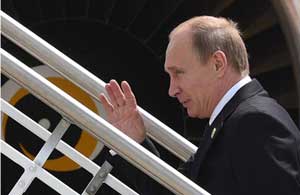
 President Vladimir Putin waves goodbye as he leaves the G20 Summit, at the airport in Brisbane, November 16, 2014 — AFP photo
 Discussion enables parties to explain their viewpoints, find least common denominators and then move forward. It is the best tool for creating a peaceful resolution of serious challenges that might confront the international community at any given point of time. The last few weeks have seen a series of meetings - the Asia-Pacific Economic Cooperation (APEC) Summit in Beijing, China, the Association of Southeast Asian Nations (ASEAN) Summit in Naypyidaw, Myanmar and the G-20 Summit in Brisbane, Australia. The conferences gained in momentum and significance as several issues came up for discussion resulting in unexpected responses. They were important because they included the leadership of the G-7, NATO, European Union, BRICS and ASEAN and also that of Japan and South Korea. The interaction among these leaders made headlines.
Their dialogue resulted in the addressing of certain issues that have been gaining world attention over the year. This enabled analysts to interpret their moves and draw conclusions which are very important against the backdrop of the chill that is creating frost in an evolving "Cold War" scenario that has been unfolding over Russia's engagement in Ukraine. In fact, it eventually reached a point which led Russia's President Putin to make an early exit from the G-20 Summit meeting. It was claimed that he did not wait until the conclusion of the meeting to catch up with 'sleep deprivation' resulting out of so many flights one after the other. Some analysts have, however, refused to agree with this presumption. They have pointed out that Putin was upset over the scorn meted out to him by some western leaders. The list apparently included Australian Prime Minister Abbott and his comment accusing Putin of trying to revive the 'lost glories of Tsarism'. Added to that was the Canadian Prime Minister's open observation that Russia should get out of Ukraine. One can only speculate that Putin's efforts to paper over the cracks pertaining to Russia's relations with the USA and others from the EU failed.
One can only observe that this latest twist will add to international anxiety and re-confirm the forebodings expressed by Mikhail Gorbachev during the symbolic 25th anniversary of the fall of the Berlin Wall and the Prime Minister of Finland sounding the alarm over Europe being on the "brink of another Cold War". This pessimism has, however, not been agreed to by Russian analysts. Vladimir Evseev of the Moscow-based Public Political Studies Center has tried to calm troubled waters and explained that the world is currently passing through a 'transition' and the difference lay in the West no longer being able to dominate Russia (as it used to do after the break-up of the Soviet Union) because of the evolving China factor. He has added that 'China today is the greatest assurance Russia has, that it will not be isolated, either politically or economically …. and that the West will find it a lot more difficult to deter Russia through a source of force'.
Putin's early exit from the G-20 Summit was taken in stride by the other leaders attending the meeting. At the conclusion the world leaders agreed to a series of measures aimed at boosting the global economy by more than $2.0 trillion. The plans, if they're fully put into action, would lift the combined gross domestic product of G20 nations by an extra 2.1 per cent by 2018 according to a communique issued from Brisbane. This assumes importance given the fact that the G20 is a group of the biggest, most advanced and emerging economies on the planet, accounting for two-thirds of the world's population and 85 per cent of global gross domestic product (GDP). Australian Prime Minister Tony Abbott, the host, in this context also noted that "We can do more for our people and the wider world when we work together."
It is understood that the action plan from the summit contains more than 800 separate reform measures that will put in place strategies that will include major investment initiatives, including actions to strengthen public investment and improvement in matters related to domestic investment and the financing climate. These are lofty objectives with built-in serious challenges. Putting them into action might not be as easy as suggested in the communique. It is understood that the International Monetary Fund (IMF) and the Organisation for Economic Co-operation and Development (OECD) will be regularly reviewing G-20's progress towards achieving the agreed measures and also maintain an accountability format. The G-20 leaders believe that if the process can be taken forward it will add millions of jobs to the economy.
Another area where participants appear to have moved forward is the question of seriously addressing the issue of climate change and the need to take strong and effective action in this regard. There was a lot of scepticism about whether the Australian Prime Minister would agree to go along with others and share their concern. Mr Abbott had faced criticism from environmental campaigners for not including talks on climate change in the summit.
However, thanks to President Obama and President Xi Jinping, a common path did eventually emerge. G20 members agreed to work to successfully adopt a measure "with legal force" under the United Nations Framework Convention on Climate Change (UNFCCC). It may be recalled that the deadline for achieving an agreement is the major conference on this issue in Paris next year. This commitment at Brisbane has followed the historic climate change deal announced by the United States and China, the world's two largest emitters of greenhouse gases after the conference in Beijing. Under the U.S.-China agreement, the United States has proposed that it would cut its 2005 level of carbon emissions by 26-28 per cent before the year 2025. China, similarly, would peak its carbon emissions by 2030 and will also aim to get 20 per cent of its energy from zero-carbon emission sources by the same year.
The Hindu, published from India, referred to this important development in an editorial. It noted that "in the absence of further details, environment experts and activists remain unsure of the full implications of this latest agreement (between USA and China) but the political significance of the agreement is clearly beyond doubt". The latest announcement represents an advance over the entrenched positions held by the two countries till recently. It may be added here that Washington has not yet ratified the legally-binding global pact to cut emissions - the 1997 Kyoto Protocol - as it opposed the view that developed and developing countries had differentiated responsibilities on countering global warming. The US position was encouraged by the fact that Beijing was exempted from the requirements of the Protocol due to its status as a developing country. One can only hope that India, another major player within this paradigm, will take serious note of the evolving scenario.
The world's most powerful industrial economies backed not only a global crackdown on tax avoidance by multinational companies but also stressed on the importance of energy security to achieve growth goals through improved infrastructure required for higher productivity. This came out of the assumption that long-term stability of oil markets was critical to ensuring the success of reforms promised by the G-20. Energy Ministers from G-20 are expected to address the facets of this issue in 2015.
In other developments, President Obama met the leaders of Japan and Australia on the sidelines of the summit and called for the peaceful resolution of maritime disputes in the South China Sea.
G20 leaders released a statement in which they vowed to do all they could to "extinguish" the Ebola outbreak in West Africa. It was reiterated in this regard that member states were committed to do what was necessary "to ensure the international effort being able to extinguish the outbreak and address its medium-term economic and humanitarian costs". This was, indeed, a positive step forward.
One has to wait and see how all these initiatives play out before the next review is undertaken during the subsequent G-20 Summit to be convened in Beijing, China in 2016.
This review of developments across the horizon would not be complete without reference to Obama's bold observations about the continuing 'backsliding' of reforms in Myanmar related to democratic governance during his visit to that country after the APEC meeting in Beijing. He reiterated that the Myanmar government has the responsibility to ensure the safety and well-being of all people in the country and also respect the fundamental human rights and freedoms of all people. He also urged the government to stop abuses in the country's ethnic areas, including reports of extra-judicial killings, rape and forced labour. Obama through these statements proved his objectivity. One can only hope that the Myanmar government will now be more judicious in its treatment of the Rohingya community, an ethnic minority that have literally been facing obliteration from the Myanmar landscape. Obama, during his stay in Myanmar, met fellow Nobel Peace laureate Suu Kyi and asked her to help consolidate the on-going process of reforms in Myanmar. The political embrace between the two Nobel winners will, I am sure, not be lost on Myanmar President Thein Sein.
Muhammad Zamir, a former Ambassador, is an analyst specialised in foreign affairs, right to information and good governance.
mzamir@dhaka.net
© 2026 - All Rights with The Financial Express

