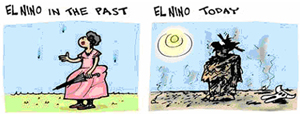
Currently there is an 80 per cent chance that an El Niño, warming sea surface temperature in the eastern Pacific (SST-EP), will develop by July-August-September of 2014, or it may develop by October-November-December of 2014. Whatever the timeframe is, this El Niño could have a big global impact and may be even more severe than before (the Figure illustrates a hypothetical comparison of the impact of El Niño in the past and today).
While the El Niño forecasts published in April lean towards a strong El Niño in 2014 (e.g., like the 1997 event), the forecasts in May tended to show a weaker event than that in 1997. This scribe also anticipates a weaker than 1997 event this year because of some favourable ocean conditions (e.g., currently the negative (cold SST-EP) or neutral phase of Pacific Decadal Oscillation (PDO)) that may prevent this year's El Niño from becoming as strong as the 1997 event (e.g., PDO was in positive phase (warm SST-EP) during the 1997 El Niño). This is indeed good news for Bangladesh. However, this year's El Niño may still cause lower than normal rainfall, warmer than normal temperature, drier than normal climate, and higher than normal cyclonic activities for the next six to eight months in Bangladesh.
Some of the most important sectors where the impacts of 2014 El Niño could be visible include the following.
AGRICULTURE: El Niño impacts on agriculture in Bangladesh can be strong, as demonstrated in the past El Niño events, and are linked to water shortages, soil degradation and disruption in planting seasons. Low rainfall is directly associated with reduced rice yields. This would significantly affect food security. Droughts during El Niño may be interrupted by devastating cyclones, as occurred on November 29-30, 1997 and April 29-30, 1991 that killed 150,000 people. Drought conditions can also lead to devastating forest and grassland fires that threaten biodiversity, wildlife and livelihoods.
WATER AND ENERGY: In Bangladesh, water supply and availability will be impacted by drought conditions arising out of El Niño. For water systems that do not have a reliable surface water source, reduced rainfall could create shortages in the water supply. Water users relying on groundwater, may see a degradation in water quality as lack of groundwater recharge from reduced rainfall can lead to increased saltwater intrusion. Already water-stressed areas may become more stressed with reduced rainfall. These impacts will also be felt in the energy sector as hydropower production may decline due to less water availability in reservoirs and rivers. If hot conditions persist, energy use for cooling can put additional demands on energy grids. However, water and power problems are nothing new in Bangladesh; even without El Niño Bangladesh had already suffered the severe effects of water and power shortages. The El Niño of 2014 is likely to further aggravate this problem.
URBAN AREAS: As rural, especially agricultural areas, are impacted by El Niño conditions, cities may experience high rates of migration that can put a strain on the provision of basic and social services. Additionally, reduced agricultural productivity will threaten cities with food security challenges, even more pronounced among already vulnerable groups like the urban poor.
HEALTH SECTOR: There is evidence that El Niño is associated with a heightened risk of certain vector-borne diseases in Bangladesh. This is particularly true for malaria, but associations are also suggested with respect to epidemics of other mosquito-borne and rodent-borne diseases that can be triggered by El Niño weather conditions. Some recent studies have found correlations between cholera incidence in Bangladesh and sea surface temperatures in the Bay of Bengal, which are also affected by El Niño.
PROBABILITY OF NEW CIVIL CONFLICTS: Drought is widely believed to relate to a conflict, because it may lead to a local scarcity and an increased resource competition, fresh water is the resource that is most vital for human existence. The government of Sudan, NGO officials and some scholars have used the drought in the mid-1980s as a partial explanation for the conflict and killings in Darfur (Moon, Ban-ki in 2007, "A Climate Culprit in Darfur," Washington Post, June 16: A15). Despite criticism, the emerging research on effects of water scarcity on an armed conflict has produced an important insight that "a negative change in water accessibility appears to be harder to adapt to and potentially more important for conflict." Similarly, civil conflicts arising throughout the tropics double during warm or dry or drought (El Niño) years relative to normal or cold or flood (La Ninã) years (note that La Ninã is the opposite of El Niño). While historians have argued that El Niño (and La Ninã) might have driven the global civil conflicts in the distant past, a new study (Nature 476, 25 Aug 2011) directly associated planetary-scale climate changes with global patterns of a civil conflict by examining El Niño (and La Ninã) and concluded that the new civil conflicts arising throughout the tropics doubled during an El Niño year relative to a La Ninã year or a normal year. This result, which indicated that El Niño (and La Ninã) may have had a role in 21 per cent of all civil conflicts since 1950, is the first demonstration that the stability of modern societies are strongly related to the global climate. Bangladesh also had serious civil conflicts and political unrest during the El Niño years in 1970-72, 1982-83, 1991, and 2013-14.
This year's El Ninõ has generated a global momentum for early preparation. Many national and international research and application climate centres are constantly monitoring this event and regularly updating early warnings for vulnerable communities across Asia and the Pacific. This scribe believes, as one of the most resilient nations in disaster management, the climate experts and concerned application agencies in Bangladesh are seriously monitoring this ongoing El Niño event. Finally, as 2014 develops into an El Ninõ year, this could exacerbate the possibility for new civil conflicts to erupt. The government and all political parties should give serious consideration to this sensitive climate issue during any political activities.
Dr. Md. Rashed Chowdhury is Principal Research Scientist, Pacific ENSO Applications Climate Centre (PEAC), Joint Institute for Marine and Atmospheric Research (JIMAR), University of
Hawaii at Manoa (UHM).
rashed@hawaii.edu
© 2026 - All Rights with The Financial Express

