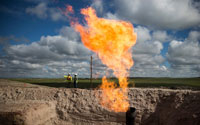
 Fracking\'s future is in doubt as oil price plummets.
 A few days ago the global benchmark Brent crude oil price index indicated Brent crude for February delivery to be at $46.10 a barrel, the lowest in more than five and half years. The fall came after Wall Street investment titan Goldman Sachs slashed its price outlook, adding to anxiety about global oversupply, weak demand and soft growth in the key Chinese and European markets. This was a continuation of the dramatic plunge that has seen oil prices halved since last June.
It is difficult to assign any single cause for this development but analysts think that it is mostly due to slackening economic growth and weakening demand from major consumers coupled with an increase in supply due to shale oil in the United States and tar sands in Canada. Analysts also believe that this downward trend will continue unless the world's major producers, especially the Gulf state members of OPEC (OrganiSation of the Petroleum Exporting Countries), move to cut their output in order to stabilise prices - an option they have avoided until now.
Economists consider that in the short term, the drop in oil prices could create many more winners than losers, in part because most of the world's population lives in energy-importing countries such as China and India. It is also thought such a process will lead to a big cash transfer from oil producers to oil consumers and savings for consumers.
The Wall Street Journal has reported that as of December, the aggregate savings for Americans was estimated at over $90 billion. This means that the U.S. economy will be boosted on balance, and would leave American consumers with more to spend. The United States, it may be pointed out, still remains the world's largest single consumer of oil, and a net importer despite its booming shale production. That also means that U.S. consumers will see lower heating bills this winter, and gasoline prices will continue to plummet. Businesses stand to benefit too, as energy costs taper off and consumers find that energy savings have left them with more money to spend.
However, the decline in price of oil could also undercut the U.S. fracking boom, which has brought U.S. oil production to levels not seen in several decades. In fact, the growth of fracking - or hydraulic fracturing, the process by which oil or gas are extracted from shale formations using a chemical flush - is considered a key factor dragging down global prices.
Some economists say OPEC is deliberately refusing to reduce production in part to weaken the competitive threat of the burgeoning U.S. energy industry, whose profitability depends on a higher price due to its comparatively steep production costs. The OPEC decision has been strongly opposed by Venezuela and sanction-struck Iran. Venezuela in particular appears to be in a tight spot because its shrinking foreign currency reserves rely 96 per cent on oil exports. With an inflation rate close to 60 per cent fueling social turbulence, some analysts fear, the country could default on its debts if oil prices don't rebound.
Even so, most analysts do not see shale production slowing in the short term. The U.S. remains dead-set on weaning itself off its longtime reliance on foreign oil and severing energy ties with the tumultuous Middle East, more generally.
On the other side of the paradigm, we have Russia already under pressure from Western sanctions imposed after their intervention in Ukraine. The diving oil prices have sent the Russian Rouble into a steeper nosedive. Russia, it may be recalled, is in a situation where oil and gas exports constitute over two-thirds of its export income. It stands to lose about $100 billion in revenues in the short term if oil prices stay as low as they are. Rachel Ziemba with Roubini Global Economics has mentioned that current estimates project a 4.0 per cent contraction of Russia's GDP as a result of the falling oil price. Policy planners in Russia are consequently facing anxiety with regard to how the Government should initiate policies to maintain financial stability and avoid default. This is also being exacerbated because of wider concerns of investors about Russia's growing geopolitical isolation, and Kremlin's insistence on staying the course in Ukraine even as the economy slides toward recession. Russia's Energy Minister, Alexander Novak, has nevertheless maintained that Moscow will not curb oil production to stabilise prices. He has observed that "If we cut, the importer countries will increase their production, and this will mean a loss of our niche market".
It is clear that the pre-dominant share of responsibility for allowing prices to fall so low has fallen on the shoulders of Saudi Arabia, the world's largest oil exporter and leader of OPEC. They are looking at revenue losses of up to US Dollar 100 billion if the price does not rebound. Analysts have, however, determined that the prognosis for Saudi Arabia, along with fellow Gulf petro-states Kuwait and the UAE, who have been seriously hit by the price drop, is not so disastrous in the short term. These countries hope to ride over their current difficulties through their foreign currency reserves. It will enable them to sustain their oil-based economies for the coming months. It may also be mentioned that production costs among the GCC (Gulf Cooperation Council) states hovers at less than $10 per barrel. In all probability, this is persuading the Middle East oil producers to believe that higher-cost producers, like U.S. shale, will be forced to stem production sooner, thereby ceding market share once again to the Gulf.
It is also being pointed out that the decision by GCC to forsake the path of inducing higher global prices by cutting production (resulting in budget surpluses for OPEC members and all the benefits that come with it) might have also been induced by the anxiety that these short-term gains would have encouraged more global investment in unconventional oil extraction, encouraging research in renewable technology and hastening the gradual but inevitable shift toward alternative energy use around the world.
While the decision not to try to force prices back up through cutting supply may seem counterintuitive, maintaining oil production levels is a good long-term strategy. The decision puts pressure on U.S. shale oil extraction, which can't produce as cheaply as conventional petroleum production. Estimates on the break-even price of shale oil vary but most sources agree that low oil prices shall, in all likelihood, discourage investment in new fracking drilling sites that would further erode OPEC's global market share (currently about 40 per cent). Moreover, cheaper oil will also discourage potential investors seeking other oil sources through deep-water drilling and tar sands.
Nevertheless, time has come for Gulf states to acclimate themselves to the growing reality of alternative energy sources and for the need to set in place policies that will modify their citizens' acceptance of a more realistic social contract, in which amenities and subsidies are at least partly reduced.
Some economists are, however, taking on a more cautious approach. They are reminding the policy planners that the last time Saudi Arabia cut its production amid a similar price decline in 1980s, it sufferred a loss of market share. It may be recalled that when Riyadh slashed production by nearly 75 per cent between 1980 and 1986, investors responded by turning their attention - and funds - to building up the nascent oil infrastructure in Norway and the U.K. It is therefore being suggested that the more populous OPEC members, with greater domestic budgetary demands, could suffer more. In this context, special reference has been made about Iran, weighed down by international sanctions and a sinking currency. It has been remarked that the current OPEC policy could also see a 5.0 per cent decline in Iran's GDP (gross domestic product) as a direct result of the price drop. Nigeria and Angola, in Africa, are also being bracketed in similar straits.
The biggest winners from falling oil prices, so far, appear to be emerging Asian economies (with the exception of Malaysia, an oil exporter), which consume a massive volume of foreign oil to fuel their burgeoning economies. According to Capital Economics, oil accounts for up to 18 per cent of total imports in Asia and 3.4 per cent of the region's GDP. Lower prices, analysts say, could result in an expansion of the region's GDP - perhaps overcoming the effect of flagging growth in China and Japan that could otherwise drag down Asia's demand and consumer curve. This decline in oil price is also expected to help countries like India and Indonesia given those countries' high oil consumption and dire need for investment in infrastructure. For Indonesia, the timing of the oil price fall has been especially fortuitous because of new President Joko Widodo's recent decision to scrap gas subsidies to cover budget shortfalls. China, which last year surpassed the U.S. as the world's biggest importer of crude oil, could stand to gain the most. Even if oil prices leveled off in the $80 per barrel range by end-2015, as is being forecast by some economists, China could still see a $50 billion boost according to the Wall Street Journal.
The writer, a former Ambassador, is an analyst specialised in foreign affairs,right to information and good governance.
mzamir@dhaka.net
© 2026 - All Rights with The Financial Express

