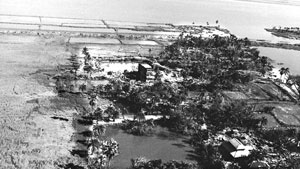
 The November 12, 1970 cyclone in the coastal belt of Bangladesh (then East Pakistan) left 300,000 to 500,000 death tolls which make it the deadliest hurricanes in the world history: Aerial view of the coastal area of Patuakhali littered with dead cattle.
Tropical cyclones from the Bay of Bengal, accompanied by storm surges, are one of the major hazards in Bangladesh. They occur mainly in April/May and October/November. Bangladesh has a long history of facing cyclones in the month of November:
* On November 12, 1970, a super cyclone caused the death of about 500,000 in Bangladesh coastline.
* On November 24, 1974, a cyclone struck the coastal areas near Cox's Bazar and Chittagong, including the offshore islands. Casualty: 200 people, 1000 cattle.
* On November 05, 1983, a cyclone hit Chittagong and Barisal region. Casualty: 300 fishermen with 50 boats missing and 2,000 houses destroyed.
* On November 19-22, 1998, a cyclonic storm, with wind speed up to 90 km/hour, and a storm surge of 1.22 to 2.44 meters hit coastal islands.
* On November 15, 2007, Sidr, a cyclone, hit the coastal area of the country, affecting approximately 8.5 million men, women, and children and killing about 4,000 people. One and a half million homes were partially or completely destroyed and around 1.2 million livestock were killed and 2.4 million acres of crops were damaged. The overall economic loss amounted to US$ 1.7 billion.
Bangladesh has invested sizeably in cyclone management over the last three decades, particularly under the democratic governments and now gained some capability to manage cyclone fallout. However, the people of hazardous coastal areas, particularly the poor still live with extreme uncertainties, risks and multifarious vulnerabilities.
Considering history, current capacity, risk and vulnerability of Bangladesh to cyclones, the following recommendations are made for relevant organisations/actors for appropriate strategies and actions in improving further the cyclone emergency and cyclone risk reduction performances.
CYCLONE EMERGENCY MANAGEMENT: An effective emergency management encompasses those measures taken before a disaster. These are aimed at minimising loss of life, disruption of critical services and damages when the disaster occurs. Prior to any cyclonic situation, a contingency plan must provide the basis for identifying and further developing response capacity like (1) analysis of context, risk mapping and identification of likely emergency scenarios, (2) mapping of capacity, vulnerabilities, constraint and resources, tangible/intangible assets, and (3) identification of other external organisations' capacity, constraint and resources in the department/ministry/area/country/region.
It is important to prepare/review contingency plan in all the administrative layers of coastal areas with the provision of necessary resources and its effective management as the pick month November begins. Position of emergency rescue teams, condition of cyclone shelters and emergency medical facilities across the vulnerable locations of the coastal belt are to be reviewed quickly by relevant organisations to face any emergency situation in time. Revisiting the level of preparedness at family, community and organisational level is very much needed by the concerned individuals and authorities in line with Standing Orders of Disasters (SOD) of the government of Bangladesh.
REDUCTION OF CYCLONE RISKS: According to the Coastal Zone Policy (2005) of the government of Bangladesh, 19 districts, out of a total of 64, covering a total of 147 upazilas (sub-districts), are in the 'coastal zone'. Cyclones and storm surges are a continuous threat for the coastal population. Lives, livelihoods, assets, livestock and property are lost in cyclones. The poor always face sufferings and difficulties to cope with and overcome the losses incurred. Nobody can avert cyclones. But, the negative consequences could be reduced by taking coordinated and comprehensive programmes.
The respective authorities at different levels should strengthen capacity-building initiatives of local government and communities at risk. A well-organised and coordinated effort is needed to further strengthen local-level planning, implementing decision-making process and allocating resources to local government for cyclone-proof programmes in the vulnerable locations. Proper resources from the central government and other sources should be ensured by the authorities and policy-makers.
Mainstreaming disaster risk reduction and climate change adaptation in existing development works and future initiatives of different government ministries/departments and non-government organisations (NGOs) of the country is very much important. Concerned authorities should develop cyclone data base, which is very important to carry out detailed study and planning. The government authorities and NGOs need to redesign their development programmes with the active participation of the most vulnerable communities to ensure that they maximise cyclone mitigation potentials and incorporate traditional community-coping practices which are fit technically, socially, environmentally and economically.
The existing embankments, dams, dikes and other infrastructures have to be critically reviewed. An effective strong green belt should be developed with trees and embankments considering present and future vulnerabilities and risks. Some targeted but tested cyclone risk reduction activities, both structural (embankments, polders, river protection, cyclone shelters, housing schemes, roads, water and sanitation facilities) and non-structural (improving awareness and networks, early warning dissemination, coordination mechanism etc.) could be undertaken/reinforced in consultation with community at risk and relevant experts/organizations. Private sectors could be involved in structural measures with appropriate facilitation and accountability mechanism from the government authorities.
But limitations such as outfitted difficulties of physical workings and weak management set-up for operation, maintenance and protection, environmental consequences and lack of engagement of people of the interventions need to be addressed effectively by the authorities. Adequate number of cyclone shelters with necessary facilities particularly for women, children and disabled people is very much essential. Maintenance of existing cyclone shelters involving community in risk is also an effective way to manage consequences of cyclones.
Rapid actions are needed by respective authorities and duty bearers to make new protections and to complete ongoing repairing work of embankments/dykes in vulnerable spots of coastal region in conjunction with community and local governments as soon as possible. Any sorts of irregularities, dilemma might cause further loss of lives, damages of crops and sufferings of the people due to cyclones and tidal surges. Appropriate allocation, rapid flow of fund and effective monitoring and supervision of these kinds of urgent activities should be ensured by the authorities responsible at different layers. Role of local governments and communities at the different stages of the work needs to be emphasised, supported and ensured by the authorities.
Effect-minimising strategies such as the use of cropping patterns which minimise exposure to losses and the setting up of cyclone smart income-generating activities need to be promoted. Crop types and patterns should be selected according to susceptibility of cyclone and salinity. Urgent efforts should be made by the concerned agencies to find new variety of species which have cyclone and salt resistance.
All livelihood initiatives in the cyclone-prone areas have to take into consideration cyclone and relevant aspects so that the initiatives do not give in, rather yield some benefits to the target people. Involvement of the community and enlisting their inputs in any kind of programme design and relevant issues affecting their lives and livelihood will make the intervention process easier and impact-bearing.
Augmenting resilience to cyclones of coastal area is a noteworthy step to protect lives, livelihoods, crops infrastructures, assets and property in Bangladesh. Both short and long-term effective initiatives in this from the responsible authorities and organisations, are very much important for moving towards achieving the Disaster Management Vision of the government of Bangladesh.
The writer is disaster risk reduction and climate change adaptation practitioner and a Fellow of EPFL, Switzerland.
Views expressed are of the writer's own.
farid.hasan2008@gmail.com
© 2026 - All Rights with The Financial Express

