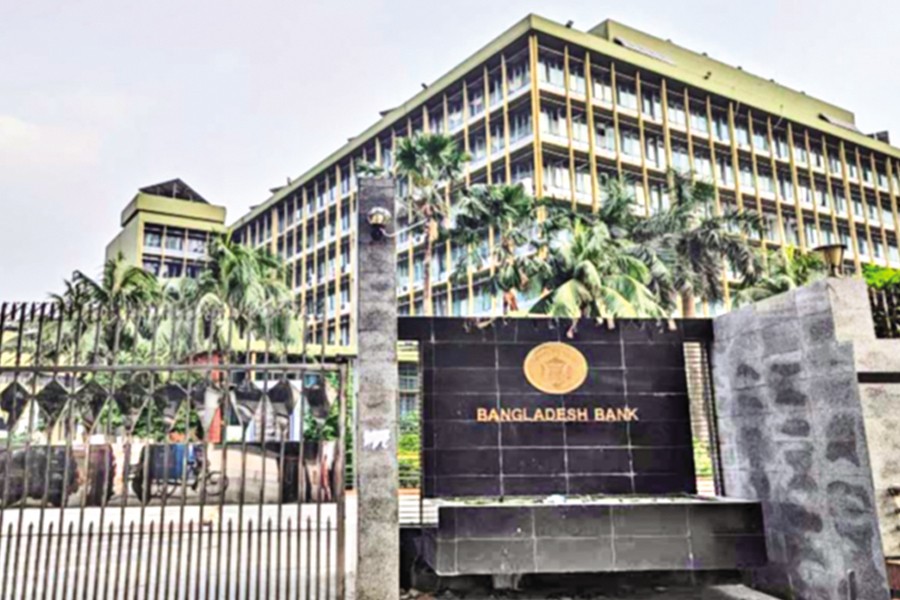
 Head quarters of Bangladesh Bank, the central bank of Bangladesh, in Dhaka —FE File Photo
 This article is inspired by recent discourses and insightful commentaries across the print media on the “Need for an Independent Central Bank (ICB).” Few would contest their arguments that political dominance over the Bangladesh Bank (BB) has undermined monetary discipline, distorted credit allocation, fueled inflationary pressures, and, most damagingly, led to foreign exchange mismanagement. Yet none of these commentaries have probed the deeper question: what does independence truly mean—and are the world’s so-called “independent” central banks really the models we imagine them to be?
The European Example—Not Quite What It Seems: Promoters of ICB almost always cite the Federal Reserve, the Bank of England, and “all central banks of the European Union” as paragons of independence, prohibited from financing Treasury deficits. Formally, that is true: Article 123 of the Treaty on the Functioning of the European Union forbids direct purchase of government debt. But reality long ago outpaced principle. During the euro-debt crisis, the European Central Bank (ECB) launched a succession of bond-buying programs—the Securities Markets Programme, Outright Monetary Transactions, and later, Quantitative Easing and the Pandemic Emergency Purchase Programme. These initiatives indirectly financed governments through secondary markets, lowering borrowing costs and expanding the money supply—legally clever but economically equivalent to direct financing.
Likewise, during the pandemic, the Federal Reserve reopened and expanded its dollar swap-line arrangements with major central banks, including the ECB, to ease global funding stress. Through this facility, the ECB temporarily drew U.S. dollars from the Fed and on-lent them to euro-area banks. Its borrowing peaked at about $140–$150 billion—well below the roughly $449 billion global total that included the Bank of Japan. These short-term liquidity swaps—not conventional loans—were fully repaid as financial conditions stabilised later that year.
This episode also underscored how interdependent ICBs have become. Even as the ECB formally adheres to Article 123 of the EU Treaty, its reliance on the Federal Reserve’s dollar liquidity revealed the practical limits of monetary sovereignty. Nor are all EU central banks bound by Article 123. Seven members—Sweden, Denmark, Poland, the Czech Republic, Hungary, Romania, and Bulgaria—retain their own currencies and domestic monetary authority. Their “independence” exists by statute yet remains politically intertwined; Sweden’s Riksbank, for instance, coordinates closely with its finance ministry. Thus, Europe’s experience reflects delegated autonomy within negotiated political limits. Even the ECB’s Executive Board is appointed through intergovernmental consensus and remains accountable to the European Parliament. Independence, then, is conditional, not absolute.
Bangladesh’s Challenge — Legal Independence, Political Intrusion: A central bank cannot be sovereign above the state. It must be shielded from political whim yet answerable to democratic oversight. The world’s strongest institutions balance these two forces through transparency and accountability. The US Federal Reserve’s governors serve 14 years long, staggered terms and operate on self-financing revenues, but the Chair must testify before Congress twice a year. The Bank of England gained operational independence in 1997, yet its inflation targets and metrics are set annually by the Chancellor’s remit. These models show that independence is a negotiated trust—not unbounded freedom.
On paper, BB already enjoys autonomy under the Bangladesh Bank Order of 1972. It designs monetary policy, manages exchange-rate operations, and regulates banks. In practice, it remains hostage to fiscal dominance and political patronage. Successive governments have used the BB to monetize deficits, reschedule bad loans, and rescue politically connected borrowers. When the regulator becomes a rescuer, monetary policy turns into fiscal policy by stealth. The flaw lies not in law but in governance.
In truth, on matters of monetary and macroeconomic policy, as well as data interpretation and analytical expertise, BB has never been qualified for genuine independence. Its institutional culture remains bureaucratic rather than technocratic; promotions reward compliance over competence. Except for the present governor, senior executives with doctoral training or research experience in macroeconomics, financial modelling, or international monetary systems are few and far between. Policy decisions are typically reactive, driven by circulars rather than analytical forecasts. Even internal publications avoid critical assessments that might contradict ministerial narratives. This intellectual deficit leaves the institution dependent—not on law, but on permission. A bank so habituated to subservience cannot transform overnight into an independent authority.
For genuine independence, reforms must ensure:
• Appointment transparency—governors and board members confirmed by Parliament, not by executive decree.
• Budgetary autonomy—financing operations without annual approval from the Finance Division.
• Mandatory reporting—quarterly updates to Parliament on inflation, liquidity, and credit.
• Term security—dismissal only for defined misconduct, never for policy disagreement.
Without such safeguards, independence remains ceremonial — word in law but a ghost in practice.
The Myth of Technocratic Perfection: The global gospel of central bank independence rests on the assumption that insulated technocrats will always act in the public interest. History warns otherwise. The 2008 financial crisis erupted under some of the world’s most independent central banks, the Federal Reserve, ECB, and Bank of England. Their autonomy did not prevent asset bubbles or reckless financial innovation; it may even have delayed corrective action. Economists such as Stiglitz, Blanchard, and Buiter have cautioned that absolute independence can turn central banks into ideological fortresses—fixated on inflation while ignoring jobs and growth. For developing economies like Bangladesh, where employment and investment are as vital as price stability, a dual-mandate model like the U.S. Federal Reserve’s may serve better than narrow inflation targeting.
Inflation Control Needs Coordination, Not Isolation: Some op-eds correctly identify excessive liquidity during FY2020–23 as a key driver of inflation. Yet Bangladesh’s inflation also stems from structural bottlenecks—energy shortages, import constraints, and supply-side weaknesses. Monetary tightening alone cannot cure these. Fiscal prudence, credible data, and coordinated supply management must complement central bank policy. An “independent” central bank working within policy incoherence will still fail—just as the ECB struggled when eurozone fiscal policies diverged. Autonomy must coexist with coherence.
The deeper challenge lies in distinguishing demand-pull from supply-push inflation. Demand-pull inflation occurs when consumer and business spending outpaces production capacity, making higher interest rates an appropriate corrective to cool demand. Supply-push inflation, by contrast, stems from cost shocks—rising fuel, food, or import prices—that compress output and purchasing power simultaneously. In such episodes, raising rates can aggravate the problem: investment contracts, unemployment rises, and yet prices remain stubbornly high. The policy dilemma, therefore, is not merely technical but diagnostic—identifying which inflation one is fighting before pulling the trigger.
Understanding and diagnosing the sources of inflation, recession, and growth require deep analytical expertise in macroeconomics, monetary theory, and data interpretation. Bangladesh Bank, given its current capacity, would need years—perhaps a decade—to cultivate such institutional competence. Until then, its policy responses are likely to remain reactive rather than anticipatory, constrained by limited research depth and an absence of high-calibre economists trained to distinguish between cyclical trends and structural shocks.
Lessons from Europe: Europe’s crisis decade offers three relevant lessons:
1. Rules must flex in crises. The ECB bent its own no-financing rule to preserve the euro. Bangladesh Bank will need similar discretion in emergencies.
2. Credibility matters more than law. Independence is sustained by transparency, not by decree. Bangladesh Bank’s credibility has eroded from data opacity and delayed responses; rebuilding trust is paramount.
3. Coordination trumps isolation. In a remittance- and export-dependent economy, monetary policy must align with fiscal and external-sector strategies.
Toward Genuine Autonomy: For independence to be meaningful, Bangladesh needs a Central Bank Reform Act anchored on three pillars:
1. Legal insulation. prohibit deficit financing; fix leadership terms.
2. Professional capacity. strengthen analytical divisions, recruit economists and financial engineers, empower research units to speak without censorship.
3. Public accountability. publish minutes of policy meetings; report to Parliament, not ministries.
Question: Does BB’s research and statistics departments have trained economists and modern data systems needed to model shocks, forecast inflation, or interpret trends? Without credible data and professional analysis, autonomy becomes blindness. Independence without intelligence is as perilous as dependence without discipline.
BB’s path to genuine autonomy will not begin with a new statute but with a new creed. It demands leadership by world-class, research-trained economists—professionals adept at interpreting data and versed across macroeconomics, monetary policy, international trade, and finance. More than credentials, they must possess the moral courage to say “no”—to ministers, to cronies, and to populist temptations that threaten policy integrity. For in the final reckoning, the only currency that never loses value is public trust.
Dr Abdullah A. Dewan, Professor Emeritus of Economics, Eastern Michigan University (USA),
Former Physicist and Nuclear Engineer, Bangladesh Atomic Energy Commission
aadeone@gmail.com
© 2026 - All Rights with The Financial Express

