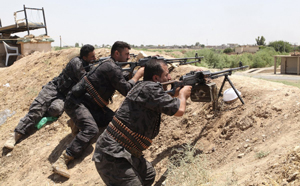
 The Kurdish army, known as Peshmerga, forced the ISIS to retreat from Kirkuk.
 The Islamic State of Iraq and Syria (ISIS), a little known radical outfit operating in the border zones of Syria, Lebanon and Iraq, has suddenly gained strength and marched towards Baghdad. It occupied the second most-populated Iraqi city of Mosul in early June with little resistance from the country's army. Then it moved to oil-rich Kirkuk, on the outskirts of the Kurdish region, but retreated after a fierce resistance from the Kurdish army known as Peshmarga.
ISIS proceeded towards the central Iraq and brought Baiji, Tikrit, Diyala, Faluja, Ramadi and other towns under its control. They are now positioned 40 miles north-west of Baghdad. Sunni soldiers and officers of the Iraqi army have reportedly either defected or surrendered to the invading forces. The government has called upon the Shiite radical groups, including Mehdi Army of Muktada al- Sadr, to thwart the impending onslaught of ISIS. Nouri al-Maliki, the Iraqi Prime Minister, who in 2011 had refused to grant immunity to the US contingent, has appealed to the United States to deploy striking force to stop the ISIS from moving any closer. ISIS is now estimated to have 10,000-strong combat forces.
DEMOGRAPHY OF IRAQ: It is imperative to be acquainted with the demography of Iraq in order to comprehend the depth of the present crisis. Among Iraq's population at 30 million, about 50 per cent are Shiite Muslims, 30 per cent Sunnis, 15 per cent Kurds and the remaining 5.0 per cent comprises Christians, Jews and other communities. During the period under UN-approved sanctions, the northern region comprising Sulaimania, Dahuk and Erbil, popularly known as Kurdish land, was enjoying quasi-independence. The region used to get 13 per cent of the oil revenue.
The southern region, encompassing Hilla, Najaf, Karbala, Basra, is predominantly inhabited by the Shiites, while the central region composed of Amber, Salahdin and Diyala is known as Sunni heartland. Baghdad, the capital city, has about 8.0 million people --but they are highly mixed as a result of intermarriages between the Shiites and the Sunnis. The mosques surrounding the graves of great Sunni sufis Abdul Quader Gilani and Imam Abu Hanifa, located in Baghdad, used to attract huge crowds on Friday prayers. Likewise, Shiite mosques in Zadria, Mutanabbia and Al-monsur in Baghdad had large attendance of devotees in the evenings. Both the communities have had peaceful coexistence for decades.
Following the US-led invasion in 2002, the sectarian harmony, that had hitherto existed, came under severe strain. During the rule of Saddam Hussein, the administration was dominated by Sunnis, but Shiites were not marginalised. Many cabinet ministers belonged to the Shiite and Christian communities. During visits to Najaf and Karbala, this writer witnessed large crowds of devotees coming from the neighbouring Gulf countries, and there was no feeling of tension in the area. Busloads of pilgrims would travel from Iran via the Kurdish areas. They used to spend the night in Baghdad prior to visits to the holy sites, and the entire area would take a festive look.
THE BIRTH OF INSURGENCY: However, during the US occupation period the situation changed -- Shiite religious sites in the south and central regions came under regular attacks and got damaged. In an act of retaliation the Sunni mosques were also desecrated. The churches were set on fire and the Christian community had to shut down the churches for some time.
The birth of insurgency and the growth of sectarian conflicts were the corollary of flawed policy of the US-installed Provisional Administration. The infamous 'debathification' resulted in the total numbing of governance. Thousands of army and police personnel were laid off who later on joined either the insurgency or embraced the Shiite militant ideology. The bureaucracy got disoriented as the senior officials were downgraded, while their junior staff got promoted to top positions. The 90,000 Food Agents, who performed the only function of collecting food commodities from the stores and releasing those to the people, were reinstated only after the UN insisted. Since the Kurdish region was exempted from the purge, the administration continued without much disruption, and insurgency could not sprout in the north.
MALIKI FAILED TO ACT AS A UNIFIER: Nouri al-Maliki, who passed most of his period of exile in Tehran and Damascus, became the Prime Minister in 2007. The US negotiated the 'drawdown' of troops with his administration. He refused to allow any residual foreign troops to continue staying in Iraq, presumably at the advice of Iranian clerics. Maliki failed to act as a unifier, which was much needed in the conflict-torn country. He marginalised the Sunni community so much that they resigned from his cabinet. He planned to arrest Tariq al-Hashimi, the Sunni Vice President. Hashimi fled to Saudi Arabia. He was tried in absentia and sentenced to death. Maliki also alienated the Kurds: in November 2013, Kurdish soldiers in the 16th Brigade refused to take orders from the Iraqi commanders. Sunni tribal leaders in Amber helped the US troops to fight out the al-Qaeda, but Maliki fought against them. Maliki was determined to send Saddam and his associates to gallows, but he had alienated the Sunni community as well.
Ayatullah Sistani, the Shiite cleric in Najaf, has echoed the appeals of Maliki. He called upon the "citizens who are able to bear arms and fight terrorists should volunteer and join the security forces to achieve this holy purpose." Maliki is also looking to Iran for support and has reportedly spoken to President Rouhani. Iran is said to have agreed to send troops to assist the Iraqi army, but warned that the presence of foreign troops would destabilise Iraq.
PRESSURE ON THE OBAMA ADMINISTRATION: In the meantime, pressure on the Obama administration has been mounting to rescue the beleaguered Maliki government. President Obama had earlier ruled out sending ground troops, but has now dispatched 150 military personnel to arrange evacuation of the Americans; and to train and advise the Iraqi armed forces. This was exactly how the US got dragged into the Vietnam War in 1960. Americans by a margin of 58 to 36 per cent have opposed getting involved in another war. The Republican Senators have launched scathing criticism of the President for letting the gains achieved in Iraq wasted by failing to take pre-emptive actions. These hawks have conveniently forgotten that 4,400 American soldiers were killed, 32,000 seriously injured and the cost reached $770 billion in Iraq war. Vice President Joe Biden rightly said the previous administration had fought two wars on credit cards.
SECTARIAN CLEANSING: Meanwhile, sectarian killings have begun in and around Baghdad, and a few hundred people have been killed. Over 300 Iraqi troops have reportedly been killed in fighting with ISIS. About 1.5 million people have been displaced -- they are now staying at makeshift camps in the middle of deserts in the temperature of 50 to 60-degree Celsius.
The present crisis has been the outcome of 'sectarian cleansing'. No government can function effectively keeping away 30 per cent of its population from the mainstream. The geopolitics of the region demands a political and not military solution to the crisis.
Though Iran has a vast Shiite population, the neighbouring countries, including Turkey, have overwhelming Sunni populations. They are aggrieved at the neglect of their fellow Sunnis in Iraq. In the recent past, so much blood has flown through the Tigris that nothing short of a confederation would provide a durable solution to the festering crisis. Kurds in the north, Shiites in the south and the Sunnis in the centre could form autonomous governments under a Central Government with adequate representation from various sectarian communities.
LITMUS TEST: US Secretary of State John Kerry has just visited Iraq and met with the leaders of different sectarian groups. It is not clear how forcefully he has demanded the formation of a unity government led by a new Prime Minister. Kerry can make US assistance conditional to a broad-based inclusive government which can work out the strategy of future governance and steer the country out of the current abyss.
The re-engagement of US military in Iraq would only escalate the sectarian conflicts in and around that country. Sunnis in neighbouring countries would be tempted to further fuel the insurgency by extending support to ISIS. The US must not fail the litmus test.
"We must not create more enemies than take off at the battlefield", the US President said last month.
The writer is a former official
at the United Nations.
darahman.chowdhury@
hotmail.com
© 2026 - All Rights with The Financial Express

