Abdur Rahman Chowdhury from Vriginia, USA | June 04, 2015 00:00:00
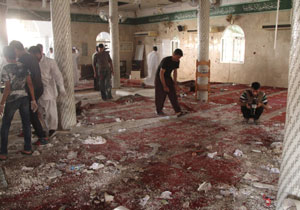 Suicide bomb attack scene at the Imam Ali mosque in Saudi Arabia\'s eastern province of Gatif, May 22, 2015. ISIS claimed responsibility of the attack. — Reuters photo
As primaries of the US presidential election begin to gain momentum the debate on whether Iraq invasion was justified has resurfaced. Presidential candidates have been asked: "After finding out there were no weapons of mass destruction (WMD), would you, if you knew that, have been in favour of Iraq invasion?" Jeb Bush, younger brother of former President George Bush, faltered - and then replied he would not have invaded. Marco Rubio, another presidential hopeful, said in March that he did not think the war was a mistake but now reversed his position and said he would not have favoured invasion. In the coming weeks reactions from other candidates would be forthcoming. Hillary Clinton, major contender of Democratic Party's nomination, who had voted in favour of the war resolution in 2003, now admits the war was a mistake.
This debate, twelve years after the invasion, is incongruous. The entire nation was cajoled by the architects of war (Bush, Cheney, Rumsfeld, Powell and Condoleezza Rice). The state machineries were mobilised to establish that Iraq was in possession of WMD to justify the invasion. And at what cost? More than 4,400 US soldiers died, 32,000 marines severely injured and cost the economy over $ 770 billion. About a million Iraqis were killed, six million displaced and infrastructures worth billions were destroyed. Mayhem still continues. But there is no word of remorse from the architects of war; they justify the invasion. Cheney and Rumsfeld insist the invasion was necessary even without WMD being found. Rice write, "I have many regrets about the run-up to the war, but I am not sorry that we overthrew Saddam." Bush in his memoir writes, "The most volatile region in the world lost one of its greatest sources of violence and mayhem…I believe the decision made in 1991 was correct - and I believe the same is true of the decision I made a dozen years later."
The debate, if any, should focus on the aftermath of invasion. How has the invasion transformed the geo-political situation in the region? How has it affected the United States? If Iraq were not invaded, would the virulent forces now operating with all brutality have come into being? And how would they have behaved?
Saddam Hussein's removal destroyed the sectarian bond, no matter, how it was orchestrated in the society. Major Iraqi cities including Baghdad, Mosul and Basra had large number of families linked between Shias and Sunnis through intermarriages. Though Sunnis were in minority, by mercy of Saddam Hussein, they were holding important positions in the government. But Shias were not ostracized - they were also leading important portfolios in the central and provincial administrations. The southern region stretching from Qarbala to Basra was predominantly Shia inhabited but Sunnis were involved in carrying out trade and commerce having based in the port city, Basra. Thousands of pilgrims would come from Iran during Muharram and other festivals. They would peacefully undertake pilgrimage and travel to Najaf and Karbala without fear and restrictions. Since invasion, the situation has worsened - Shias and Sunnis are positioned against each other, as if, they are in the battlefield. No festivals have taken place without bloodshed in recent years.
During the occupation, de-Bathification, implying expulsion of all those affiliated with the Bath Party led by Saddam Hussein, was ruthlessly pursued. This included police, army personnel, civil servants and even contractors engaged in part time work. About 90,000 Food Agents assigned to arrange monthly delivery of basic food rations to households were threatened to be purged. They were retained at the intervention of the United Nations. Most of the young and energetic defence and police personnel, after being laid off for months, were embraced by the radical groups. They are familiar with the roads, streets and installations and best suited to carry out insurgency. Joined by foreign fighters, the insurgency caused havoc in the country. The insurgency turned intractable and Paul Brammer, the head of Provisional Administration, hastily arranged swearing-in ceremony of his successor and left Baghdad under the cover of darkness. Insurgency was later on brought under a limit with the cooperation of the tribal leaders but the sectarian policy of Baghdad government fuelled the crisis again. Islamic State (ISIS) seized the opportunity and according to international media, former army officials of Saddam regime have taken charge of ISIS striking force. Half of Syria has fallen to the ISIS and about one-third of central region of Iraq is now under ISIS control. A mosque in southern Saudi Arabia was recently attacked, about 35 people were killed and many were severely wounded. ISIS claimed responsibility of the carnage. The grand coalition with Arab states and US air strikes have failed to deter ISIS from making further gains. More troops, more weapons, more air strikes - nothing seems to be working. Pentagon runs short of strategy. Defence Secretary Ashton Carter told in exasperation "the Iraqi army is not willing to fight".
Iraq, under a stable leadership with disciplined military, was a regional power. It was in possession of huge reserve of oil and gas. Iraq was home to the Arab League after Egypt was expelled from the organisation for signing peace deal with Israel. Baghdad always championed the Arab cause. In both 1967 and 1973 wars it provided unqualified support to Egypt-led coalition against Israel. Baghdad also championed Palestinian statehood. The 2003 invasion neutralised Iraq both politically and militarily and paved Iran's emergence as a regional power. Tehran now wields considerable influence over the region. Hamas and Hezbollah owe allegiance to Tehran. The crisis in Yemen can only be resolved at Tehran's terms. Iranian troops are already deployed in Iraq and Syria to confront ISIS. Baghdad and Damascus look towards Tehran for leadership - a trait that could not have been imagined fifteen years ago.
The Iranian government has agreed to discuss the nuclear issue with the US. A framework has already been drafted and by end June an agreement is due to be finalised. The US and EU partners are cognizant of the reality that they are engaged with a regional power that cannot be dictated. De-nuclearising Iran is no longer an option; acquiescing to a nuclear threshold is now the challenge.
Peace talks between Israel and Palestinians have fallen apart due to the intransigence of Benjamin Netanyahu, the Israeli prime minister. He has dismissed the two-state solution. The Palestinians are now approaching the International Criminal Court for justice. If and when election takes place, the moderate Fatah group would possibly be replaced by radical Hamas who would seek a solution in their term.
Military regime in Cairo is determined to eliminate the dissidents. The judiciary is being used to incarcerate thousands and sending hundreds to gallows for opposing the junta. President Sissi, a friend of Obama administration, should pay heed to Washington and make space for the opposition. If not, Egypt might be transformed into a hotbed for ISIS recruitment.
These are the corollaries of destabilising a stable country where people of different sects, faiths and tradition had co-existed for years. The invasion of Iraq unfolded a Pandora's box with profound consequences to the region and beyond. The architects of invasion are, however, unmoved.
The writer is a former official of the United Nations. darahman.chowdhury@hotmail.com
© 2026 - All Rights with The Financial Express

