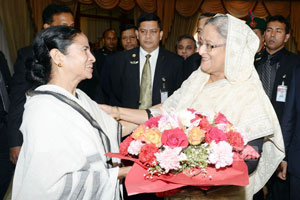
 West Bengal Chief Minister Mamata Banerjee (left) meets with Prime Minister Sheikh Hasina at Ganabhaban on February 21, 2015: Mamata tried to dispel negative impression created in the past by stating more than once that the Bangladesh authorities need to
 Mercurial Chief Minister of Paschimbanga (West Bengal) Mamata Banerjee has left Dhaka after a whirlwind visit where each working hour was taken up with meetings and a carefully planned charm offensive.
Mamata Banerjee first visited Bangladesh seventeen years ago as a Member of the Indian Lower House of Parliament (Lok Sabha). She, however, refused to accompany the former Indian Prime Minister Manmohan Singh during his important visit to Dhaka in 2011. This negative attitude on her part had raised eyebrows in Dhaka. Her absence was meant to demonstrate her opposition to the resolution of two outstanding challenges that have continued to affect bilateral relations between Bangladesh and India - the ratification by India of the Land Boundary Agreement (already ratified by Bangladesh in 1974) and the signing of an agreement related to the sharing of waters flowing down the Teesta River. This stance on her part was severely criticised Bangladesh.
This time round the invitation to Mamata Banerjee to visit Dhaka was extended by Bangladesh Foreign Minister A. H. Mahmood Ali. An example of cultural diplomacy, the visit was organised within the context of the various programmes that are held in Dhaka and the rest of Bangladesh in the observance of the 'Ekushey Dibosh' on the 21st of February every year. The other eminent foreign personality included within this cultural paradigm was the Speaker of the British House of Lords.
Mamata's presence at midnight in the Shahid Minar along with her 39-member entourage and paying of respect to those who have sacrificed their lives for the sake of the Bangla language reiterated her commitment for the 'Language Movement'. It added to the glamour and dignity of the occasion.
The visit of the Chief Minister to Dhaka is being seen against the evolving political perspective and the political landscape both in India - in Delhi as well as in Kolkata - and also in Dhaka. Modi's BJP juggernaut won the Indian national election last year and several other Indian State elections that followed soon after. It was, however, recently decimated in the Delhi election by Kejriwal and his Aam Admi Party. That election also left the Indian Congress Party in tatters (they failed to win even one seat out of seventy in this election). That scenario altered the situation given Mamata's active and open support for Kejriwal in this election. It also boosted her status and that of her party, Trinamool Congress, in the rest of India. As expected, this has not been acknowledged as a positive development by BJP. In fact, rumours have surfaced that the General Secretary of Trinamool is being enticed to leave his Party and be part of the BJP bandwagon. There have also been in recent times disclosure that suggested some associated with Mamata's party were involved in financing Islamist fanatics who are trying to undermine secular democratic politics in Bangladesh.
The unfolding of the above events have led analysts to suggest that Mamata's decision to visit Dhaka and participate in an inter-active engagement process was meant not only to re-assure Bangladesh authorities that she was not trying to subvert the present regime governing Bangladesh but also to stress that she is an important Indian national identity and must be perceived as such by her State's neighbours. It was also meant to underline her growing significance to the voters of West Bengal, particularly the Muslim section (who constitute 31 per cent of the State's population) where she will have to face a fresh State election next year.
Mamata Banerjee had a very active time during her short stay in Dhaka. She tried to dispel negative impression created in the past by stating more than once that the Bangladesh authorities need to have confidence in her friendship and her resolve to help Bangladesh in resolving outstanding issues including the ratification of the Land Boundary Agreement (LBA) and also in the signing of an agreement with regard to the division of waters of the Teesta River.
The reference to the Land Boundary Agreement will encourage Bangladesh because the relevant measures to be adopted in this regard by the Indian authorities are expected to be addressed during the current Indian parliamentary session that has started in Delhi from February 23. Mamata's joining the cavalcade will facilitate the dynamics.
It would be interesting to note here that the Bangladesh authorities did not raise the question of sharing of the Teesta waters with Mamata Banerjee. It was done by Mamata herself.
On the Teesta front, Mamata has hinted that there are certain technical details that need resolution. That is, indeed, going to be a stumbling block. It may be recalled at this point that both Bangladesh (its hydrological experts) and India (its relevant bureaucratic structure as well as their hydrological experts) had arrived at a reasonable compromise after years of discussion (that would not affect the socio-economic prospects of either country) that was expected to be signed during former Prime Minister Manmohan Singh's visit to Dhaka in 2011. That did not happen due to opposition from Mamata's party from Kolkata. In the meantime the situation has seriously deteriorated in the districts (Nilphamari, Rangpur and Dinajpur) through which the Teesta flows in Bangladesh. Water experts revealed last week that the water flow in this river is now hovering around 300 cusecs which is totally unacceptable. It should have been over 5,100 cusecs. Farmers consequently are unable to access to water for irrigation. It is also affecting other areas of economic activity that is the source of livelihood of the rural population in this area. From this point of view, any further delay in concluding the Teesta agreement will not only exacerbate anger and disappointment but also promote desertification in the sub-region, home to a few million people.
West Bengal's Chief Minister needs to understand that Bangladesh has been very patient over the two issues of LBA and sharing of Teesta waters for many decades. However, such action on our part should not be misconstrued any further. If necessary, Mamata needs to play the positive role as was played by her predecessor Jyoti Basu earlier on (during negotiations between Dhaka and Delhi), when India and Bangladesh managed to positively address the issue of sharing the Ganges water flow. She should also persuade the authorities in the Indian State of Sikkim to desist from actions that are contrary to international legal obligations as set forth in the internationally recognised Convention on the Non-navigational Uses of International Water Courses adopted in 1997 and in force since last year (after the completion of the expected regulatory requirements associated with this Convention).
It would be pertinent at this point to note that the Chief Minister during her visit did reiterate more than once that while there may be problems, both countries should focus on solutions. That has been a source of encouragement for all of us. In fact, it reminded me of Prime Minister Modi's observation that the glass is never half-empty. There is always oxygen in that empty space.
It is this context that has generated some optimism between cultural activists on both sides. This has been reflected in the decision to promote greater cooperation in the field of culture - preserving the history of our Liberation struggle and the role played by the then State government of West Bengal and the Central Indian government of Delhi in 1971 in assisting Bangladesh. This will hopefully help remove the knots that exist in the areas related to production of cinemas and the reception of Bangladeshi Television channels for viewers in West Bengal and other neighbouring Indian States. It was announced that a Chair would be established in the name of Bangabandhu in the Kolkata University out of respect for his inimitable contribution towards enhancing the Bangalee ethos. Prime Minister Sheikh Hasina has been invited to inaugurate this Chair and she has agreed to do so.
It also needs to be noted that, as proposed by Mamata Banerjee, consistent with the spirit of a more constructive bilateral relationship engagement between the countries, a decision has been taken to set up a Joint Business Council for the two countries by April this year. This Council will recommend ways for quicker resolution of the long-standing disputes in the trade, business and investment sectors. It is hoped that steps by this Council will help tackle the several para-tariff and non-tariff barriers that have plagued the exports from Bangladesh to India.
In another development, the new Indian Foreign Secretary Mr. S. Jaishankar will soon visit Dhaka. One hopes that exchange of views with him will act as a catalyst for further consolidation of the friendly relations that exist between the peoples of the two countries and the two governments. This can only strengthen South Asia and create greater stability in the region.
The writer, a former Ambassador, is an analyst specialised in foreign affairs, right
to information and good governance.
mzamir@dhaka.net
© 2026 - All Rights with The Financial Express

