When the BNP first proposed the idea of Family Card last year, this scribe immediately wondered: is BNP leadership considering Zakat as a source of funding this initiative? This is because providing such a widespread cash allowance is not financially possible solely depending on government revenue generation given Bangladesh's current fiscal state. Others also had similar question in mind. As soon as BNP made the plan public, various circles started questioning the likely source of funding this initiative, noting that providing allowances to crores of families is now an extremely challenging task considering the current state of revenue generation.
From IDEASFORDEVELOPMENT (IFD), we, however, refrained from making any comment on funding this initiative because BNP still did not make it clear how the programme would be funded. We thus assumed the BNP leadership might be seriously considering Zakat as a potential funding source, and based on this notion, we included the idea of Family Card in our "BNP's Top Ten" video, which was released recently from our YouTube channel.
Our assumption proved correct, most probably.
Over the last few days, it has become clear that Prime Minister Tarique Rahman is indeed seriously considering the Zakat option. He first revealed his government's plan of raising Zakat during an Iftar party few days ago, and the following day, he invited few Islamic scholars to discuss about how Zakat can be administered efficiently. The back to back meetings of the PM proved his seriousness on this issue. These discussions on Zakat surprisingly coincided with the official inauguration of the Family Card programme in Dhaka's Korail slum. Thus we believe that it was not a mere coincidence, rather a planned chain of events.
If what we believe is true, then Prime Minister Tarique Rahman would be the first head of state in Bangladesh's history who is establishing Zakat-one of the pillars of Islam-on Bangladeshi soil. Although Zakat laws and a Zakat Board under the Islamic Foundation have long existed, Zakat has never been a government priority in this Muslim-majority country. Consequently, distribution of Zakat all over the country always remained as individual initiatives, although some private institutions have now emerged who are collecting Zakat and distributing them. Despite this fact, their efforts still seem to be inadequate compared to the country's true potentials of raising Zakat.
The Potential of Zakat Collection in Bangladesh: Theoretically, a successful yearlong nationwide Zakat drive could mobilize 2-2.5 per cent of the gross domestic product (GDP). Based on current GDP of Bangladesh, this could translate to approximately US$10 billion worth of Zakat, which is roughly Tk 1.22 trillion. This calculation assumes every corporate entity and every taxable citizen contributes a portion of their income to the government as Zakat.
In the current context, if the government makes Zakat a national priority, and also rejuvenates the Zakat Board under a different brand and organisation structure, and runs a successful media campaign with public support including Islamic scholars, collecting at least Tk 200 billion annually is achievable. The potential donors will not include local citizens and corporates, but also non-resident Bangladeshis (NRBs) who live abroad and spending their Zakat money in those countries just because there is no established domestic system of collecting Zakat in Bangladesh.
Global Muslim population can also be attracted to route their Zakat to Bangladesh if the government runs a targeted global campaign. Non Muslim individuals and Foundations can also be a source of large amount of donations, as they have been funding Bangladesh's NGO sector for decades.
In short, the potential for Zakat as a source of funding various social programmes is vast and it could fund, not only the Family Card programme, but also many other social initiatives of the current government.
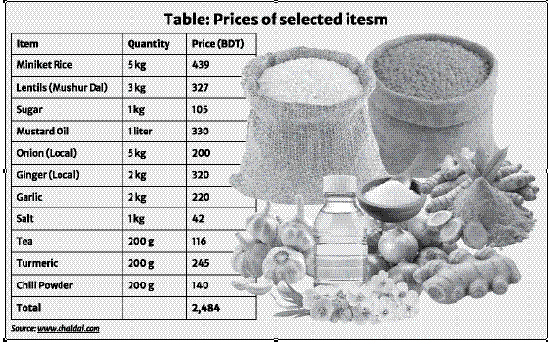
Economic Impact of Zakat Distribution: Under the Family Card programme, the government now plans to provide a monthly allowance of Tk 2,500 to poor families. To understand the real value of this allowance, let us consider how many items one can buy with this money at ongoing retail market rates (see the table)
Cash vs Goods - Which Option has more Economic Benefits: We believe the government should provide the poor families goods instead of cash. Sending Tk 2,500 via mobile costs roughly Tk 15 per family (at least Tk 5 per 1,000) as transfer costs. For 10 million families, this is Tk 150 million in transaction fees alone. Furthermore, if cash allowances are provided, families would buy at retail prices, whereas the government can buy in bulk at much lower factory gate prices, bypassing middleman margins. This allows for more goods for the same Tk 2,500 allowance.
Direct government procurement may also promote industrial competition if the government allows smaller companies to participate in the government procurement, creating a new incentive for small-scale industries. Now a days, small market players are losing their market share on a regular basis due to the mammoth distribution channels of large corporate houses. The government can reverse this trend by giving small players an opportunity to survive in the market.
The issue of regional economic disparity can also be addressed if the government procurement drive is designed accordingly. For example, instead of a Dhaka centric procurement planning, procurement of goods may take place in every district giving priority to the local small enterprises. This will promote local entrepreneurship and also reduce transportation costs to reach out to the actual beneficiaries.
This programme will pump in an additional Tk 200 billion worth of economic activity, which did not persist just because these monies were in the hands of the rich sitting idle.
Weaknesses of the Family Card Programme: Family Card programme has a weakness, however. One of the major weaknesses is that the plan targets to give allowance to every family in the country gradually targeting 40 million families in total. According to the most recent census conducted in 2022, Bangladesh has a total of 41 million families (or households) all over the country.
Thus targeting all families in country ignores their actual monetary need. The question thus arises, why should government give monthly allowance to those living in affluent areas like Gulshan or Banani? If this money comes from Zakat, then they are not even eligible to receive it!!
Giving money to those who don't need it will discourage productivity. We also think monthly fixed allowance for all families is not a feasible option; such monthly allowance should be reserved only for those who live below the poverty line. Other families should only receive it for a limited time after an assessment of their actual financial condition. If any well off family falls in financial hardship all on a sudden, they may apply for such allowance for a limited time, and such allowance can be granted only after a detailed scrutiny.
End Note: Family Card programme is a great initiative indeed. If Zakat collection becomes a national priority to fund this programme, it will be a landmark shift in Bangladesh's development history. This pillar of Islam has been neglected for over 55 years now, mainly due to the allergic sensitivity of the country's elite society toward any Islamic concept.
Interestingly, BNP also did not mention Zakat in its manifesto-only Jamaat-e-Islami did. Thus, seeing the ruling party planning to implement an idea from an opposition party is indeed a memorable event in Bangladesh's growth journey. This trend will definitely strengthen Bangladesh's democracy going forward.
Mabroor Mahmood is the Founder of IDEAS FOR DEVELOPMENT (IFD). ideasfd@gmail.com
© 2026 - All Rights with The Financial Express

