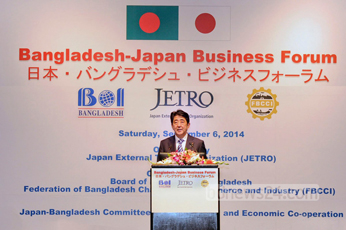
 Japanese Prime Minister Shinzo Abe speaks at a programme of Bangladesh-Japan Business Forum at a hotel in Dhaka on September 06, 2014.
 The recent visit Prime Minister Shinzo Abe to Dhaka has raised a new hope to further strengthen the traditionally deep-rooted bilateral relations between Bangladesh and Japan. The visit has offered a big opportunity to Bangladesh to reach a higher economic development trajectory as Japan is looking to South Asia for investment. The existing congenial ties between the two countries can help grab more investment in our thrust sectors. The visit took place when Japanese investment in China dropped by 45 per cent over the last 11 months. It seems Bangladesh does not want to miss this opportunity. There is a possibility that Vietnam, Myanmar, India and other destinations might seize the chance if Bangladesh fails to fulfill Japanese investors' expectations in terms of investment facilities.
While addressing business leaders in Dhaka, Shinzo Abe expressed his plans to promote investment in transport, infrastructure, power and energy, and garment sectors. As many as 50 executives from top companies of Japan showed their interest to invest here; this will help advance the Japan-Bangladesh Comprehensive Partnership. In this context, the government's decision to sacrifice Dhaka's candidature for a non-permanent seat in the UN Security Council for 2016-17 term in favour of Tokyo seems to be a good move.
Noting that the Bangladesh economy is 'an emerging' one, Prime Minister Abe said, the Bay of Bengal Industrial Growth Belt (BIG-B) initiative is the 'centrepiece' of Japanese cooperation with Bangladesh. He mentioned that the $6.0-billion loan promises he made for the next four to five years were all under Japan's BIG-B concept. The improvement of transportation and infrastructure, stable supply of power and energy, urban development including a special economic zone and also public sector development including improved market access to the financial market are the keys to the BIG-B
concept.
Underscoring Bangladesh's geo-political importance, Abe said the country is also important for implementing his 'Abenomics', a much-talked-about economic policy he has adopted to inflate the decade-long deflated Japanese
economy.
Abe has also emphasised the importance of creating proper climate to attract investment from Japan. Bangladesh enjoys duty-free benefit to Japanese market for 8,884 products, resulting in the rise in readymade garment (RMG) exports. In 2011-12, the garment export to Japan increased by 38.8 per cent from the previous year. When Japan is suffering due to an aging population, Bangladesh could be an attractive potential market or source of cheap labour for Japanese companies.
Prime Minister Sheikh Hasina also pointed out investment potential in textiles, leather, petrochemicals, pharmaceuticals, shipbuilding, agro-based industries, light engineering and electronics, telecommunications and IT. Last year Japan provided a total of $11 billion grants and aid in the form of technical assistance and soft loans to Bangladesh. But the country will be able to become self-dependent, not merely aid-dependent if Japan invests in high-tech manufacturing like automobiles and microprocessors. For use of foreign aid and cooperation, Bangladesh must have capability and competence. This was indicated by the Prime Minister of Japan when he underscored the importance of investment in infrastructures.
Speaking in Japanese at a Bangladesh-Japan Business Forum event in Dhaka, Abe said he would 'promote' trade and investment in Bangladesh. Bangladesh is 'very important' for him for its location between South East Asia and India. He said the country was also important for implementing his 'Abenomics'. "I am promoting Abenomics in Japan to lead the Japanese economy. To me Bangladesh is very important to enhance trade and investment of Japan because I am leading Abenomics to lead Japanese economic growth. That's why I chose Bangladesh for my visit today."
Abe said both countries entered 'a new level of cooperation' which was reflected in the frequent high-level visits. In this context, he referred to his own visit, Sheikh Hasina's visit to Japan in May and the Japanese foreign minister's Dhaka visit in March. "This year is a memorable and special year for Japan-Bangladesh relations," he added.
Japan has a grand design of combining the two oceanic regions - Pacific Ocean and Indian Ocean - for more geo-political space to boost its economy. The largest Bay in the world, Bay of Bengal, forms the north-eastern part of the Indian Ocean. Bangladesh is located in the north of this Bay. Abe mentioned three dimensions of the BIG-B concept:
(a) One is to promote infrastructure improvement for industrial development,
(b) Second is to create better environment for investments and
(c) Last but not least, to promote improved 'solidarity and unitedness' in the region including Bangladesh.
The major elements of the Joint Statement on the outcome of the visit of Japanese Prime Minister Shinzo Abe to Bangladesh are target-specific, programmatic and visionary. As these spell out shared intent, understanding and decisions at the highest political level, the rhetoric phase has graduated to the substantive one. Now these fall squarely on bureaucracies and private sector leaders of the two countries to follow, coordinate and implement the decisions.
We often make a good start but when it comes to follow-up measures, we would be found lagging behind. The speed and competence with which we meet our part of the bargain can make all the difference between a half-way house and a fully gainful bilateral engagement.
The question today is what the Japanese want from us or aim at and how we plan to meet their already expressed expectations. According to Japan's China-plus policy, Tokyo wants to relocate its investment in and step up trade with a country like Bangladesh. It seeks special economic zone with emphasis on location, competitive incentives, improved infrastructure and labour supply as critical
factors.
High-profile Japanese CEOs have made it clear that they look to Bangladesh as the next investment destination. Already steelmaker Nippon has expressed its willingness to open a factory in Chittagong.
The writer is an economic analyst.
anumahmud@yahoo.com
© 2026 - All Rights with The Financial Express

