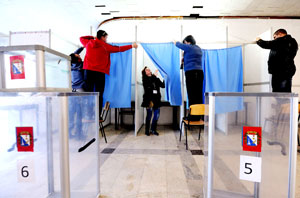
 Employees prepare the polling booth in one of the polling stations of Sevastopol on March 15, 2014, on the eve of the March 16 referendum in Crimea to decide if the people of Crimea want the republic to remain a part of Ukraine or join the Russian Federa
 Russia's recent intervention in Ukraine has been denounced by the United States Administration as a 'brazen act of aggression'. Both Washington and its allies have come forward to show their support for the embattled leadership in Kiev. Moscow has been slammed for violation of Ukraine's sovereignty and warnings have been issued that Moscow risked being stripped of its coveted seat as one of the Group of Eight (G-8) nations and could even face a damaging economic fallout for sending troops into Ukraine's Crimean peninsula.
Russian President Vladimir Putin had apparently hoped that Ukraine's past president Viktor Yanukovych would be able to solve the evolving crisis in his country by himself. However, things came to a head when Yanukovych fled Kiev towards the end of February and landed in Russia. It was later stated by those who had taken over in that country (after his departure) that steps would be taken to put him on trial for the deaths of over 80 people during the recent wave of protests in Kiev. At this juncture Russian President Vladimir Putin stated that Russia considered Yanukovych to be Ukraine's rightful leader. He also accused the Western powers of encouraging dissent by 'radical extremists' against Yanukovych's decision in November last year to ditch a pact with the European Union in favour of closer ties with Russia.
It would be important here to understand as to why Putin considers Ukraine in general and Crimea, in particular, to be so vital for Russia's interests. It is because of geo-strategic reasons. Russia's Black Sea fleet, its base and the sprawling military infrastructure that go with it, are significant for Russia's geopolitical ambitions. It needs to be pointed out here that such an assumption has led the Russian leadership to recently agreeing to spend billions of US Dollars in naval hardware - six new submarines and six new frigates. Putin now feels that this initiative is threatened because of unrest in Ukraine.
After the entry of Russian troops into the Crimean peninsula, Putin has explained that Moscow took the step to protect more than two million people of Russian origin living in that area of Ukraine. He has also accused the west of encouraging a coup in Kiev on February 22 and driving that country towards anarchy. He has dismissed threats of any sanctions that might be put in place against Russia and warned that such a measure could backfire.
This view was strongly supported by Kremlin's hawkish economic aide Sergei Glazyev. Commenting on US-EU threats of possible sanctions, he retorted that Russia would find a way 'not just to reduce our dependency on the United States to zero but would emerge from the sanctions with greater benefits'. He threatened that Russia could stop using US Dollars for international transactions and create its own payment system using its 'trade and economic relations with its partners in the East and the South'. He has suggested that, if necessary, Russian firms and banks would not return loans taken from American financial institutions. He has criticised that any sanction imposed by the European Union (EU) would be a 'catastrophe' as Russia could end up halting gas supplies. It is understood that Russian lawmakers have already started working on a draft law to allow the confiscation of property, assets and accounts of European or US companies in the eventuality of sanctions being imposed on Russia over Ukraine.
Economists in Europe have not quite agreed with Glazyev's dire vision. However, at the same time, they have urged the EU and the US to approach the emerging situation with caution. They have also pointed out that in the event of a supply disruption, the hardest hit would be the countries that depend on Russian gas imports via Ukraine and lack large storage capacity - Bulgaria, Slovakia and Moldova.
In the meantime, Russia has pulled back some of its forces from the Ukrainian border. This step, taken on March 04, immediately induced calm in the financial arena. World markets have responded with signs of recovery. Oil, gold and wheat, along with the Japanese Yen, which had gained because of the growing anxiety over the standoff, gave back some of their gains. Confidence in equity markets has been restored. The red alert over the situation has been downgraded to amber.
Putin has, however, tried to contain further deterioration of the situation in his own way. Russia has informed the United Nations Security Council on March 03 that the deposed Ukrainian president had formally asked Moscow to deploy Russian troops to re-establish law and order in Ukraine. This has apparently not been agreed to by Putin. It has been hinted that the deposed president, in the eyes of Russia has very little political future and that he had been given shelter to save his life.
Meanwhile, the United States has announced that it has suspended military cooperation with Russia in the light of recent events in Ukraine. They have put on hold all military-to-military engagements between the two countries. Such a suspension of the post-Cold War cooperation, covering exercises and bilateral meetings related to security scenarios and port visits, is being viewed as a significant downturn in global diplomacy and relations between Moscow and the West since the fall of the Berlin Wall in 1989.
The European Union has announced that they are looking at a range of possible sanctions against Russia. Hawkish ex-Soviet satellites in this 28-member bloc are pushing hard for sanctions. They are arguing that banking sanctions are a powerful tool that take advantage of America's central role in the international financial system and which have helped place pressure on the Iranian economy over the past two years. They have argued that if Russian banks can be targeted, then any bank in the world that continues to do business with them can be cut off from the US financial system.
However, many others, including heavyweight France and Germany, have called for soft diplomacy in a recent meeting in Madrid. Germany Angela Merkel, in particular, has called on Russia not to do anything to further destabilise the situation. Her comment came after Putin insisted on Russia's right to use 'all available means' in Ukraine. The 15-member Organisation for Security and Cooperation in Europe (OSCE), including the United States, has agreed to send military observers to Ukraine. EU Foreign Policy Chief Ashton in her talks with Russian Foreign Minister Sergey Lavrov has nevertheless hinted that the EU would consider 'targeted measures'. Apparently, the first of these has been to freeze the assets of 18 Ukrainians, including the ousted Moscow-backed former President, who are accused of embezzlement.
Other developments have seen the Crimean Parliament voting unanimously on March 06 'to enter into the Russian Federation with the rights of a subject of the Russian Federation'. The issue of a referendum on the future status of Crimea has created a stir but Russia is firm about it. The Vice-Premier of Crimea has announced that all 'state property would be nationalised, the Russian Rouble adopted and henceforth Ukrainian troops in Crimea would be treated as occupiers and be forced to surrender or leave'. It is being considered that such an announcement could have been made only with the approval of President Putin. In response, the new Ukrainian government in Kiev has declared that any such referendum would be illegal and has opened a criminal investigation against those involved with the prospective referendum. Kiev has also reiterated that they do not recognise the current local administration in Crimea. Supporting those in Kiev, European Commission President Jose Manuel Barroso has reiterated in a Twitter message: 'We stand by a united and inclusive Ukraine'. It has been reported that the EU was ready to provide Ukraine with 11 billion Euros in loans and grants over the coming years. The United States has also promised US$ 1.0 billion as aid required for energy subsidy in Ukraine.
Despite all the surface bravado by Putin, he needs to understand that the world has changed and the equation is not the same as it was in 1968 when the Soviet Union invaded Czechoslovakia. This contrast between then and now underlines why talk of a new cold war can be misleading. The world, as Gideon Rachman has noted in the Financial Times, "is no longer divided into two mutually exclusive, and hostile, political and economy systems - a capitalist west and a communist east". Russia for all practical purposes is now also a member of the global, capitalist order.
It is against this background that sanity should prevail amongst both sides of the divide. Time has come to agree on de-escalation and also offering Putin a face saving way-out of the quagmire. Obama and the West should back off from their threat of sanctions and agree on ways of re-assuring the safety of ethnic Russian-speaking majority in Crimea. If necessary, international observers, under the United Nations flag, could monitor the sensitive situation that exists in the regions of Ukraine bordering Russia. At the same time, the Russian side also needs to understand that their sphere of influence will not be affected by such measures.
The West must not forget that they need Russia just as much as Russia needs them. This applies particularly in resolving critical international issues like Syria and Iran.
Muhammad Zamir, a former Ambassador, is specialised in foreign affairs, right to information and good governance. mzamir@dhaka.net
© 2026 - All Rights with The Financial Express

