There are several local government bodies in Bangladesh. The Constitution of the Republic commits for local government bodies at every level of all administrative units. The local government bodies include Union Parishad, Upazila Parishad, Zila Parishad, Municipalities, City Corporations, Chittagong Hill Tracts Local Government Councils and Chittagong Hill Tracts Development Board. The ideal hypothesis is that these local government bodies should be capable of providing civic services to the inhabitants living within their respective area. These bodies should have both administrative and financial powers so that they can provide their assigned services to the people. These local government bodies have the powers of collecting revenue fees, tolls, etc. But the revenues they collect are not sufficient to meet the local demand. For this reason, the central government provides revenue and development assistance to these local government bodies.
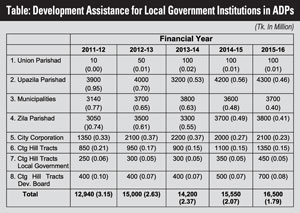
In this article, the development assistance provided to the local government bodies is analysed to see what kind of treatment they are getting in the annual development programmes (ADPs). The development assistance provided to the local government bodies in ADPs over five years has been shown in the table.
* Compiled from successive RADPs and ADPs
* Figures in parentheses show percentage shares of total ADP and Revised Annual Development Programme (RADP) outlay
It is to be noted that the RADPs outlays for FYs 2011-12, 2012-13, 2013-14 and 2014-15 were Tk. 410000.00 million, tk 523660.00 million, Tk. 600000.00 million and Tk 750000.00 million respectively. Meanwhile, ADP of Tk 970000.00 million has been approved on 14 May 14, 2015 for fiscal year 2015-16.
The allocation for each category of local government bodies for financial year (FY) 2011-12 to 2014-15 has been adapted from revised annual development programmes (RADPs) of those fiscal years. The figures of FY 2015-16 have been taken from the recently approved ADP for 2015-16.
It should be mentioned that as of today there are 4548 Union Parishads, 487 Upazial Parishads, 322 Municipalities, 64 Zila Parishads and 7 City Corporations in the country.
It can be seen from the table that all the local government bodies, including those for Chittagong Hill Tracts, got 3.15 per cent, 2.63 per cent, 2.37 per cent, 2.07 per cent and 1.79 per cent of total RADP and ADP funds for FY 2011-12, 2012-13, 2013-14, 2014-2015 and 2015-16 respectively. The allocations for local government bodies were Tk. 12,940 million, Tk. 15,000 million, Tk. 14,200 million, Tk. 15,550 million and Tk. 16,500 million for successive five years. The trend is that the percentage share of local government bodies in total RADP and ADP outlays has been decreasing over the years. Even the allocation for individual category of local government bodies is not significant. When we look at the higher allocation for three successive FYs (2013-2016), we find that only Tk. 100 million was given each year to 4548 Union Parishads making them too much dependent on local MPs and Upazila Parishad chairmen. Again, while the Upazila Parishads have been assigned with many transferred subjects like roads, bridges, culverts, health & hygiene, education, social welfare, sinking tube-wells, small drainage and irrigation, the allocations for these bodies do not show a reasonably comfortable situation. In this case also, the allocation has been found to be decreasing from 0.95 per cent in FY 2011-12 to 0.70 per cent in FY 2012-13, 0.53 per cent in FY 2013-14, 0.56 per cent in FY 2014-15 and finally to 0.46 per cent for FY 2015-16. Same situation is found in the cases of City Corporations, Zila Parishads and Municipalities. A static situation regarding allocation in RADPs and ADPs has been found to be maintained in the case of local government bodies of Chittagong Hill Tracts districts.
There may be a debate as to the development assistance provided by the central government to local government bodies. There may be an argument that local government bodies should be self-sufficient by their local resources. But these bodies have been entrusted with numerous socio-economic functions. In order to perform these functions they need reasonable financial support from the government. The whole population of the country live under one form of local government or the other. There are many civic amenities which the citizens demand from these local bodies. Policy makers should keep this in mind and allocate more resources to local government bodies so that they can reasonably cope up with local public demand.
The writer is a former Planning Secretary, Government of Bangladesh.
chowdhuryjafar@ymail.com
© 2026 - All Rights with The Financial Express

