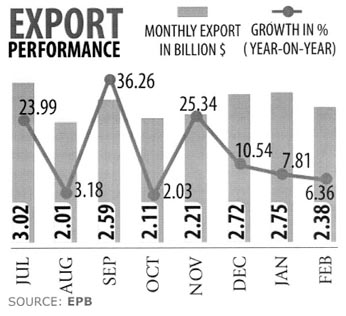
Bangladesh has been consistently doing well in its export sector. The Export Promotion Bureau data indicates an increase of US $3.02 billion in July 2013 and has hovered around US$ 2.01 to US$ 2.72 billion during the months August 2013 to February 2014. The country earned US$ 19.82 billion in eight months for the period July 2013-February 2014. This indicates an increase of 13.96 per cent for the same period last year. The export target is US$ 30.5 billion for the year 2013-3014.
The present trend indicates a favourable position for Bangladesh to achieve its export targets. The primary product that drives the export engine is the garment sector which has emerged as the second largest exporter only after China. Bangladesh exported US$ 7.91 billion of knitwear products and US$ 8.22 billion of woven items during the period under review. The growth stood at 17.5 per cent and 15.92 per cent respectively.
Growth of exports for the month of February was 6.36 per cent as against 7.81 per cent for January 2014. This could be a warning bell for the garments sector as it re-adjusts itself to the compliance issues of maintaining a certain acceptable level of safety standards in the industry. This along with the higher salaries for the garments workers will certainly put pressure on the overall garments sector profitability and its competitive price advantage for the world market.
It is essential that the non-compliant factories be allowed a minimum time frame within which these will take necessary actions for improvement of the working conditions and safety measures. It must, however, be remembered that for many of the non-compliant factories, the owners may not have the sufficient funds at their disposal to proceed with the necessary steps to make their factory fully compliant. While the onus should be on the retailers as well as the factory owners, the commercial banks must come forward with some refinancing scheme supported by the Bangladesh Bank (BB) to borrow/release funds at concessional rates. It may, however, be applicable to other export industries that suffer from safety standards and lower wages structure.
The jute industry in Bangladesh is not doing well. The mandatory use of jute bags policy has not been implemented successfully. Synthetic bags are used on large scale for its price advantage. Rice millers and others are not so much concerned with the environment friendly aspect of the jute bags.
Although it is a law in Bangladesh to use jute bags as done in West Bengal it is a shame that Bangladesh has not been able to implement this policy which would certainly have allowed the jute industry to survive. Directly and indirectly over 30 million people are connected with the cultivation and processing of jute for their livelihood. Unfortunately, this important sector has consistently been neglected by the successive governments. It will be interesting to find out the real culprits who were involved in not implementing the policy for jute bag usage.
With the lowering of the Indian Rupee against the US$ and the Taka appreciating against the greenback the jute and jute goods exporters find themselves in a disadvantageous position. The government also seems to be giving less importance to this sector which used to be a lifeline in the past. The policy makers have to come up with an acceptable solution fast. Otherwise we will soon see the extinction of this industry and with it the loss of more jobs and social unrest. To avoid such a situation, a policy direction is required instead of ad-hoc initiatives.
Leather goods, hides and skin, tea, pharmaceuticals, processed fruits, cement and food are all being exported to various destinations around the world. We need to expand our export trade with our neighbours particularly members of the SAARC and the ASEAN. The seven sister states bordering Bangladesh also offer great potential. Bangladesh needs to take advantage and find newer markets and expand the existing ones.
Trade with India and China has to increase to offset the balance of payments situation which is unfavorable to Bangladesh. The land route connectivity with India, China, Myanmar and Bangladesh is a dream project that needs faster implementation for the overall socio-economic well being of the people of the region.
The proposed deep seaport in Sonadia and a new seaport in Putuakhali will certainly enhance cargo handling capacity within this region. The land-locked countries like Nepal, Bhutan and the bordering states of India will find it more economical to expand their export trade and usher in regional integration.
Prof. Dr. Akbaruddin Ahmad is the Chairman, Policy Research Centre Bangladesh (PRC.bd) & Vice Chancellor, Darul Ihsan University. akbarudinahmad@gmail.com
© 2026 - All Rights with The Financial Express

